IGRJ17361-4441: a possible new accreting X-ray binary in NGC6388
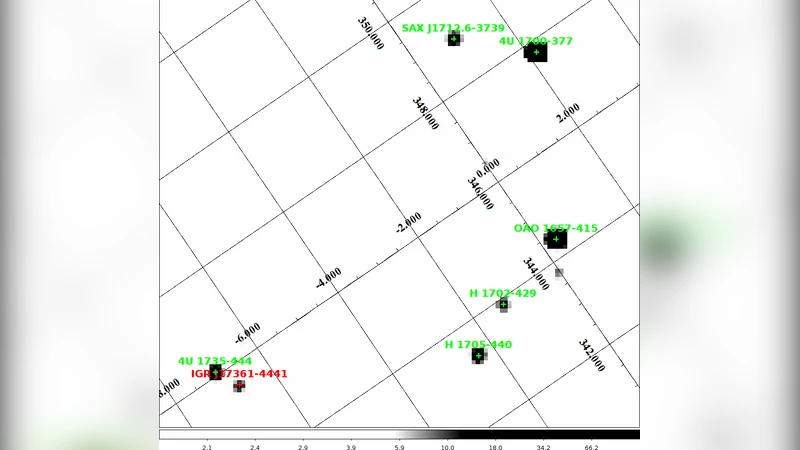
IGRJ17361-4441 is a newly discovered INTEGRAL hard X-ray transient, located in the globular cluster NGC6388. We report here the results of the X-ray and radio observations performed with Swift, INTEGRAL, RXTE, and the Australia Telescope Compact Array (ATCA) after the discovery of the source on 2011 August 11. In the X-ray domain, IGRJ17361-4441 showed virtually constant flux and spectral parameters up to 18 days from the onset of the outburst. The broad-band (0.5-100 keV) spectrum of the source could be reasonably well described by using an absorbed power-law component with a high energy cut-off (N_H\simeq0.8x10^(22) cm^(-2), {\Gamma}\simeq0.7-1.0, and E_cut\simeq25 keV) and displayed some evidence of a soft component below \sim2 keV. No coherent timing features were found in the RXTE data. The ATCA observation did not detect significant radio emission from IGRJ17361-4441, and provided the most stringent upper limit (rms 14.1 {\mu}Jy at 5.5 GHz) to date on the presence of any radio source close to the NGC6388 center of gravity. The improved position of IGRJ17361-4441 in outburst determined from a recent target of opportunity observation with Chandra, together with the X-ray flux and radio upper limits measured in the direction of the source, argue against its association with the putative intermediate-mass black hole residing in the globular cluster and with the general hypothesis that the INTEGRAL source is a black hole candidate. IGRJ17361-4441 might be more likely a new X-ray binary hosting an accreting neutron star. The ATCA radio non-detection also permits us to derive an upper limit to the mass of the suspected intermediate massive black hole in NGC6388 of <600 M\odot. This is a factor of 2.5 lower than the limit reported previously.
💡 Research Summary
The paper presents a comprehensive multi‑wavelength study of the hard X‑ray transient IGR J17361‑4441, discovered by INTEGRAL on 2011 August 11 in the direction of the globular cluster NGC 6388. The authors combined observations from Swift/XRT, INTEGRAL/IBIS‑ISGRI and JEM‑X, RXTE/PCA, and the Australia Telescope Compact Array (ATCA) to characterize the source’s spectral, temporal, and positional properties during the first 18 days of its outburst.
INTEGRAL data (20–100 keV) show a strong detection (15 σ) with an average flux of 1.2 × 10⁻¹⁰ erg cm⁻² s⁻¹. JEM‑X did not detect the source, providing a 3 σ upper limit consistent with the ISGRI flux. Swift/XRT monitored the source from 2011 August 16 to September 2, finding a remarkably stable 0.3–10 keV flux of (4.5–4.8) × 10⁻¹¹ erg cm⁻² s⁻¹. The XRT spectra are well described by an absorbed power‑law with column density N_H≈(0.2–0.5) × 10²² cm⁻² and photon index Γ≈0.5–0.9.
A joint XRT + ISGRI broadband fit (0.5–100 keV) requires an absorbed cutoff power‑law (Γ≈1.0, cutoff energy E_cut≈24 keV) plus a soft blackbody component (kT≈0.08 keV, emitting radius ≈1.4 × 10³ km for a distance of 10 kpc). The resulting 1–100 keV flux is 1.7 × 10⁻¹⁰ erg cm⁻² s⁻¹, corresponding to an X‑ray luminosity L_X≈3.6 × 10³⁶ erg s⁻¹ at the cluster distance of 13.2 kpc.
RXTE/PCA observations (1.6 ks) were performed 6 days after the outburst onset. Despite high time resolution (0.96 µs) and a thorough Fourier analysis, no coherent pulsations were detected above a 3 σ threshold, largely because of contamination from the nearby bright low‑mass X‑ray binary 4U 1735‑444, which contributes up to ~25 % of the observed count rate.
ATCA observed the field on 2011 August 25 at 5.5, 9, 17, and 19 GHz. No radio counterpart was found at the refined X‑ray position. The most stringent limit comes from the 5.5 GHz band, with an rms noise of 14.1 µJy, translating to a 3 σ upper limit on the radio luminosity L_R < 5 × 10²⁸ erg s⁻¹ (assuming 13.2 kpc). This limit is 2.5 times deeper than previous measurements and, when combined with the X‑ray luminosity, places the source far below the empirical “fundamental plane” of black‑hole activity. Consequently, the hypothesis that IGR J17361‑4441 is a black‑hole candidate, or that it is associated with the putative intermediate‑mass black hole (IMBH) at the cluster centre, is strongly disfavoured.
The hard X‑ray spectrum (Γ≈0.7–1.0, cutoff ≈25 keV) and the presence of a soft excess are reminiscent of accreting neutron‑star systems, particularly high‑magnetic‑field (∼10¹² G) high‑mass X‑ray binaries (HMXBs). However, the old stellar population of a globular cluster and the lack of characteristic variability (e.g., wind‑accretion flares) argue against a young HMXB. The authors therefore favour an interpretation as a low‑mass X‑ray binary (LMXB) hosting an accreting neutron star. The inferred blackbody radius (~10³ km) is compatible with emission from an accretion disk or a diffuse cloud rather than a hot spot on the neutron‑star surface.
Finally, the non‑detection in radio allows the authors to place a new upper limit on the mass of any IMBH in NGC 6388 of < 600 M_⊙, a factor of 2.5 lower than previous constraints. This result tightens the limits on the existence of intermediate‑mass black holes in globular clusters and highlights the importance of coordinated X‑ray and radio observations for classifying transient sources in dense stellar environments.
Comments & Academic Discussion
Loading comments...
Leave a Comment