The evolution of pebble size and shape in space and time
We propose a mathematical model which suggests that the two main geological observations about shingle beaches, i.e. the emergence of predominant pebble size ratios and strong segregation by size are interrelated. Our model is a based on a system of ODEs called the box equations, describing the evolution of pebble ratios. We derive these ODEs as a heuristic approximation of Bloore’s PDE describing collisional abrasion. While representing a radical simplification of the latter, our system admits the inclusion of additional terms related to frictional abrasion. We show that nontrivial attractors (corresponding to predominant pebble size ratios) only exist in the presence of friction. By interpreting our equations as a Markov process, we illustrate by direct simulation that these attractors may only stabilized by the ongoing segregation process.
💡 Research Summary
The paper addresses two long‑standing geological observations on shingle beaches: (1) the emergence of dominant pebble size ratios and (2) the strong segregation of pebbles by size. The authors propose a unified mathematical framework that links these phenomena through the coupled processes of abrasion and transport.
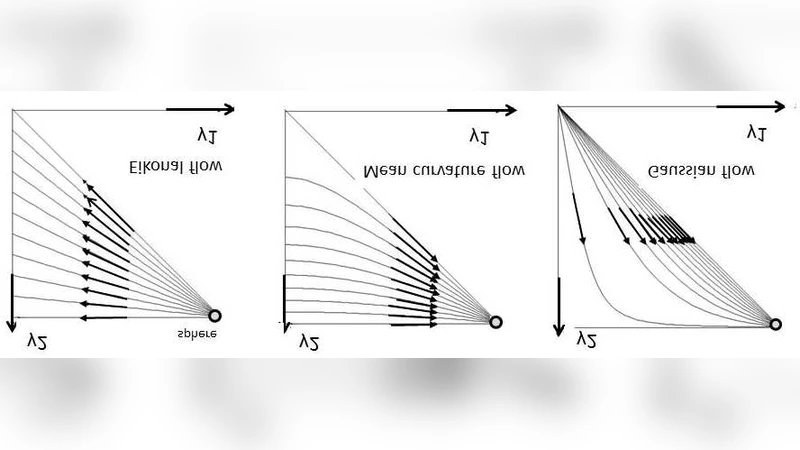
Starting from Bloore’s collisional abrasion partial differential equation (PDE) v = 1 + 2bH + cK, they derive a low‑dimensional ordinary differential equation (ODE) system called the “box equations”. In this reduction a pebble is represented by an orthogonal bounding box with half‑lengths u₁ ≤ u₂ ≤ u₃. The shape is encoded by the ratios y₁ = u₁/u₃ and y₂ = u₂/u₃, which lie inside the Zingg triangle (the region 0 ≤ y₁ ≤ y₂ ≤ 1). The three terms of Bloore’s PDE become three planar vector fields – an Eikonal (constant) flow, a mean‑curvature flow (coefficient b) and a Gaussian‑curvature flow (coefficient c). The coefficients b and c are not arbitrary; they are linked to the integrated mean curvature M and surface area A of the abrading environment via b = M/4π and c = A/4π, and must satisfy the Minkowski inequality b² ≥ c.
The resulting ODE system, ˙y = F(y,b,c), is three‑dimensional, but the third component y₃ = u₃ always decreases (˙y₃ < 0), so the full flow has no genuine fixed points. The only self‑similar (homothetic) solution is the sphere (y₁ = y₂ = 1). However, when b and c are positive (i.e., when frictional abrasion is present) the projection onto the (y₁,y₂) plane acquires non‑trivial equilibria. These equilibria correspond to the “dominant size ratios” observed in the field (for example, the classic 7:6:3 ratio). In the absence of friction (b = c = 0) the system reduces to pure Eikonal flow and no such attractors exist.
To capture the interaction between a pebble and its surrounding ensemble, the authors introduce a second set of variables z representing a second pebble (or the average environment). The coupled system
˙y = F(y, b(z), c(z)), ˙z = F(z, b(y), c(y))
forms a Markov‑type process: each pebble’s abrasion coefficients depend on the current shape of the other. This mutual abrasion model allows the inclusion of global transport effects: when transport segregates pebbles by size, the system repeatedly visits regions of the (y₁,y₂) plane where the flow slows down (so‑called “loitering surfaces”). Numerical simulations show that segregation stabilises the non‑trivial equilibria, turning them from transient to persistent attractors. In other words, abrasion alone can generate temporary size ratios, but without the continual size‑sorting action of wave‑driven transport these ratios decay.
The authors validate the box‑equation approximation by directly solving Bloore’s PDE for selected initial shapes and comparing the evolution of shape ratios; the agreement is qualitative but robust. Simple laboratory experiments—placing a mixture of pebbles in a flowing water channel—reproduce the predicted segregation and the emergence of dominant ratios. Field data from Chesil Beach (≈100 000 measured pebbles) are cited to illustrate that real shingle beaches indeed display the predicted clustering of similar‑sized pebbles and characteristic shape ratios.
In summary, the paper provides a concise yet powerful dynamical‑systems model that unifies collisional abrasion, frictional effects, and size‑dependent transport. It demonstrates mathematically that friction (non‑zero b and c) is necessary for the existence of non‑spherical attractors, and that the segregation process acts as a stabilising feedback. The framework can be extended to pure abrasion, pure transport, or any intermediate regime, offering a versatile tool for coastal geomorphologists and engineers interested in predicting beach evolution, designing artificial shingle beaches, or interpreting sediment‑size distributions in the geological record.
Comments & Academic Discussion
Loading comments...
Leave a Comment