Reduced Basis representations of multi-mode black hole ringdown gravitational waves
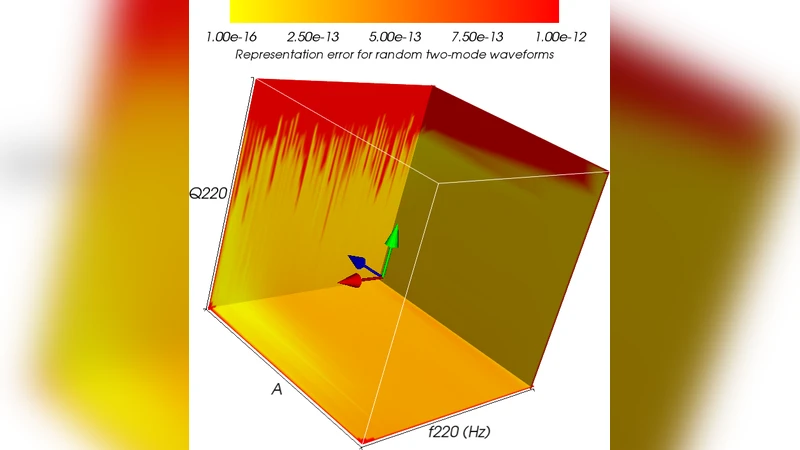
We construct compact and high accuracy Reduced Basis (RB) representations of single and multiple quasinormal modes (QNMs). The RB method determines a hierarchical and relatively small set of the most relevant waveforms. We find that the exponential convergence of the method allows for a dramatic compression of template banks used for ringdown searches. Compressing a catalog with a minimal match $\MMm=0.99$, we find that the selected RB waveforms are able to represent {\em any} QNM, including those not in the original bank, with extremely high accuracy, typically less than $10^{-13}$. We then extend our studies to two-mode QNMs. Inclusion of a second mode is expected to help with detection, and might make it possible to infer details of the progenitor of the final black hole. We find that the number of RB waveforms needed to represent any two-mode ringdown waveform with the above high accuracy is {\em smaller} than the number of metric-based, one-mode templates with $\MMm=0.99$. For unconstrained two-modes, which would allow for consistency tests of General Relativity, our high accuracy RB has around $10^4$ {\em fewer} waveforms than the number of metric-based templates for $\MMm=0.99$. The number of RB elements grows only linearly with the number of multipole modes versus exponentially with the standard approach, resulting in very compact representations even for many multiple modes. The results of this paper open the possibility of searches of multi-mode ringdown gravitational waves.
💡 Research Summary
The paper presents a novel application of the Reduced Basis (RB) method to the problem of constructing compact, high‑accuracy template banks for black‑hole ringdown gravitational‑wave searches. Ringdown signals are modeled as a superposition of damped sinusoids—quasinormal modes (QNMs)—characterized by complex frequencies that depend on the final black‑hole mass and spin. Traditional matched‑filter searches use a metric‑based placement of templates in the (frequency, quality‑factor) space to guarantee a minimal match (MM) between any possible signal and the nearest template. While a single‑mode (ℓ=m=2, n=0) search requires only a few thousand templates for MM=0.99, extending the search to two or more modes causes the dimensionality of the parameter space to explode, leading to template banks with up to a million points for the same MM. This makes multi‑mode searches computationally prohibitive.
The RB approach circumvents this scaling problem by first generating a dense “training space” of waveforms sampled across the relevant parameter ranges (mass, spin, and mode indices). A greedy algorithm then iteratively selects the waveform that maximally deviates from the current RB span, adds it to the basis, and orthonormalizes the set. The scalar product used in the selection is the noise‑weighted inner product familiar from Wiener filtering, ensuring direct relevance to matched‑filtering performance. Because the dependence of the waveforms on the physical parameters is smooth, the RB error (the norm of the residual after projection onto the basis) decays exponentially with the number of basis elements. In practice the authors set a target representation error ε² = 10⁻¹², which corresponds to a minimal match of ≈0.999999999999 (essentially perfect).
For a single‑mode catalog covering frequencies 10–4000 Hz and quality factors 2.1–20 (equivalent to black‑hole spins j∈
Comments & Academic Discussion
Loading comments...
Leave a Comment