Can the evolution of music be analyzed in a quantitative manner?
We propose a methodology to study music development by applying multivariate statistics on composers characteristics. Seven representative composers were considered in terms of eight main musical features. Grades were assigned to each characteristic and their correlations were analyzed. A bootstrap method was applied to simulate hundreds of artificial composers influenced by the seven representatives chosen. Afterwards we quantify non-numeric relations like dialectics, opposition and innovation. Composers differences on style and technique were represented as geometrical distances in the feature space, making it possible to quantify, for example, how much Bach and Stockhausen differ from other composers or how much Beethoven influenced Brahms. In addition, we compared the results with a prior investigation on philosophy. Opposition, strong on philosophy, was not remarkable on music. Supporting an observation already considered by music theorists, strong influences were identified between composers by the quantification of dialectics, implying inheritance and suggesting a stronger master-disciple evolution when compared to the philosophy analysis.
💡 Research Summary
The paper asks whether the evolution of music can be studied quantitatively and proposes a methodology that adapts a previously developed framework for philosophy to the domain of musicology. Seven historically significant composers—Monteverdi, Bach, Mozart, Beethoven, Brahms, Stravinsky, and Stockhausen—are selected as “reference points.” For each composer the authors define eight binary‑paired musical characteristics that capture fundamental aspects of composition (e.g., Sacred vs. Secular, Short vs. Long duration, Harmony vs. Counterpoint, Vocal vs. Instrumental, Discursive vs. Non‑discursive, Motivic Stability vs. Variety, Rhythmic Simplicity vs. Complexity, Harmonic Stability vs. Variety). Each characteristic is scored on a 1‑to‑9 scale, producing a 7 × 8 data matrix.
Because the sample size is tiny, the authors generate a large synthetic population of “artificial composers” using a bootstrap procedure. Random score vectors are drawn from a multivariate normal distribution centered on the original scores; the probability of a candidate vector is weighted by its Euclidean distance to the original vector set, ensuring that the synthetic data preserve the statistical structure of the real composers. One thousand bootstrap samples are created and combined with the original data for subsequent analysis.
First, Pearson correlation coefficients are computed among the eight characteristics. Notable findings include a strong positive correlation (0.69) between Sacred‑Secular and Vocal‑Instrumental, indicating that sacred music tends to be vocal, and a negative correlation (‑0.33) between Vocal‑Instrumental and Non‑discursive‑Discursive, reflecting historical patterns of vocal music being more programmatic. These correlations are interpreted as confirming known music‑historical relationships.
Next, principal component analysis (PCA) is applied to the combined dataset. The first four principal components account for 83 % of the total variance (32 %, 20 %, 17 %, and 14 % respectively). Loadings show that no single characteristic dominates any component; instead, each component is a mixture of several traits, suggesting that composer style is defined by complex, multidimensional interactions rather than a single factor.
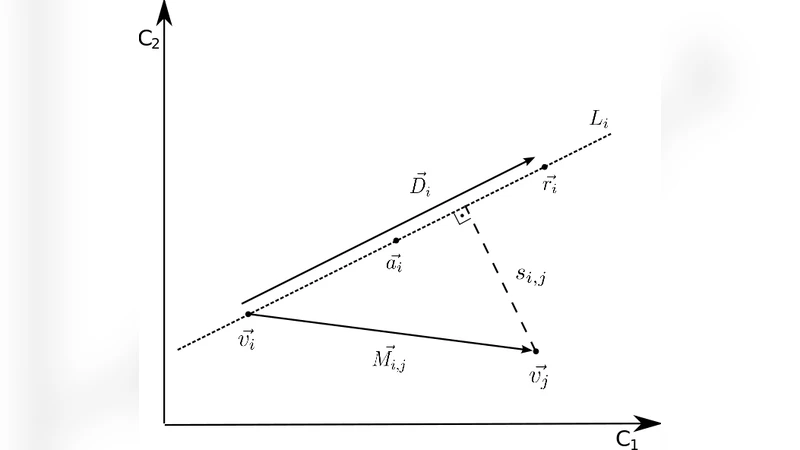
The core contribution of the paper is the definition of three novel, geometry‑based indices that aim to capture non‑numeric relations traditionally discussed in music theory: Opposition, Skewness, and Counter‑dialectics. For a composer i with state vector v₁, the average state a₁ across all composers is computed, and a “mirror” or opposite state r₁ = v₁ + 2(a₁ − v₁) is defined. The opposition vector D₁ = r₁ − v₁ points from the composer toward the direction of maximal contrast with the historical average. For a pair (i, j) the musical move Mᵢⱼ = vⱼ − vᵢ is projected onto Dᵢ; the normalized projection yields the Opposition Index Wᵢⱼ. Skewness measures the perpendicular distance of Mᵢⱼ from the line defined by Dᵢ, quantifying how much the new work deviates from a simple opposition trajectory. Counter‑dialectics involves three successive composers (i, j, k) interpreted as thesis, antithesis, and synthesis; the index is the distance from vₖ to the midpoint line between vᵢ and vⱼ, scaled appropriately. In higher dimensions this generalizes to distances from a point to a hyperplane.
Applying these indices to the bootstrap population reveals patterns that differ markedly from those observed in philosophy. In the philosophical dataset, opposition scores were high, reflecting a tradition of explicit dialectical conflict. In the musical dataset, opposition scores are modest, while counter‑dialectics scores are relatively high. This suggests that musical evolution is less driven by direct opposition and more by a process of synthesis and inheritance—consistent with the master‑apprentice model long noted by musicologists.
Specific composer relationships emerge from the quantitative analysis. Beethoven shows high opposition and counter‑dialectics values relative to both Bach and Mozart, supporting the view of Beethoven as a bridge between Baroque counterpoint and Classical homophony. Brahms and Stravinsky exhibit strong mutual counter‑dialectics, indicating a significant cross‑century influence. Stockhausen, despite being a 20th‑century avant‑garde figure, still retains measurable ties to earlier traditions through its position in the multidimensional space.
Robustness checks involve perturbing each original score by adding –2, –1, 0, +1, or +2 with equal probability, repeating this 1,000 times, and re‑running PCA. The resulting eigenvalues and component loadings change only marginally, demonstrating that the methodology is not overly sensitive to small scoring errors.
The authors acknowledge several limitations: the small number of real composers, the subjective nature of the eight characteristic scores, and the reliance on a simple bootstrap that may not capture all historical nuances. Nevertheless, they argue that the approach provides a proof‑of‑concept that musical evolution can be modeled quantitatively, and that the geometric indices offer a novel way to formalize concepts such as influence, innovation, and synthesis.
In conclusion, the paper successfully adapts a quantitative, multivariate framework from philosophy to music, demonstrates that composer styles can be represented as points in an 8‑dimensional feature space, and introduces mathematically defined indices that capture historically meaningful relationships. The findings support the long‑standing musicological view that inheritance and synthesis dominate musical development, contrasting with the more oppositional dynamics observed in philosophical thought. Future work could expand the composer set, refine characteristic selection, and integrate objective audio‑analysis features to further validate and extend the proposed methodology.
Comments & Academic Discussion
Loading comments...
Leave a Comment