Overview of an Extensive Multi-wavelength Study of GX 339-4 during the 2010 Outburst
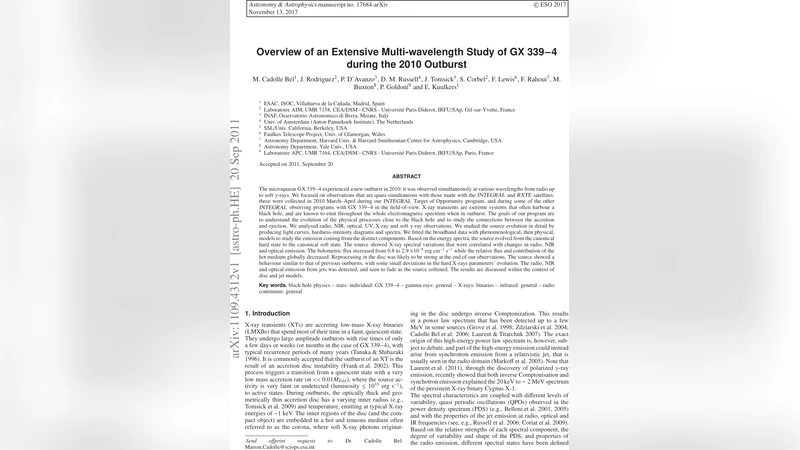
The microquasar GX 339-4 experienced a new outburst in 2010: it was observed simultaneously at various wavelengths from radio up to soft gamma-rays. We focused on observations that are quasi-simultaneous with those made with the INTEGRAL and RXTE satellites: these were collected in 2010 March-April during our INTEGRAL Target of Opportunity program, and during some of the other INTEGRAL observing programs with GX 339-4 in the field-of-view. X-ray transients are extreme systems that often harbour a black hole, and are known to emit throughout the whole electromagnetic spectrum when in outburst. The goals of our program are to understand the evolution of the physical processes close to the black hole and to study the connections between the accretion and ejection. We analysed radio, NIR, optical, UV, X-ray and soft gamma-ray observations. We studied the source evolution in detail by producing light curves, hardness-intensity diagrams and spectra. We fitted the broadband data with phenomenological, then physical, models to study the emission coming from the distinct components. Based on the energy spectra, the source evolved from the canonical hard state to the canonical soft state. The source showed X-ray spectral variations that were correlated with changes in radio, NIR and optical emission. The bolometric flux increased from 0.8 to 2.9*10^{-8} erg cm^{-2} s^{-1} while the relative flux and contribution of the hot medium globally decreased. Reprocessing in the disc was likely to be strong at the end of our observations. The source showed a behaviour similar to that of previous outbursts, with some small deviations in the hard X-rays parameters’ evolution. The radio, NIR and optical emission from jets was detected, and seen to fade as the source softened. The results are discussed within the context of disc and jet models.
💡 Research Summary
The 2010 outburst of the black‑hole X‑ray binary GX 339‑4 was monitored from radio frequencies up to soft γ‑rays with a coordinated multi‑wavelength campaign. The campaign combined Target‑of‑Opportunity observations with INTEGRAL (IBIS/ISGRI 18–200 keV and JEM‑X 5–25 keV) and a dense set of contemporaneous data from RXTE (PCA 3–25 keV), Swift (XRT 0.3–10 keV, BAT 15–50 keV, UVOT 180–600 nm), the ATCA radio array (5.5 GHz and 9 GHz), the REM telescope (optical/NIR) and the Faulkes Telescope South (optical). The observations span MJD 55200–55400, with particular emphasis on the periods around MJD 55260–55310 when the source was observed quasi‑simultaneously by several facilities.
Light curves in the soft X‑ray band (2–10 keV, ASM) and the hard X‑ray band (15–80 keV, BAT/ISGRI) show the classic “hard‑to‑soft” evolution: the hard flux peaks around MJD 55295 and then declines, while the soft flux continues to rise and reaches its maximum roughly a month later (MJD 55327). Simultaneous optical, near‑infrared and radio measurements display a similar pattern – the jet‑related emission is strong during the early hard state and fades rapidly as the source softens.
A hardness‑intensity diagram (HID) constructed from the RXTE/PCA data confirms the canonical state sequence: the source moves from the low/hard state (LHS) through the hard‑intermediate state (HIMS) and soft‑intermediate state (SIMS) into the high/soft state (HSS). Timing analysis (not detailed here) shows the disappearance of strong band‑limited noise and low‑frequency QPOs as the transition proceeds, consistent with the spectral changes.
Spectral modelling was performed in two steps. First, phenomenological models (disk‑blackbody plus a power‑law) were fitted to the broadband data to obtain basic parameters such as the inner‑disk temperature and the photon index. Second, physical Comptonisation models (e.g., EQPAIR) that self‑consistently treat the hot corona, the soft disc photons and possible non‑thermal tails were applied. The results indicate that during the LHS the corona is hot (electron temperature kTₑ≈70 keV) and optically thick (τ≈2.5), contributing roughly 30 % of the bolometric luminosity. As the source softens, kTₑ drops below 30 keV, τ decreases, and the disc blackbody component dominates, with the inner‑disk temperature rising to ≈0.7 keV. The bolometric flux rises from 0.8 × 10⁻⁸ to 2.9 × 10⁻⁸ erg cm⁻² s⁻¹, a factor of ≈3.5, while the relative contribution of the hot medium declines.
Radio measurements at 5.5 GHz and 9 GHz show a flat spectrum (≈9 mJy) in the hard state, followed by a decrease to ≈7–8 mJy as the source enters the soft state, indicating jet quenching. Near‑infrared and optical fluxes, which contain a significant synchrotron jet component in the hard state, also fade during the transition, supporting the disc‑jet coupling scenario.
Compared with previous outbursts (e.g., 2004, 2007), the overall evolution of the hard‑X‑ray spectral parameters is similar, but the 2010 event shows a slightly higher electron temperature and a more prolonged hard‑X‑ray plateau at the onset of the transition. This suggests modest variations in the energy transfer efficiency between the accretion disc and the corona.
In summary, the paper presents a comprehensive, quasi‑simultaneous, broadband dataset of GX 339‑4’s 2010 outburst. The analysis demonstrates a clear transition from a corona‑dominated hard state to a disc‑dominated soft state, accompanied by the suppression of jet emission. These observations provide strong empirical support for models that link accretion‑disc physics with jet production and quenching in black‑hole X‑ray binaries.
Comments & Academic Discussion
Loading comments...
Leave a Comment