Early radio and X-ray observations of the youngest nearby type Ia supernova PTF11kly (SN 2011fe)
On August 24 (UT) the Palomar Transient Factory (PTF) discovered PTF11kly (SN 2011fe), the youngest and most nearby type Ia supernova (SN Ia) in decades. We followed this event up in the radio (centimeter and millimeter bands) and X-ray bands, starting about a day after the estimated explosion time. We present our analysis of the radio and X-ray observations, yielding the tightest constraints yet placed on the pre-explosion mass-loss rate from the progenitor system of this supernova. We find a robust limit of dM/dt<10^-8 (w/100 km/s) [M_solar/yr] from sensitive X-ray non-detections, as well as a similar limit from radio data, which depends, however, on assumptions about microphysical parameters. We discuss our results in the context of single-degenerate models for SNe Ia and find that our observations modestly disfavor symbiotic progenitor models involving a red giant donor, but cannot constrain systems accreting from main-sequence or sub-giant stars, including the popular supersoft channel. In view of the proximity of PTF11kly and the sensitivity of our prompt observations we would have to wait for a long time (decade or longer) in order to more meaningfully probe the circumstellar matter of Ia supernovae.
💡 Research Summary
The paper reports on the earliest and most sensitive radio and X‑ray observations of the nearby Type Ia supernova PTF11kly (SN 2011fe), discovered by the Palomar Transient Factory on 2011 August 24. Because the optical light curve rose extremely rapidly, the explosion time could be constrained to within a few hours (UT 2011 August 23.69). This precise timing allowed the authors to begin follow‑up observations in the radio (centimeter and millimeter bands) and X‑ray bands only about a day after the explosion, a cadence never achieved for a Type Ia event before.
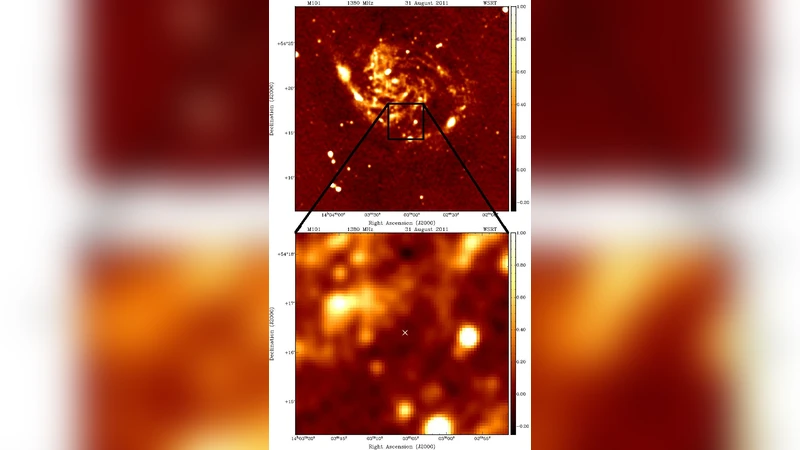
Radio observations were carried out with CARMA (≈100 GHz), the Expanded Very Large Array (EVLA; 1.4–8.5 GHz) and the Westerbork Synthesis Radio Telescope (WSRT; 1.4 GHz). Six epochs spanning 0.9 to 8 days post‑explosion were obtained. No emission was detected at any frequency; the deepest limits are ≈5 µJy at 1.4 GHz and ≈4 µJy at 8.5 GHz (3σ). X‑ray observations were performed with Swift/XRT (0.9 day, 4.5 ks) and Chandra (4 days, 49.7 ks). Both instruments yielded non‑detections, with Swift providing an upper limit of (F_X < 6.2\times10^{-14}) erg cm(^{-2}) s(^{-1}) (0.3–10 keV) and Chandra an even tighter limit of (F_X < 9.0\times10^{-16}) erg cm(^{-2}) s(^{-1}).
To translate these limits into constraints on the circumstellar environment, the authors adopt the standard Chevalier synchro‑self‑absorption (SSA) model for radio emission from supernova shocks. The model relates the observed radio flux (or its upper limit) to the density of the circumstellar medium (CSM), which for a steady wind is (\rho(r)=\dot M/(4\pi r^{2}v_{w})). The radio analysis requires assumptions about the micro‑physical parameters: the fraction of post‑shock energy in relativistic electrons ((\epsilon_{e}\approx0.1)) and in magnetic fields ((\epsilon_{B}), taken to lie between 0.01 and 0.1). Using these values and the non‑detections, the authors derive a robust upper limit on the pre‑explosion mass‑loss rate of the progenitor system: \
Comments & Academic Discussion
Loading comments...
Leave a Comment