Climate instability on tidally locked exoplanets
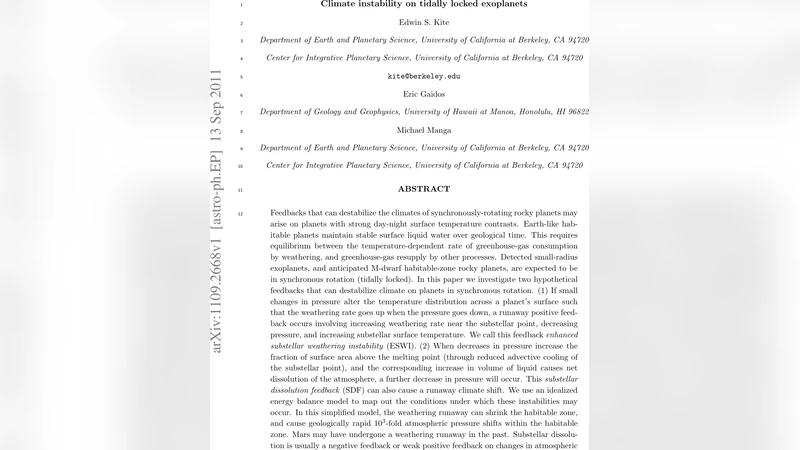
Feedbacks that can destabilize the climates of synchronously-rotating rocky planets may arise on planets with strong day-night surface temperature contrasts. Earth-like habitable-zone (HZ) planets maintain stable surface liquid water over geological time. This requires equilibrium between the temperature-dependent rate of greenhouse-gas consumption by weathering,and greenhouse-gas resupply by other processes. Detected small-radius exoplanets, and anticipated M-dwarf HZ rocky planets, are expected to be tidally locked. We investigate two feedbacks that can destabilize climate on tidally-locked planets. (1) If small changes in pressure alter the temperature distribution across a planet’s surface such that the weathering rate increases when the pressure decreases, a positive feedback occurs involving increasing weathering rate near the substellar point, decreasing pressure, and increasing substellar surface temperature. (2) When decreases in pressure increase the surface area above the melting point (through reduced advective cooling of the substellar point), and the corresponding increase in volume of liquid causes net dissolution of the atmosphere, a further decrease in pressure occurs. We use an idealized energy balance model to map out the conditions under which these instabilities may occur. The weathering runaway can shrink the habitable zone, and cause geologically rapid 10^3-fold pressure shifts within the HZ. Mars may have undergone a weathering runaway in the past. Substellar dissolution is usually a negative feedback or weak positive feedback on changes in pressure. Both instabilities are suppressed if the atmosphere has a high radiative efficiency. Our results are most relevant for atmospheres that are thin and have low greenhouse-gas radiative efficiency. These results identify a new pathway by which HZ planets can undergo rapid climate shifts and become uninhabitable.
💡 Research Summary
The paper investigates two previously unrecognized climate‑feedback mechanisms that can destabilize the atmospheres of synchronously rotating (tidally locked) rocky exoplanets. Using a highly simplified energy‑balance model (EBM) that couples surface temperature, atmospheric temperature, and turbulent heat exchange, the authors explore how small changes in surface pressure can dramatically reshape the day‑night temperature distribution and, in turn, drive runaway climate transitions.
The first mechanism, termed the Enhanced Substellar Weathering Instability (ESWI), hinges on the fact that on a tidally locked world with a strong day‑night contrast, most silicate weathering—and thus CO₂ draw‑down—occurs near the substellar point where temperatures are highest. When atmospheric pressure rises modestly, the increased turbulent heat transport (parameterized by a coefficient β proportional to pressure) cools the substellar region because the atmosphere becomes warmer than the surface on the nightside and cooler on the dayside. This cooling reduces the weathering rate precisely where it matters most, allowing volcanic or other CO₂ sources to outpace removal and further raise pressure. The result is a positive feedback loop: pressure ↑ → substellar cooling → weathering ↓ → CO₂ ↑ → pressure ↑. The model shows that this loop operates only when the atmospheric radiative efficiency Λ is low (≈0.1 or less) and the atmosphere is thin enough that β is pressure‑sensitive. Under these conditions the system possesses a bistable regime and can experience a “pressure runaway” where atmospheric pressure changes by orders of magnitude (10³‑fold) on geological timescales, potentially shrinking the conventional habitable zone.
The second mechanism, the Substellar Dissolution Feedback (SDF), involves the formation of a localized liquid reservoir (e.g., a shallow pond or ocean) at the substellar point as pressure falls and the surface temperature gradient steepens. Some atmospheric gases dissolve into this liquid according to Henry’s law, removing mass from the atmosphere. If the volume of liquid grows faster than the decrease in dissolved concentration with pressure (i.e., if the relationship V ∝ Pⁿ with n > 1), then a decrease in pressure leads to more dissolution, which further lowers pressure—a second positive feedback. For n > 2 the feedback becomes runaway, potentially driving the atmosphere to collapse while the liquid reservoir expands. However, the authors find that realistic solubilities, temperature dependencies, and the need for deep, highly soluble liquids make SDF a weak or even negative feedback in most plausible exoplanet scenarios. Only in cases of very low pressure, deep oceans, and gases with exceptionally high solubility could SDF trigger a climate shift.
Both instabilities are strongly suppressed when the atmosphere’s greenhouse efficiency Λ is high. A more radiatively effective atmosphere reduces the day‑night temperature contrast, making the substellar point less sensitive to pressure changes; the surface becomes nearly isothermal, and the feedbacks disappear. Consequently, the authors argue that ESWI and SDF are most relevant for planets with thin, CO₂‑dominated atmospheres that also serve as the primary greenhouse gas.
The paper also draws a parallel to early Mars, suggesting that a past episode of ESWI could have contributed to the planet’s loss of a thicker CO₂ atmosphere. For exoplanet observations, the authors propose that measuring the day‑night temperature contrast (ΔTs) via secondary eclipse or phase‑curve photometry, combined with constraints on atmospheric pressure from transmission spectroscopy, could identify candidates where these feedbacks operate.
In summary, the study introduces a novel pathway—through pressure‑dependent weathering and substellar dissolution—by which tidally locked rocky planets with thin, low‑efficiency atmospheres can undergo rapid, large‑scale climate transitions. These mechanisms may significantly narrow the habitable zone for such worlds and must be considered when assessing the long‑term habitability of the many small exoplanets now being discovered around M‑dwarf stars.
Comments & Academic Discussion
Loading comments...
Leave a Comment