Narrow absorption features in the co-added XMM-Newton RGS spectra of isolated Neutron Stars
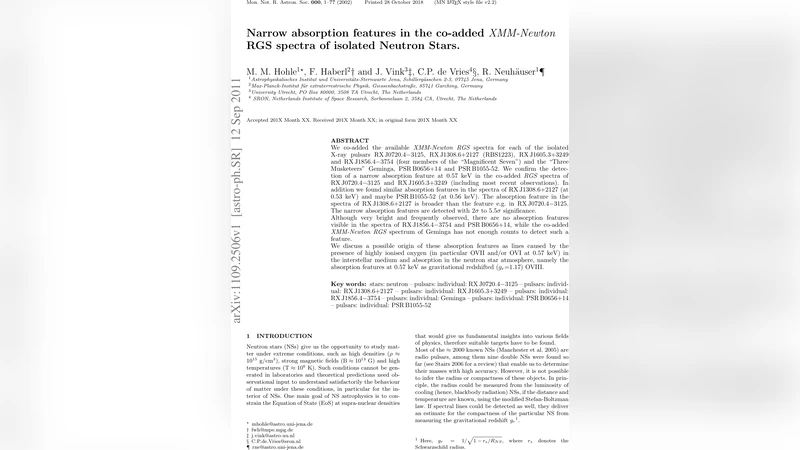
We co-added the available XMM-Newton RGS spectra for each of the isolated X-ray pulsars RX,J0720.4$-$3125, RX,J1308.6+2127 (RBS,1223), RX,J1605.3+3249 and RX,J1856.4$-$3754 (four members of the “Magnificent Seven”) and the “Three Musketeers” Geminga, PSR,B0656+14 and PSR,B1055-52. We confirm the detection of a narrow absorption feature at 0.57 keV in the co-added RGS spectra of RX,J0720.4$-$3125 and RX,J1605.3+3249 (including most recent observations). In addition we found similar absorption features in the spectra of RX,J1308.6+2127 (at 0.53 keV) and maybe PSR,B1055-52 (at 0.56 keV). The absorption feature in the spectra of RX,J1308.6+2127 is broader than the feature e.g. in RX,J0720.4$-$3125. The narrow absorption features are detected with 2$\sigma$ to 5.6$\sigma$ significance. Although very bright and frequently observed, there are no absorption features visible in the spectra of RX,J1856.4$-$3754 and PSR,B0656+14, while the co-added XMM-Newton RGS spectrum of Geminga has not enough counts to detect such a feature. We discuss a possible origin of these absorption features as lines caused by the presence of highly ionised oxygen (in particular OVII and/or OVI at 0.57 keV) in the interstellar medium and absorption in the neutron star atmosphere, namely the absorption features at 0.57 keV as gravitational redshifted ($g_{r}$=1.17) OVIII.
💡 Research Summary
The authors present a systematic search for narrow absorption lines in the high‑resolution X‑ray spectra of eight isolated neutron stars (NSs) using all available XMM‑Newton Reflection Grating Spectrometer (RGS) observations. The sample comprises four members of the “Magnificent Seven” (RX J0720.4‑3125, RX J1308.6+2127, RX J1605.3+3249, RX J1856.4‑3754) and the three “Three Musketeers” (Geminga, PSR B0656+14, PSR B1055‑52). By re‑processing each observation with SAS v10.0, applying strict good‑time‑interval filtering, and co‑adding the first‑order RGS1 spectra (RGS2 lacks coverage around 0.57 keV), the authors achieve total effective exposures of 516 ks for RX J0720.4‑3125, 170 ks for RX J1308.6+2127, 110 ks for RX J1605.3+3249, and comparable exposures for the remaining sources.
The spectral analysis is performed in XSPEC using a baseline model consisting of interstellar absorption (phabs), a black‑body component (bbodyrad) representing the thermal surface emission, and a broad Gaussian to account for known cyclotron‑like features below the RGS band. On top of this, a narrow Gaussian is added to test for additional absorption lines. The statistical improvement is evaluated via χ² reduction and the significance of the line is quoted in σ.
Key results:
- RX J0720.4‑3125 shows a narrow absorption feature at 568.6 ± 1.8 eV with an equivalent width of –1.9 ± 0.6 eV, detected at 5.6 σ. This confirms earlier reports (Hambaryan et al. 2009) and benefits from the inclusion of four newer observations, raising the total exposure to 533 ks after filtering.
- RX J1605.3+3249 exhibits a line at 576.1 ± 2.6 eV, EW = –3.2 ± 1.6 eV, with a significance of 3.5 σ, consistent with the original detection by van Kerkwijk et al. (2004).
- RX J1308.6+2127 (RBS 1223) shows a broader feature centered at 535.3 +7.4 –13.4 eV, EW = –20 +10 –13 eV, detected at ~2–3 σ. The line is broader than the 0.57 keV features and cannot be reproduced by simply increasing the neutral oxygen abundance in the interstellar absorption model, suggesting an intrinsic NS atmospheric origin.
- No statistically significant narrow lines are found in RX J1856.4‑3754 or PSR B0656+14, despite their brightness, and the Geminga spectrum lacks sufficient counts for a meaningful search.
- A tentative feature at 0.56 keV is reported for PSR B1055‑52, but its significance remains low.
The authors discuss two plausible origins for the detected lines. First, absorption by highly ionised oxygen (OVII, OVI) in the hot plasma of the Local Bubble could produce a line near 0.57 keV; this would be an interstellar medium (ISM) effect common to all sight‑lines. Second, the lines could arise in the NS atmosphere itself, where gravitational redshift (g_r≈1.17) would shift the OVIII Ly‑α transition (rest‑frame 0.653 keV) down to the observed energies. The latter interpretation would provide a direct measurement of the NS compactness (M/R) and thus constrain the equation of state of ultra‑dense matter.
The paper demonstrates that co‑adding all available RGS data can significantly improve sensitivity to weak spectral features, achieving detections down to equivalent widths of ~2 eV. It also highlights the need for future high‑resolution missions (e.g., XRISM Resolve, Athena X‑IFU) to resolve line profiles, discriminate between ISM and atmospheric origins, and ultimately use such features as diagnostics of neutron‑star structure and the local interstellar environment.
Comments & Academic Discussion
Loading comments...
Leave a Comment