Ice-lens formation and geometrical supercooling in soils and other colloidal materials
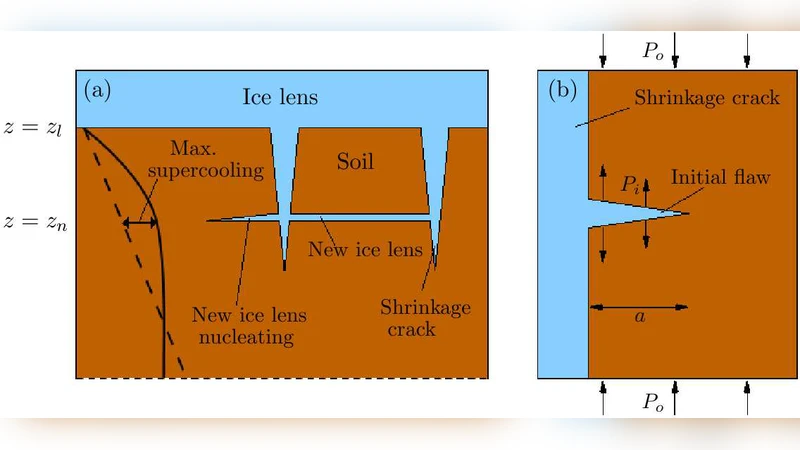
We present a new, physically-intuitive model of ice-lens formation and growth during the freezing of soils and other dense, particulate suspensions. Motivated by experimental evidence, we consider the growth of an ice-filled crack in a freezing soil. At low temperatures, ice in the crack exerts large pressures on the crack walls that will eventually cause the crack to split open. We show that the crack will then propagate across the soil to form a new lens. The process is controlled by two factors: the cohesion of the soil, and the geometrical supercooling of the water in the soil; a new concept introduced to measure the energy available to form a new ice lens. When the supercooling exceeds a critical amount (proportional to the cohesive strength of the soil) a new ice lens forms. This condition for ice-lens formation and growth does not appeal to any ad hoc, empirical assumptions, and explains how periodic ice lenses can form with or without the presence of a frozen fringe. The proposed mechanism is in good agreement with experiments, in particular explaining ice-lens pattern formation, and surges in heave rate associated with the growth of new lenses. Importantly for systems with no frozen fringe, ice-lens formation and frost heave can be predicted given only the unfrozen properties of the soil. We use our theory to estimate ice-lens growth temperatures obtaining quantitative agreement with the limited experimental data that is currently available. Finally we suggest experiments that might be performed in order to verify this theory in more detail. The theory is generalizable to complex natural-soil scenarios, and should therefore be useful in the prediction of macroscopic frost heave rates.
💡 Research Summary
The paper introduces a physically‑based, fracture‑mechanics model for the formation and growth of ice lenses in freezing soils and other dense colloidal suspensions. Traditional theories of frost heave have relied on empirical “stress‑partition” functions or on the presence of a frozen fringe—a thin layer of partially frozen soil ahead of the warmest ice lens. However, experiments on clays, silica microspheres, and other colloids have shown that periodic ice lenses can develop even when no frozen fringe is present, indicating that existing models are incomplete.
Motivated by a series of observations—(i) the appearance of crack‑like ice‑filled fissures in frozen soil cross‑sections, (ii) time‑lapse imaging of a new lens propagating in a kaolinite clay cell in a distinctly crack‑like manner, and (iii) the strong dependence of lens spacing on the soil’s tensile (shear) strength—the authors adopt a fracture‑mechanics perspective. They treat a pre‑existing flaw (a crack or pore) that is large compared with the particle size but small compared with the spacing of lenses as the nucleation site. Ice that fills this flaw exerts a pressure on the crack walls; as the temperature drops, the under‑cooling ((T_m - T)) increases, raising the ice pressure according to the Clapeyron relation
\
Comments & Academic Discussion
Loading comments...
Leave a Comment