Periodic magnetorotational dynamo action as a prototype of nonlinear magnetic field generation in shear flows
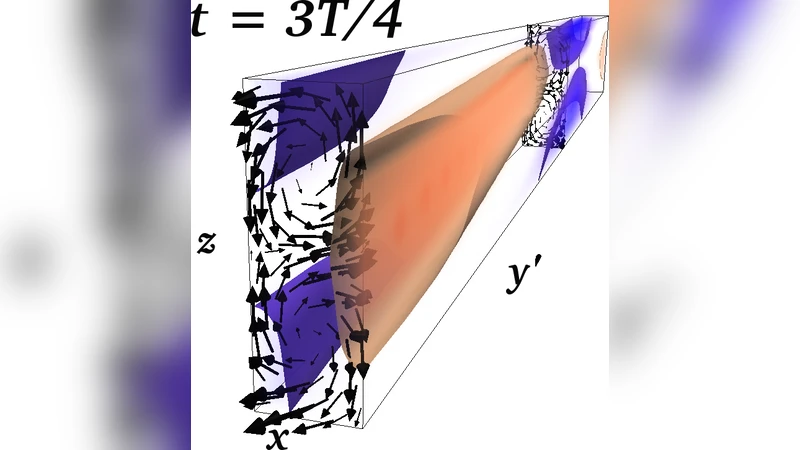
The nature of dynamo action in shear flows prone to magnetohydrodynamic instabilities is investigated using the magnetorotational dynamo in Keplerian shear flow as a prototype problem. Using direct numerical simulations and Newton’s method, we compute an exact time-periodic magnetorotational dynamo solution to the three-dimensional dissipative incompressible magnetohydrodynamic equations with rotation and shear. We discuss the physical mechanism behind the cycle and show that it results from a combination of linear and nonlinear interactions between a large-scale axisymmetric toroidal magnetic field and non-axisymmetric perturbations amplified by the magnetorotational instability. We demonstrate that this large scale dynamo mechanism is overall intrinsically nonlinear and not reducible to the standard mean-field dynamo formalism. Our results therefore provide clear evidence for a generic nonlinear generation mechanism of time-dependent coherent large-scale magnetic fields in shear flows and call for new theoretical dynamo models. These findings may offer important clues to understand the transitional and statistical properties of subcritical magnetorotational turbulence.
💡 Research Summary
This paper addresses the long‑standing problem of magnetic field generation in shear flows that are susceptible to magnetohydrodynamic (MHD) instabilities, using the magnetorotational instability (MRI) dynamo in a Keplerian shear flow as a prototype. The authors combine direct numerical simulations (DNS) in a shearing‑box framework with a high‑dimensional Newton–Krylov solver (named PEANUTS) to compute an exact, time‑periodic solution of the three‑dimensional incompressible MHD equations with rotation and linear shear.
The governing equations are the incompressible MHD set written in the local shearing‑sheet approximation: a linear background shear Uₛ = −S x e_y, a uniform rotation Ω = (2/3)S e_z for a Keplerian profile, and the usual viscous and resistive terms. The kinetic and magnetic Reynolds numbers are defined as Re = S L²/ν and Rm = S L²/η, with L the box size. The DNS are performed with the spectral code SNOOPY, which implements shear‑periodic boundary conditions in x and periodic conditions in y and z. A key technical ingredient is the “remap” procedure: as non‑axisymmetric shearing waves are sheared into increasingly trailing structures (kₓ(t)=kₓ⁰+ky S t), they become strongly dissipated. At regular intervals the most trailing modes are pruned and replaced by new leading modes, allowing the system to generate fresh non‑axisymmetric structures dynamically rather than being forced into decay.
To locate a nonlinear limit cycle, the authors first design initial conditions that contain (i) a large‑scale axisymmetric poloidal magnetic field Bₓ⁰ (the “seed” field) and (ii) a small amplitude non‑axisymmetric MRI‑unstable perturbation. In DNS this configuration produces a pseudo‑cyclic evolution: the seed poloidal field is sheared into a toroidal component B_y⁰ (the Ω‑effect), the toroidal field destabilises MRI modes, and the resulting non‑axisymmetric fluctuations generate an electromotive force (EMF) through the nonlinear term u×B. The EMF possesses an axisymmetric component that regenerates the original poloidal field, thus closing a feedback loop.
Having observed this loop, the authors feed a snapshot of the pseudo‑cycle into the Newton solver, together with an estimate of the period. The solver minimizes the norm of X(T)−X(0) (where X is the full state vector) and converges to a solution with residuals below 10⁻¹², confirming the existence of an exact periodic orbit (limit cycle). The cycle period is about 57 shear times (in units of S⁻¹) for the chosen parameters (Re≈400, Rm≈300). Linear stability analysis of the cycle, performed with an eigenvalue solver based on SLEPc, reveals a single unstable Floquet multiplier, indicating that the orbit sits on a low‑dimensional unstable manifold—a hallmark of subcritical dynamics.
The physical mechanism of the cycle is dissected in detail. The Ω‑effect stretches the axisymmetric poloidal field into a toroidal field. The toroidal field, being MRI‑unstable, amplifies non‑axisymmetric shearing waves whose wavevectors are continuously sheared by the background flow. These amplified waves interact nonlinearly, producing a mean EMF that has the correct spatial phase (sin(k_z z)) to regenerate the original poloidal field (cos(k_z z)). The resistive and viscous terms balance the growth, allowing the cycle to persist. Importantly, this regeneration cannot be captured by standard mean‑field dynamo theory, which relies on a linear α‑effect and a prescribed turbulent diffusivity; the EMF here is intrinsically tied to the finite‑amplitude MRI dynamics and to the time‑dependent geometry of the shearing waves.
The authors argue that such nonlinear cycles constitute the building blocks of the “zero‑net‑flux” MRI turbulence observed in many astrophysical disk simulations. The turbulence appears to be organised around a chaotic saddle populated by many such unstable periodic orbits, analogous to the role of exact coherent structures in hydrodynamic transition to turbulence (e.g., in pipe flow or plane Couette flow). The discovery of a concrete, fully resolved MRI dynamo cycle therefore bridges the gap between phenomenological turbulence studies and dynamical‑systems approaches, offering a concrete example of a subcritical dynamo that does not require an externally imposed net magnetic flux.
Implications are far‑reaching. For dynamo theory, the work demonstrates that large‑scale magnetic field generation in shear flows can be fundamentally nonlinear, challenging the universality of mean‑field models. For astrophysics, it provides a plausible mechanism for the onset and sustenance of magnetic activity in accretion disks that lack a net vertical field, potentially influencing angular momentum transport and disk evolution. Finally, the methodological advances—particularly the combination of shearing‑box DNS with a matrix‑free Newton–Krylov solver—open the way to systematic searches for other exact coherent structures (e.g., travelling waves, relative periodic orbits) in MHD shear flows. Future work will likely explore parameter‑space extensions, interactions among multiple cycles, and the role of additional physics (stratification, compressibility, realistic boundary conditions) to bring the theory closer to astrophysical reality.
Comments & Academic Discussion
Loading comments...
Leave a Comment