A Linear-Optical Proof that the Permanent is #P-Hard
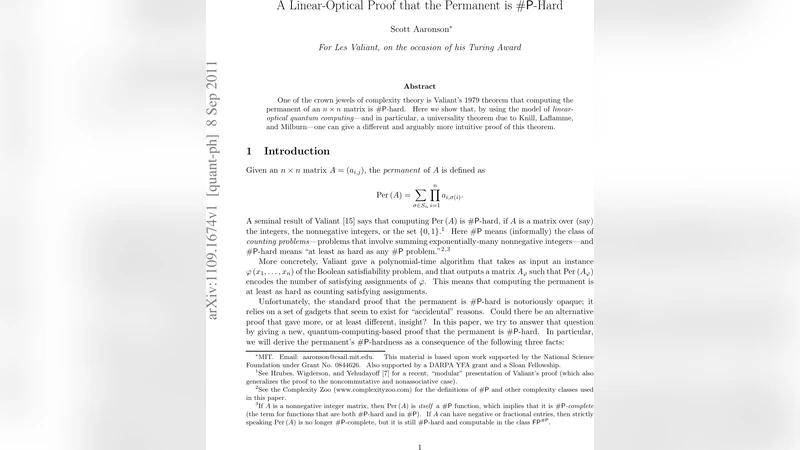
One of the crown jewels of complexity theory is Valiant’s 1979 theorem that computing the permanent of an n*n matrix is #P-hard. Here we show that, by using the model of linear-optical quantum computing—and in particular, a universality theorem due to Knill, Laflamme, and Milburn—one can give a different and arguably more intuitive proof of this theorem.
💡 Research Summary
The paper presents a novel proof that computing the permanent of an (n\times n) matrix is #P‑hard, using the framework of linear‑optical quantum computing (LOQC). The authors begin by recalling Valiant’s classic 1979 result, which shows #P‑hardness via a combinatorial reduction that relies on intricate gadget constructions (variable and clause gadgets, cycle covers, etc.). While mathematically sound, that proof is often regarded as “opaque” and heavily dependent on ad‑hoc constructions. The authors therefore ask whether a more intuitive, physics‑driven argument exists.
The core of their approach rests on three well‑known facts. (1) The Knill‑Laflamme‑Milburn (KLM) theorem states that a linear‑optical circuit equipped with post‑selection (i.e., conditioning on specific photon‑count outcomes) can simulate any quantum circuit built from a universal gate set (G) consisting of all single‑qubit gates and the two‑qubit CSIGN gate. (2) Quantum amplitudes of universal circuits can encode #P‑hard quantities; this is essentially the content of Aaronson’s PP = PostBQP theorem and related work. (3) In an (n)-photon linear‑optical network, the transition amplitude between two Fock states (|S\rangle) and (|T\rangle) is exactly the permanent of an (n\times n) matrix derived from the underlying mode‑wise unitary transformation. This follows from the bosonic symmetrization over all possible photon permutations.
The proof proceeds as follows. Given any #P problem (e.g., counting satisfying assignments of a Boolean formula (\phi)), one first builds a standard quantum circuit (Q) over the gate set (G) whose acceptance amplitude (\langle 0^{\otimes k}|Q|0^{\otimes k}\rangle) equals (up to a known scaling factor) the number of satisfying assignments of (\phi). This step uses known constructions that embed counting into quantum amplitudes. Next, the KLM reduction algorithm translates (Q) into a post‑selected linear‑optical circuit (L). The translation is polynomial‑time and introduces a pair of optical modes for each logical qubit (dual‑rail encoding), plus auxiliary modes for the post‑selection infrastructure. Importantly, all post‑selection measurements can be deferred to the end of the computation, so the circuit’s unitary part is a pure linear‑optical transformation (U).
Because of fact (3), the overall amplitude (\langle I|,\phi(L),|I\rangle) (where (|I\rangle) is the standard initial Fock state with one photon in each even‑indexed mode) equals the permanent (\operatorname{Per}(U)) of a matrix derived from (U). Since this amplitude already encodes the #P‑hard quantity from the original problem, computing the permanent must be at least as hard as any #P problem; thus the permanent is #P‑hard. The reduction bypasses Valiant’s combinatorial gadgets entirely, relying instead on the physical correspondence between bosonic interference and matrix permanents.
The authors emphasize several advantages of their proof. It avoids cycle‑cover arguments, uses only the weaker “post‑selected” version of the KLM universality theorem (not the full adaptive‑measurement version), and makes the hardness of approximation immediate (post‑selection arguments typically lift to approximation hardness). Moreover, the same methodology can be applied to other counting problems, such as special cases of the permanent or the Jones polynomial, suggesting a broader utility of quantum‑computational techniques in classical complexity theory.
In the related work discussion, the paper situates itself among prior quantum‑based proofs of classical results (e.g., Aaronson’s PP = PostBQP, Kupberg’s quantum proof of Jones‑polynomial hardness) and earlier uses of linear optics to study permanents (Rudolph’s reformulation of Valiant’s proof). The contribution here is a fully self‑contained, independent proof that draws on tools originally developed for quantum information rather than combinatorial complexity.
In conclusion, by exploiting the natural appearance of permanents in bosonic linear‑optical amplitudes and the universality of post‑selected linear optics, the authors provide a conceptually clear and physically motivated proof that the permanent is #P‑hard, enriching both the theory of quantum computation and the landscape of classical complexity reductions.
Comments & Academic Discussion
Loading comments...
Leave a Comment