QED Effective Action in Magnetic Field Backgrounds and Electromagnetic Duality
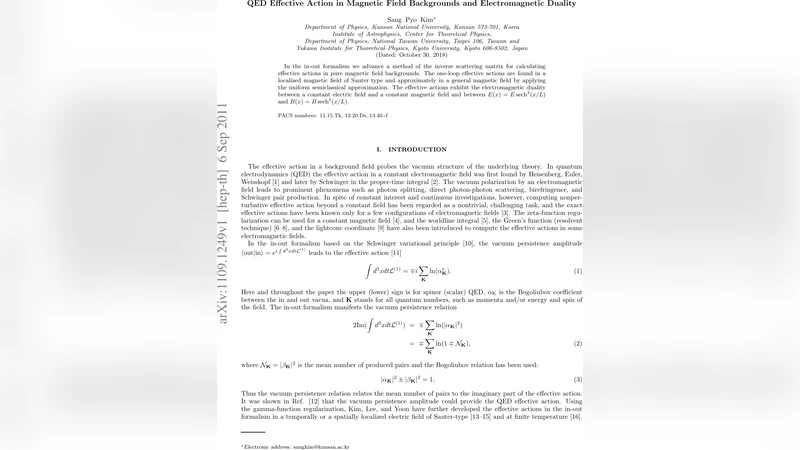
In the in-out formalism we advance a method of the inverse scattering matrix for calculating effective actions in pure magnetic field backgrounds. The one-loop effective actions are found in a localized magnetic field of Sauter type and approximately in a general magnetic field by applying the uniform semiclassical approximation. The effective actions exhibit the electromagnetic duality between a constant electric field and a constant magnetic field and between $E(x) = E sech^2 (x/L)$ and $B(x) = B sech^2 (x/L)$.
💡 Research Summary
The paper develops a novel approach to compute one‑loop QED effective actions in static magnetic‑field backgrounds using the in‑out formalism. The key idea is to replace the usual Bogoliubov coefficients, which encode pair production in electric fields, by an “inverse scattering matrix” (ISM) that characterizes the ratio of exponentially growing to decaying Jost solutions of the charged‑particle wave equation in a magnetic field. For a constant magnetic field the wave equation reduces to the harmonic‑oscillator form, whose solutions are parabolic‑cylinder functions (D_{p}(\xi)). By matching the asymptotic Jost functions at (x\to\pm\infty) one obtains the ISM (\mathcal M_{p}= \sqrt{2\pi},e^{-i(p-1)\pi/2}/\Gamma(-p)). Inserting (\ln\mathcal M_{p}^{*}) into the standard in‑out expression for the effective Lagrangian and performing the spin‑sum, proper‑time integration, and gamma‑function regularization reproduces the well‑known Heisenberg‑Euler‑Schwinger result for a constant magnetic field. The ISM is real, so the effective action has no imaginary part, reflecting the absence of pair creation in a pure magnetic background.
The method is then applied to a spatially localized Sauter‑type magnetic field (B(x)=B,\text{sech}^{2}(x/L)). The squared Dirac/Klein‑Gordon equation can be solved in terms of hypergeometric functions. Using connection formulas for the hypergeometric solutions, the ISM is expressed as a product of gamma functions (\mathcal M=\Gamma(b)\Gamma(c-a)\Gamma(a)\Gamma(c-b)). In the limit of a strong field ((qBL\gg |\omega|)) this reduces to the constant‑field form, confirming consistency. After gamma‑function regularization the effective action takes a multi‑integral form (Eq. 26) that contains the same spectral function (F_{\sigma}(s)) as the resolvent‑Green‑function method, thereby establishing the equivalence of the two approaches.
For a general, non‑uniform magnetic field where exact solutions are unavailable, the authors propose a uniform semiclassical approximation. By rewriting the wave equation in a canonical form and defining an action integral (S_{\sigma}=\oint \sqrt{-\Pi_{1}^{2}(x)},dx), one obtains an effective quantum number (p=-\frac12+S_{\sigma}/\pi). Substituting this into the ISM formula yields an approximate effective action (\mathcal L^{(1)}\propto \ln
Comments & Academic Discussion
Loading comments...
Leave a Comment