Transportation dynamics on networks of mobile agents
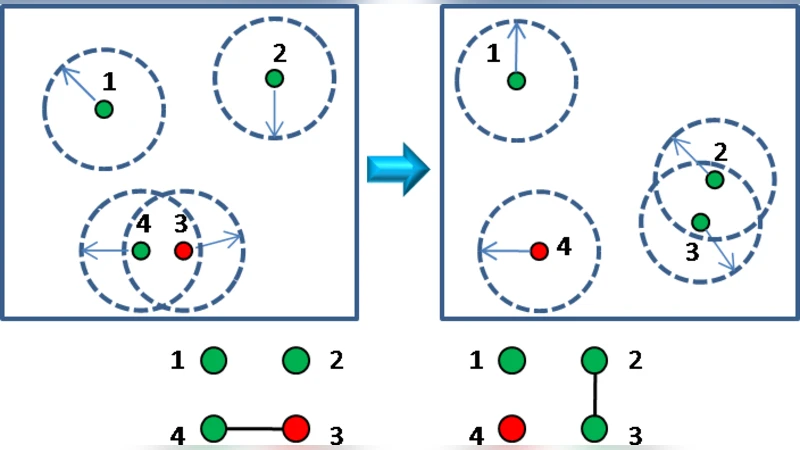
Most existing works on transportation dynamics focus on networks of a fixed structure, but networks whose nodes are mobile have become widespread, such as cell-phone networks. We introduce a model to explore the basic physics of transportation on mobile networks. Of particular interest are the dependence of the throughput on the speed of agent movement and communication range. Our computations reveal a hierarchical dependence for the former while, for the latter, we find an algebraic power law between the throughput and the communication range with an exponent determined by the speed. We develop a physical theory based on the Fokker-Planck equation to explain these phenomena. Our findings provide insights into complex transportation dynamics arising commonly in natural and engineering systems.
💡 Research Summary
The paper investigates the fundamental physics of data‑packet transportation on networks whose nodes are mobile agents, a situation increasingly common in wireless ad‑hoc systems, cellular networks, and other mobile communication platforms. The authors construct a minimal yet realistic model: N agents move in a square domain of size L with periodic boundaries, each traveling at a constant speed v but choosing a new random direction each time step. Two agents are linked if their Euclidean distance is less than a predefined communication radius a, forming a time‑varying graph whose instantaneous degree distribution follows a Poisson law with mean ⟨k⟩ that grows with a.
At each discrete time step R new packets are generated with uniformly random sources and destinations. Each agent can forward at most C = 1 packet per step. The forwarding rule is local: an agent searches within its communication circle of radius a; if the destination lies inside, the packet is delivered directly, otherwise it is handed to a randomly chosen neighbor inside the circle. Queues are assumed unlimited and obey FIFO.
To quantify network performance the authors adopt the order parameter η(R)=lim_{t→∞} C·R·⟨ΔN_p/Δt⟩, where N_p(t) is the total number of packets present at time t. η = 0 indicates a free‑flow regime (generation equals removal), while η > 0 signals congestion (packet accumulation). By sweeping R they locate a critical packet‑generation rate R_c that separates the two phases.
Numerical experiments reveal two central findings. First, the dependence of R_c on the agents’ speed v is hierarchical: for very low v, R_c stays at a low plateau; as v increases past a certain threshold, R_c jumps to a higher plateau and then remains roughly constant for larger v. This “two‑step” structure suggests that once agents move fast enough to explore the space efficiently, further speed gains bring diminishing returns. Second, the dependence of R_c on the communication radius a follows a power law R_c ∝ a^β. The exponent β decreases with increasing v (β≈3.5 at v = 0, β≈2 at v = 5), indicating that higher mobility weakens the sensitivity of throughput to communication range. When a approaches the system size L, R_c approaches N, because every agent can reach any other in a single hop.
To explain these observations the authors develop an analytical framework based on the Fokker‑Planck equation for the probability density P(r,t) of a packet’s position. In the static‑agent limit (v = 0) the problem reduces to diffusion in a plane punctuated by absorbing “holes” of radius a (the communication zones). Solving the eigenvalue problem
Comments & Academic Discussion
Loading comments...
Leave a Comment