Exact dynamical state of the exclusive queueing process with deterministic hopping
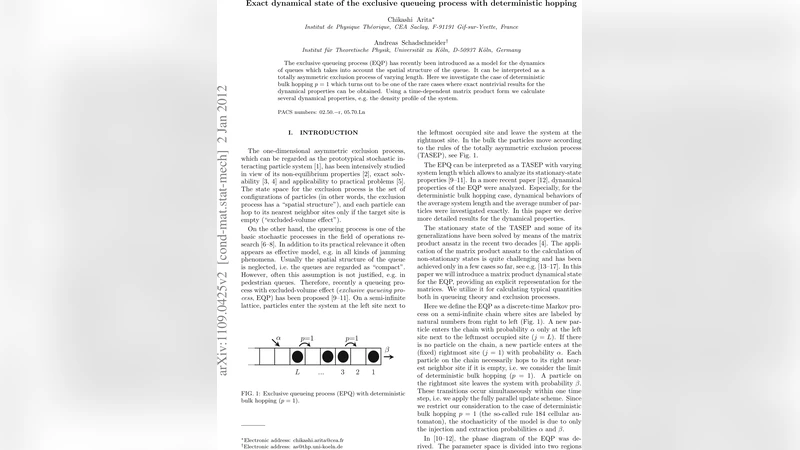
The exclusive queueing process (EQP) has recently been introduced as a model for the dynamics of queues which takes into account the spatial structure of the queue. It can be interpreted as a totally asymmetric exclusion process of varying length. Here we investigate the case of deterministic bulk hopping p=1 which turns out to be one of the rare cases where exact nontrivial results for the dynamical properties can be obtained. Using a time-dependent matrix product form we calculate several dynamical properties, e.g. the density profile of the system.
💡 Research Summary
The paper studies the Exclusive Queueing Process (EQP), a stochastic model that combines features of a queue with those of the totally asymmetric simple exclusion process (TASEP). Particles enter a semi‑infinite lattice at the leftmost empty site with probability α and leave at the rightmost occupied site with probability β. In the bulk the particles hop deterministically to the right (p = 1), so stochasticity originates only from the injection and extraction events.
The authors first write the master equation for the probability P_t(τ) of a configuration τ at discrete time t. By assuming a factorized form P_t(τ)=Q_t(|τ|) Y(τ), where |τ| is the system length (position of the leftmost particle), they separate the dynamics into a length‑dependent part Q_t(L) and a configuration‑dependent weight Y(τ). The weight Y(τ) satisfies simple recursion relations that can be represented by a matrix‑product ansatz with two 2 × 2 matrices D (occupied) and E (empty) and boundary vectors ⟨W| and |V⟩. Because E² = 0, the algebra simplifies dramatically.
The length dynamics obeys a linear three‑term recurrence
Q_{t+1}(L)=α Q_t(L−1)+(1−α)(1−β) Q_t(L)+(1−α)β Q_t(L+1)
with Q_0(0)=1, Q_0(L>0)=0. Solving this recurrence by generating‑function techniques yields
Q_t(L)=C_z
Comments & Academic Discussion
Loading comments...
Leave a Comment