Extreme value and record statistics in heavy-tailed processes with long-range memory
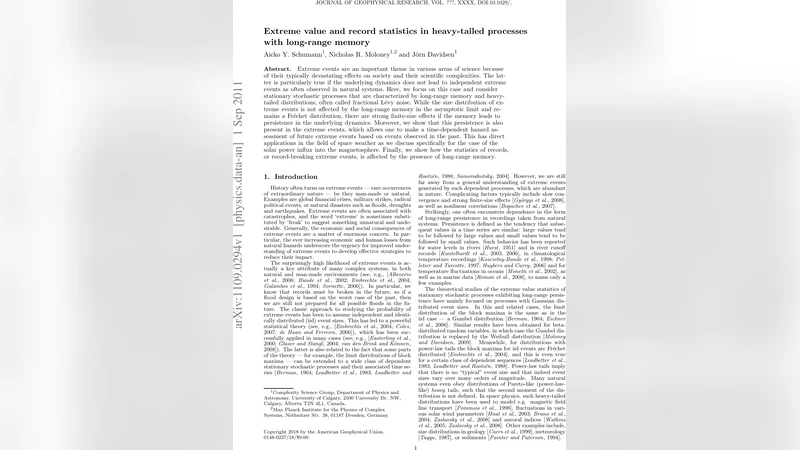
Extreme events are an important theme in various areas of science because of their typically devastating effects on society and their scientific complexities. The latter is particularly true if the underlying dynamics does not lead to independent extreme events as often observed in natural systems. Here, we focus on this case and consider stationary stochastic processes that are characterized by long-range memory and heavy-tailed distributions, often called fractional L'evy noise. While the size distribution of extreme events is not affected by the long-range memory in the asymptotic limit and remains a Fr'echet distribution, there are strong finite-size effects if the memory leads to persistence in the underlying dynamics. Moreover, we show that this persistence is also present in the extreme events, which allows one to make a time-dependent hazard assessment of future extreme events based on events observed in the past. This has direct applications in the field of space weather as we discuss specifically for the case of the solar power influx into the magnetosphere. Finally, we show how the statistics of records, or record-breaking extreme events, is affected by the presence of long-range memory.
💡 Research Summary
The paper investigates the extreme‑value and record statistics of stationary stochastic processes that simultaneously exhibit long‑range memory and heavy‑tailed distributions, commonly referred to as fractional Lévy noise or linear stable fractional noise. The authors focus on symmetric α‑stable processes (0 < α < 2) characterized by a self‑similarity (Hurst) exponent H (0 < H < 1). While the asymptotic distribution of block maxima for such processes is known to be the Fréchet law with shape parameter ξ = 1/α, the study systematically quantifies finite‑size corrections and demonstrates that long‑range persistence (H > 0.5) or anti‑persistence (H < 0.5) strongly modulates these corrections.
Using the Davies–Harte algorithm, synthetic time series are generated for a range of (α, H) pairs. Block maxima Mₙ are computed for block sizes spanning several orders of magnitude (10² – 10⁶). The results confirm that, regardless of H, the tail exponent converges to the theoretical Fréchet value as n → ∞. However, for realistic sample sizes the conditional distribution P(Mₙ₊₁ | Mₙ) deviates markedly from the unconditional distribution. In the persistent regime (H > 0.5) large maxima tend to cluster: a large Mₙ dramatically increases the probability that the next block also contains a large maximum. Conversely, anti‑persistent series exhibit a suppression effect, making large values less likely to follow one another. These findings enable the definition of a time‑dependent hazard function that quantifies the risk of a future extreme event given the magnitude of the most recent block maximum.
The paper also extends classical record‑statistics theory, which assumes independent and identically distributed (iid) variables, to the case of long‑range dependent α‑stable series. For iid data the expected number of records up to time t grows as ln t + γ, and the variance follows a similar logarithmic law, both independent of the underlying distribution. In the presence of memory, the authors show that the record‑arrival process becomes non‑stationary: persistence leads to more frequent record breaking, while anti‑persistence reduces the record rate. Moreover, the mean and variance of the record count N(t) acquire explicit dependence on both α and H, deviating from the simple logarithmic scaling. The inter‑record interval distribution likewise acquires heavy‑tailed features, reflecting the clustering of extremes.
To illustrate practical relevance, the methodology is applied to the ε‑parameter derived from ACE spacecraft measurements (2000–2007), which quantifies the solar‑wind energy flux into Earth’s magnetosphere. Empirical analysis yields α ≈ 1.6 and H ≈ 0.7, indicating a heavy‑tailed, persistent process. The conditional block‑maximum distributions and record statistics of the ε‑time series match the theoretical predictions for the (α, H) pair, confirming that the clustering of extreme solar‑wind events can be captured by the proposed framework. The authors demonstrate how the time‑dependent hazard function can be used to assess the probability of a severe geomagnetic storm given recent observations, and how record‑statistics can provide estimates for the expected waiting time until a new record‑breaking event occurs.
In conclusion, the study shows that while the asymptotic extreme‑value law (Fréchet) is robust to long‑range dependence, finite‑sample behavior, hazard assessment, and record dynamics are strongly shaped by the memory exponent H. Persistent fractional Lévy noise exhibits clustering of extremes and accelerated record breaking, whereas anti‑persistent noise shows the opposite. These insights have broad implications for risk assessment in fields where extreme events are not independent, such as climate extremes, seismic activity, financial crashes, and space weather. The paper provides both a theoretical foundation and practical tools for incorporating long‑range memory into extreme‑value and record‑statistics analyses.
Comments & Academic Discussion
Loading comments...
Leave a Comment