Sensitivity And Out-Of-Sample Error in Continuous Time Data Assimilation
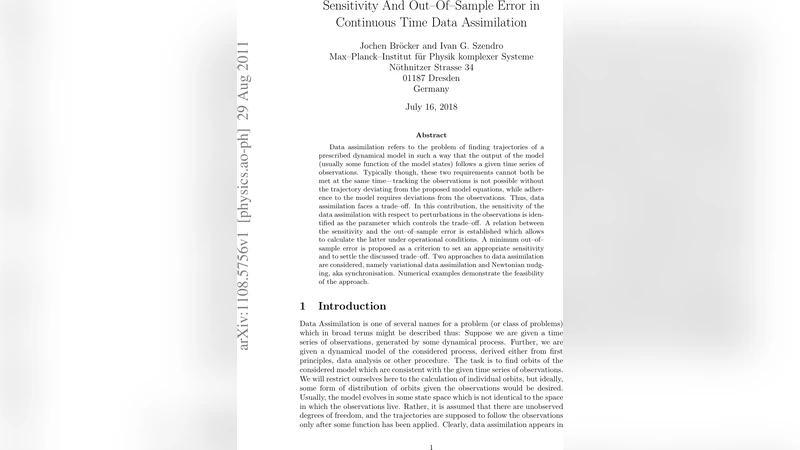
Data assimilation refers to the problem of finding trajectories of a prescribed dynamical model in such a way that the output of the model (usually some function of the model states) follows a given time series of observations. Typically though, these two requirements cannot both be met at the same time–tracking the observations is not possible without the trajectory deviating from the proposed model equations, while adherence to the model requires deviations from the observations. Thus, data assimilation faces a trade-off. In this contribution, the sensitivity of the data assimilation with respect to perturbations in the observations is identified as the parameter which controls the trade-off. A relation between the sensitivity and the out-of-sample error is established which allows to calculate the latter under operational conditions. A minimum out-of-sample error is proposed as a criterion to set an appropriate sensitivity and to settle the discussed trade-off. Two approaches to data assimilation are considered, namely variational data assimilation and Newtonian nudging, aka synchronisation. Numerical examples demonstrate the feasibility of the approach.
💡 Research Summary
**
The paper addresses a fundamental dilemma in continuous‑time data assimilation: the need to balance fidelity to noisy observations against adherence to the governing dynamical model. Because real‑world models are imperfect, a trajectory that perfectly follows the observations will inevitably deviate from the model dynamics, and a trajectory that strictly respects the model will generally fail to match the data. The authors propose that the key to managing this trade‑off is a single “sensitivity” parameter, denoted α, which controls how strongly the assimilation algorithm reacts to observation perturbations.
The core theoretical contribution is a quantitative relationship between this sensitivity and the out‑of‑sample error (OOS). The OOS is defined as the expected squared difference between the assimilation output and a hypothetical independent observation of the same underlying truth (i.e., an observation corrupted by a different realization of the noise). By expanding the OOS, the authors show that it decomposes into two terms: the tracking error (the usual misfit between model output and the actual observations) and twice the covariance between the observations and the assimilation output. Normalizing this covariance by the observation noise variance yields the sensitivity S. Consequently, OOS = tracking error + 2 S · σ², where σ² is the observation noise variance. Because tracking error and the covariance are quantities already available during assimilation, the OOS can be evaluated without any external validation data.
Two major assimilation frameworks are examined. First, variational data assimilation (VDA) is formulated with a cost functional that combines a misfit term (weighted by a matrix W) and a model‑dynamics penalty scaled by α. The resulting Euler‑Lagrange equations lead to a two‑point boundary‑value problem. The authors demonstrate that the sensitivity S can be extracted from the adjoint variables computed in the standard VDA workflow, requiring essentially no extra computation. Second, Newtonian nudging (also called synchronization) introduces a feedback term K (η − C(x)) into the model equations. Here the nudging gain K plays the role of the sensitivity parameter: larger K forces the state to follow the observations more closely (reducing tracking error but increasing model deviation), while smaller K does the opposite. An analytical expression for the OOS as a function of K is derived, allowing the optimal K to be chosen by minimizing the OOS.
Numerical experiments on both a chaotic Lorenz‑63 system and a simple linear model illustrate the theory. By sweeping α (or K) across its admissible range, the authors compute tracking error, model‑error, and OOS. The OOS exhibits a clear minimum at intermediate values of α (approximately 0.4–0.6), confirming that neither extreme—pure observation fitting nor pure model fidelity—is optimal. The experiments also validate that the sensitivity computed via the proposed methods matches the empirical covariance between observations and assimilation outputs.
In summary, the paper provides a rigorous link between sensitivity and out‑of‑sample error for continuous‑time data assimilation, proposes a practical criterion (minimum OOS) for selecting the sensitivity parameter, and shows how this criterion can be implemented with negligible additional cost in both variational and nudging schemes. The approach is attractive for operational settings such as weather forecasting, ocean modelling, and real‑time control, where only the statistics of observation noise are known and a reliable, automatically tuned balance between data and model is essential.
Comments & Academic Discussion
Loading comments...
Leave a Comment