The Acceleration of Ions in Solar Flares During Magnetic Reconnection
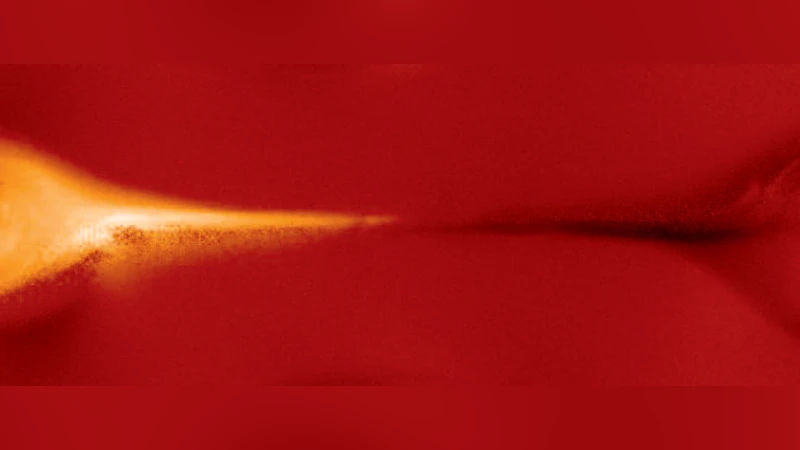
The acceleration of solar flare ions during magnetic reconnection is explored via particle-in-cell simulations that self-consistently follow the motions of both protons and $\alpha$ particles. We demonstrate that the dominant ion heating during reconnection with a guide field (a magnetic component perpendicular to the reconnection plane) results from pickup behavior during the entry into reconnection exhausts. In contrast with anti-parallel reconnection, the temperature increment is dominantly transverse, rather than parallel, to the local magnetic field. The comparison of protons and alphas reveals a mass-to-charge ($M/Q$) threshold in pickup behavior that favors heating of high $M/Q$ ions over protons, which is consistent with impulsive flare observations.
💡 Research Summary
The paper investigates ion acceleration during solar flare magnetic reconnection using fully kinetic particle‑in‑cell (PIC) simulations that self‑consistently follow both protons and α‑particles. The authors focus on guide‑field reconnection, which is the typical configuration in the solar corona, and examine how ions are heated as they enter the reconnection exhausts. A key result is that ions whose mass‑to‑charge ratio (M/Q) exceeds a critical threshold behave like pickup ions: they become demagnetized when crossing the narrow boundary layer at the exhaust edge, acquire a “thermal velocity” comparable to the Alfvén outflow speed, and experience a rapid increase in their magnetic moment μ. This non‑adiabatic pickup leads to strong heating primarily in the direction perpendicular to the local magnetic field (T⊥), whereas ions below the threshold (protons in the present simulations) remain essentially adiabatic and are heated only weakly, mainly in the parallel direction (T∥).
The simulations employ the p3d code with a Harris current‑sheet equilibrium, a guide field Bz = 2 Bx, and a plasma β of 0.2. Protons and a 1 % population of α‑particles (M/Q = 2) are included, with equal initial temperatures. The ion sound Larmor radius sets the exhaust‑boundary thickness, and the crossing time τc is compared to the cyclotron period to derive the non‑adiabatic condition M/Q > 5√(2π) β⁻¹/², which reduces to M/Q > 1 for the chosen parameters. Consequently, protons are marginally adiabatic while α‑particles are non‑adiabatic.
Analysis of particle trajectories shows that α‑particles, upon entering the exhaust from the upstream region, experience a sharp jump in μ and are rapidly accelerated by the transverse electric field Ey. Their velocity distributions downstream develop a ring‑like structure in the plane perpendicular to the guide field, characteristic of pickup behavior. Protons, by contrast, retain their magnetic moment and display only modest heating, primarily in the parallel direction, consistent with adiabatic motion.
Temperature maps reveal that the perpendicular temperature of α‑particles increases by more than a factor of two relative to protons, exceeding the simple mass‑proportional scaling and matching observations of enhanced high‑M/Q ion abundances in impulsive flares. The predicted temperature increments (ΔT⊥ ≈ ½ mα vx² for α‑particles and ΔT∥ ≈ Bx² Bz² vx² for protons) agree reasonably with the simulation results, with minor deviations attributed to a mixture of adiabatic and non‑adiabatic particle populations.
The authors argue that this M/Q‑dependent pickup heating provides a natural explanation for the observed over‑abundance of high‑M/Q ions in impulsive solar flares and for the large T⊥/T∥ anisotropy measured in the extended corona. Energy gains of order 25 keV per nucleon are estimated for typical coronal conditions (B ≈ 50 G, n ≈ 10⁹ cm⁻³), sufficient to account for the energetic ions detected in flare events.
In summary, the study demonstrates that guide‑field magnetic reconnection can act as an efficient ion accelerator through a pickup mechanism that preferentially heats ions with M/Q above a threshold. This process yields strong perpendicular heating, reproduces key observational signatures of impulsive flares, and highlights the importance of kinetic effects and mass‑to‑charge dependence in solar energetic particle generation. Future work should extend the analysis to three dimensions, explore a broader range of ion species, and incorporate electron heating to fully capture the dynamics of flare energy release.
Comments & Academic Discussion
Loading comments...
Leave a Comment