Electron velocity distribution instability in magnetized plasma wakes and artificial electron mass
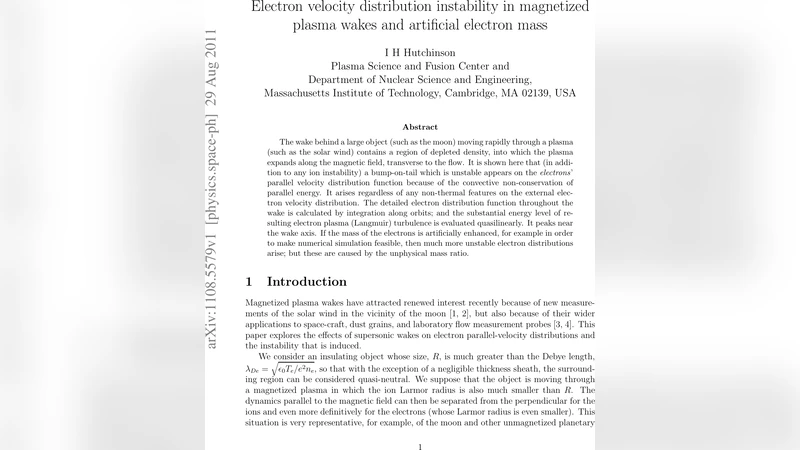
The wake behind a large object (such as the moon) moving rapidly through a plasma (such as the solar wind) contains a region of depleted density, into which the plasma expands along the magnetic field, transverse to the flow. It is shown here that (in addition to any ion instability) a bump-on-tail which is unstable appears on the electrons’ parallel velocity distribution function because of the convective non-conservation of parallel energy. It arises regardless of any non-thermal features on the external electron velocity distribution. The detailed electron distribution function throughout the wake is calculated by integration along orbits; and the substantial energy level of resulting electron plasma (Langmuir) turbulence is evaluated quasilinearly. It peaks near the wake axis. If the mass of the electrons is artificially enhanced, for example in order to make numerical simulation feasible, then much more unstable electron distributions arise; but these are caused by the unphysical mass ratio.
💡 Research Summary
The paper investigates the electron‑scale physics of plasma wakes that form behind a large, magnetized object moving rapidly through a streaming plasma such as the solar wind. While previous work has largely focused on ion dynamics and the macroscopic density depletion that characterises the wake, the authors demonstrate that the electrons experience a fundamentally non‑conservative evolution of their parallel kinetic energy as the plasma expands along the magnetic field lines into the low‑density region. This “convective non‑conservation” of parallel energy inevitably produces a bump‑on‑tail feature in the electron velocity distribution function (VDF), even when the upstream electron VDF is perfectly Maxwellian.
To quantify this effect, the authors integrate the electron equations of motion along characteristic orbits that thread the wake. By mapping each orbit back to the undisturbed upstream plasma, they reconstruct the full two‑dimensional (space‑parallel‑velocity) electron VDF throughout the wake. The resulting VDF exhibits a pronounced high‑velocity bump that is strongest on the wake axis and decays rapidly with transverse distance. The bump satisfies the classic resonance condition for Langmuir (electron plasma) waves, rendering the wake region linearly unstable to electrostatic perturbations.
Using quasilinear theory, the authors estimate the saturation level of the ensuing Langmuir turbulence. The calculated electric‑field energy density peaks near the wake centreline, indicating that a substantial fraction of the free energy stored in the electron bump can be transferred to plasma waves. This turbulence could, in turn, modify electron temperature, cause anomalous resistivity, and contribute to particle acceleration observed in lunar and planetary wakes.
A critical part of the study examines the impact of the “artificial electron mass” technique commonly employed in particle‑in‑cell (PIC) simulations to reduce computational cost. By artificially increasing the electron mass (thereby lowering the electron‑to‑ion mass ratio), the convective non‑conservation effect is amplified: electrons respond more sluggishly to the expanding magnetic‑field‑aligned flow, producing far larger and more numerous bumps in the VDF. Consequently, simulations that employ an unrealistic mass ratio predict a dramatically enhanced electron instability that does not exist in the true physical system. The authors argue that such unphysical results can mislead interpretations of wake dynamics and must be avoided by preserving the realistic mass ratio or by applying appropriate scaling corrections.
In summary, the work establishes that electron‑driven bump‑on‑tail instabilities are an intrinsic feature of magnetized plasma wakes, independent of any upstream non‑thermal electron population. The instability is strongest along the wake axis, where the parallel expansion is greatest, and it can generate significant Langmuir turbulence. Moreover, the study warns that numerical shortcuts—specifically, artificially heavy electrons—can artificially inflate this instability, leading to erroneous conclusions about wake physics. The findings have direct relevance for interpreting in‑situ measurements from lunar, planetary, and cometary wakes, and they provide guidance for designing more faithful kinetic simulations of space plasma environments.
Comments & Academic Discussion
Loading comments...
Leave a Comment