Solar magnetism eXplorer (SolmeX)
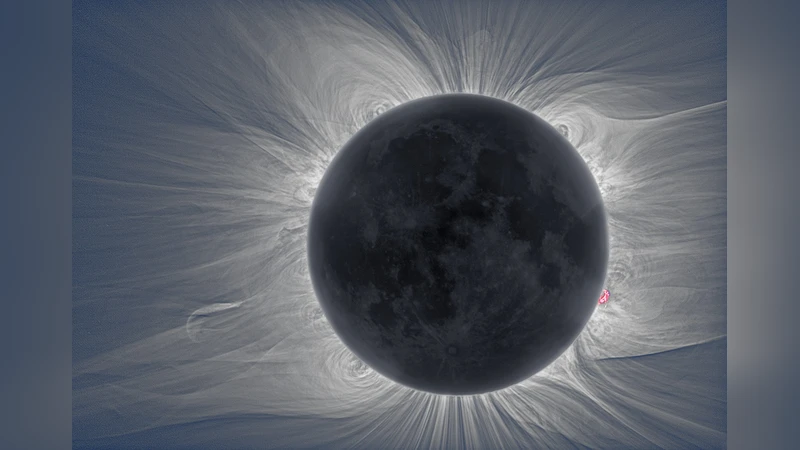
The magnetic field plays a pivotal role in many fields of Astrophysics. This is especially true for the physics of the solar atmosphere. Measuring the magnetic field in the upper solar atmosphere is crucial to understand the nature of the underlying physical processes that drive the violent dynamics of the solar corona – that can also affect life on Earth. SolmeX, a fully equipped solar space observatory for remote-sensing observations, will provide the first comprehensive measurements of the strength and direction of the magnetic field in the upper solar atmosphere. The mission consists of two spacecraft, one carrying the instruments, and another one in formation flight at a distance of about 200m carrying the occulter to provide an artificial total solar eclipse. This will ensure high-quality coronagraphic observations above the solar limb. Solmex integrates two spectro-polarimetric coronagraphs for off-limb observations, one in the EUV and one in the IR, and three instruments for observations on the disk. The latter comprises one imaging polarimeter in the EUV for coronal studies, a spectro-polarimeter in the EUV to investigate the low corona, and an imaging spectro-polarimeter in the UV for chromospheric studies. SOHO and other existing missions have investigated the emission of the upper atmosphere in detail (not considering polarization), and as this will be the case also for missions planned for the near future. Therefore it is timely that SolmeX provides the final piece of the observational quest by measuring the magnetic field in the upper atmosphere through polarimetric observations.
💡 Research Summary
The paper presents the Solar magnetism eXplorer (SolmeX), a dedicated space mission designed to obtain the first comprehensive vector magnetic‑field measurements of the Sun’s upper atmosphere (chromosphere, transition region, and corona). SolmeX consists of two spacecraft flying in formation at a separation of roughly 200 m. The “occulting” spacecraft carries a large disk that blocks the bright solar disk, creating an artificial total eclipse for the science spacecraft. This configuration suppresses stray light in the visible and infrared (IR) bands, enabling high‑precision polarimetric observations of the faint coronal emission, while ultraviolet (UV) and extreme‑ultraviolet (EUV) instruments can observe on‑disk because the photosphere is intrinsically dark at those wavelengths.
The scientific rationale is built around five core questions: (1) What is the magnetic structure of the outer solar atmosphere? (2) How does the magnetic field evolve over the solar cycle? (3) What drives large‑scale eruptions such as flares and coronal mass ejections (CMEs)? (4) How do magnetic processes heat and drive dynamics in the upper atmosphere? (5) How is the magnetic field coupled from the photosphere to the corona? To answer these, SolmeX targets five representative structures—coronal loops, spicules/type‑II jets, small transition‑region loops, CMEs, and the connectivity between the lower atmosphere and the corona.
Five instruments are integrated on the science spacecraft:
-
CUSP (Coronal UV Spectro‑Polarimeter) – a slit spectro‑polarimeter operating in the UV (e.g., Ly‑α 121.6 nm, C IV 154.8 nm). It provides high spectral resolution (R≈30 000) and rapid cadence (≤30 s) to capture the Hanle‑induced linear polarization in transition‑region and coronal lines, crucial for diagnosing magnetic fields of order 1 G.
-
VIRCOR (Visible‑IR Coronagraph) – a coronagraphic spectro‑polarimeter working in visible and IR lines (Fe XIV 530.3 nm, Fe XIII 1074.7 nm). The IR Zeeman effect yields direct measurements of magnetic‑field strength down to ∼1 G with spatial resolution ≈0.5″, allowing the determination of twist, shear, and connectivity of coronal loops.
-
EIP (EUV Imaging Polarimeter) – an imaging polarimeter in the EUV (Fe IX/X 17.1 nm). It records full‑disk images with polarimetric sensitivity, providing maps of the magnetic‑field direction in the low corona together with temperature and density diagnostics from the intensity data.
-
SUSP (Scanning UV Spectro‑Polarimeter) – a UV slit spectro‑polarimeter for on‑disk observations of chromospheric and transition‑region lines (Mg II k 279.6 nm, C II 133.5 nm). It delivers high‑resolution (≈0.3″) magnetic‑field maps of spicules, fibrils, and small loops, probing the coupling between the chromosphere and corona.
-
ChroME (Chromospheric Magnetic Explorer) – a fast‑cadence imaging polarimeter covering H α, Ca II K, and other chromospheric diagnostics. It captures the evolution of magnetic structures in the chromosphere with sub‑second cadence, essential for studying rapid phenomena such as type‑II spicules and wave propagation.
The mission exploits both Zeeman and Hanle effects: Zeeman splitting provides field strength in strong‑field regimes (≥10 G) and linear/circular polarization signatures, while the Hanle effect modifies linear polarization in weak‑field regimes (∼1 G), giving access to field direction. SolmeX aims for a polarimetric sensitivity of 10⁻⁴–10⁻⁵ and a temporal cadence of ≤30 s, surpassing the capabilities of existing ground‑based facilities and previous space missions that have only measured intensity.
Formation‑flight control is a critical technology. The two spacecraft must maintain relative position to within 1 cm and attitude to within 0.1 mrad, achieved through laser ranging, high‑precision thrusters, and autonomous navigation algorithms. The occulter size and shape are optimized for each wavelength band to minimize diffraction and stray‑light leakage.
The mission profile places the spacecraft at the Sun–Earth L1 Lagrange point, providing continuous Sun viewing and a thermally stable environment. A nominal three‑year science phase (covering the rise of solar activity) and a possible three‑year extension (covering solar maximum) are planned, assuming a launch in 2022.
Scientific impact is twofold. First, direct magnetic‑field measurements will validate and calibrate the extensive extrapolation techniques currently used to infer coronal fields from photospheric magnetograms, thereby improving our understanding of coronal heating mechanisms (wave dissipation, reconnection, turbulence). Second, by capturing the magnetic topology of CMEs and flares in real time, SolmeX will provide decisive constraints for space‑weather forecasting models, enhancing prediction of geomagnetic storms that affect Earth’s technological infrastructure.
SolmeX builds on the heritage of the earlier COMPASS proposal, retaining the core spectro‑polarimetric concepts while introducing a novel dual‑spacecraft formation and a new set of instruments (especially ChroME and the imaging polarimeter EIP). The mission thus represents a significant step forward in solar physics, promising to close a long‑standing observational gap and to deliver data that will shape our understanding of magnetised plasmas throughout astrophysics.
Comments & Academic Discussion
Loading comments...
Leave a Comment