Self-organized network design by link survivals and shortcuts
One of the challenges for future infrastructures is how to design a network with high efficiency and strong connectivity at low cost. We propose self-organized geographical networks beyond the vulnerable scale-free structure found in many real systems. The networks with spatially concentrated nodes emerge through link survival and path reinforcement on routing flows in a wireless environment with a constant transmission range of a node. In particular, we show that adding some shortcuts induces both the small-world effect and a significant improvement of the robustness to the same level as in the optimal bimodal networks. Such a simple universal mechanism will open prospective ways for several applications in wide-area ad hoc networks, smart grids, and urban planning.
💡 Research Summary
The paper addresses a fundamental problem in the design of future communication and transportation infrastructures: how to achieve high efficiency and strong connectivity while keeping construction and maintenance costs low. The authors propose a self‑organized network model that departs from the vulnerable scale‑free (SF) structures commonly observed in many real‑world systems. Their approach is grounded in a realistic wireless ad‑hoc setting where each node has a constant transmission range and can only directly communicate with geographically neighboring nodes.
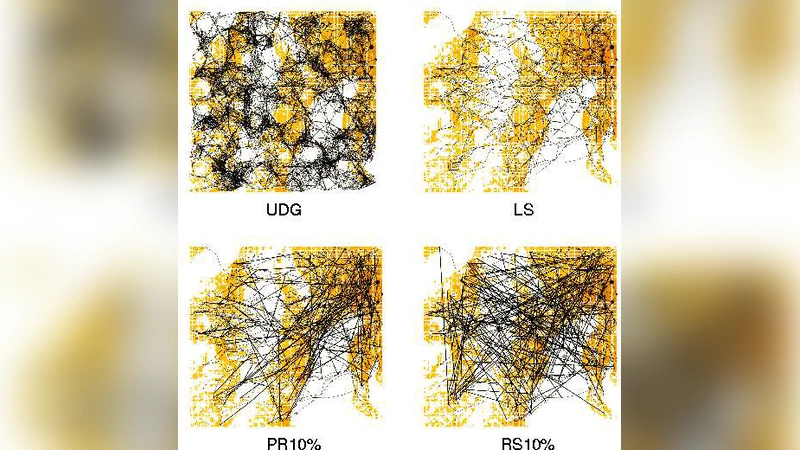
Initial topology – Unit Disk Graph (UDG).
Nodes are uniformly distributed over a normalized 1 × 1 square. A transmission range A = 2.0 (in normalized units) is chosen because it yields a percolation threshold where almost every node belongs to the giant component, as confirmed by a connectivity‑ratio versus A plot. The resulting UDG exhibits an exponential degree distribution with a small maximum degree (≈ log N), i.e., it is not a hub‑dominated network.
Traffic generation and routing.
Two node classes are defined: normal nodes (90 % of the population) and active nodes (10 %). Active nodes generate packets 1 000 times more frequently than normal nodes, mimicking the higher traffic demand of densely populated urban areas. At each discrete time step R = 0.1 Nₜ packets are injected, where Nₜ is the number of surviving nodes. Routing follows a modified greedy algorithm: a packet at node u selects among its one‑hop neighbors the node v that minimizes Euclidean distance to the destination t. Even if all neighbors are farther from t than u, the packet still moves to the closest neighbor, guaranteeing progress. A self‑avoiding rule prevents cycles by remembering visited nodes. This protocol requires only local positional information and works under dynamic topologies.
Self‑organization phase – Link Survival (LS).
Whenever a packet traverses a link, the link’s weight is incremented by 1. After all packets have been forwarded in a time step, each link weight is decreased by 1 with probability p_d = 0.1. If a weight reaches zero, the link is removed; isolated nodes are also deleted. All links start with weight = 5 to avoid premature deletion. The LS process runs for T = 3 × 10⁴ steps, after which the network reaches a steady state: links that are rarely used disappear, while those that carry traffic persist. The resulting LS network is planar, has a low average degree, and its surviving nodes concentrate in high‑population zones.
Shortcut addition – Path Reinforcement (PR) and Random Shortcut (RS).
After LS convergence, the authors enrich the topology with shortcuts. Two strategies are examined:
-
Path Reinforcement (PR). For each packet, a shortcut is added between the packet’s current node and a randomly chosen node that the packet has already visited on its route. The number of shortcuts is set to 10 % or 30 % of the surviving LS links. Because shortcuts connect nodes separated by more than two hops, the network does not degenerate into a quasi‑complete graph. PR therefore creates “highways” that reflect actual traffic flows, especially linking densely populated regions.
-
Random Shortcut (RS). Shortcuts are added between two randomly selected nodes, independent of traffic, at the same 10 % or 30 % ratios. This approach mirrors earlier work showing that random rewiring dramatically improves robustness in SF and multi‑scale quartered networks.
The authors deliberately do not discuss the physical implementation of such shortcuts, assuming future wireless technologies (directional antennas, beamforming, hybrid wired‑wireless links) will enable them.
Evaluation – Efficiency and Robustness.
The three network families (LS, PR, RS) are compared on three metrics:
Connectivity and topology. LS removes nodes in low‑density (mountain or sea) areas, leaving a compact core in high‑density zones. PR and RS retain the LS backbone but overlay longer links.
Communication efficiency. Average shortest‑path length and packet delivery time drop significantly when shortcuts are added. With 30 % shortcuts, the average hop count is reduced by roughly 40 % compared to LS alone, demonstrating a small‑world effect.
Robustness to attacks. Random node or link removal experiments show that LS alone is fragile: removing ≈ 10 % of nodes fragments the giant component. PR and RS, however, maintain a giant component up to ≈ 30 % removal, matching the robustness of optimal bimodal networks (networks with two distinct degree classes). The PR scheme, because shortcuts are placed along frequently used routes, provides multiple alternative paths and mitigates hub‑targeted attacks.
Real‑world relevance. The authors use Japanese statistical population data to assign a realistic exponential distribution of node densities. High‑population cells are visualized with darker shading, and node size reflects the local population. The resulting spatial pattern resembles actual router density maps, suggesting that the model captures essential features of urban communication infrastructures.
Conclusions and future work.
The paper demonstrates that a simple, locally‑driven mechanism—incrementing link weights on traffic, probabilistically pruning unused links, and reinforcing paths with a modest fraction of shortcuts—can self‑organize a network that is both efficient (short paths, low latency) and robust (resilient to random failures and targeted attacks). This contrasts with scale‑free networks that, while having short paths, are highly vulnerable to hub removal. The proposed framework is universal: it does not depend on specific geographic layouts, and the only required information is local neighbor positions and traffic counts.
Future research directions include: (i) designing distributed protocols for dynamic shortcut creation and removal, (ii) extending the model to mobile nodes and energy‑constrained devices, (iii) integrating wired backbones or hybrid architectures, and (iv) applying the methodology to other domains such as smart grids, vehicular ad‑hoc networks, and urban planning where cost‑effective, resilient connectivity is paramount.
Comments & Academic Discussion
Loading comments...
Leave a Comment