Imploding ignition waves: I. one dimensional analysis
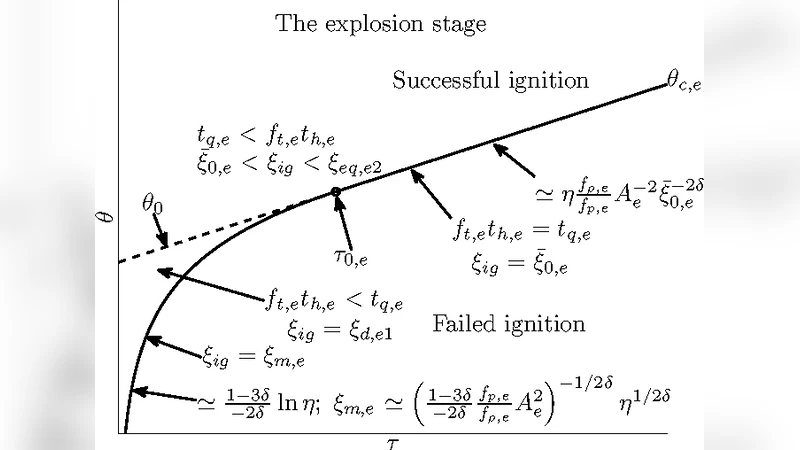
We show that converging spherical and cylindrical shock waves may ignite a detonation wave in a combustible medium, provided the radius at which the shocks become strong exceeds a critical radius, R_c. An approximate analytic expression for R_c is derived for an ideal gas equation of state and a simple (power-law-Arrhenius) reaction law, and shown to reproduce the results of numerical solutions. For typical acetylene-air experiments we find R_c0.1 mm (spherical) and R_c1 mm (cylindrical). We suggest that the deflagration to detonation transition (DDT) observed in these systems may be due to converging shocks produced by the turbulent deflagration flow, which reaches sub (but near) sonic velocities on scales »R_c. Our suggested mechanism differs from that proposed by Zel’dovich et al., in which a fine-tuned spatial gradient in the chemical induction time is required to be maintained within the turbulent deflagration flow. Our analysis may be readily extended to more complicated equations of state and reaction laws. An order of magnitude estimate of R_c within a white dwarf at the pre-detonation conditions believed to lead to Type Ia supernova explosions is 0.1 km, suggesting that our proposed mechanism may be relevant for DDT initiation in these systems. The relevance of our proposed ignition mechanism to DDT initiation may be tested by both experiments and numerical simulations.
💡 Research Summary
The paper investigates how converging spherical and cylindrical shock waves can ignite a detonation in a combustible medium. The authors restrict the analysis to one‑dimensional flow with either spherical (ν = 3) or cylindrical (ν = 2) symmetry and adopt an ideal‑gas equation of state together with a simple power‑law Arrhenius reaction rate, W = κ ρⁿ(1‑λ)ᵐ exp
Comments & Academic Discussion
Loading comments...
Leave a Comment