Strong Variable Ultraviolet Emission from Y Gem: Accretion Activity in an AGB Star with a Binary Companion?
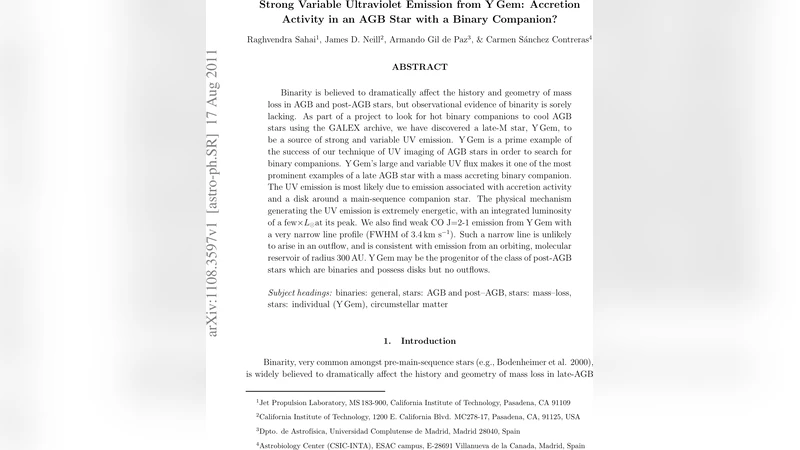
Binarity is believed to dramatically affect the history and geometry of mass loss in AGB and post-AGB stars, but observational evidence of binarity is sorely lacking. As part of a project to look for hot binary companions to cool AGB stars using the GALEX archive, we have discovered a late-M star, Y Gem, to be a source of strong and variable UV emission. Y Gem is a prime example of the success of our technique of UV imaging of AGB stars in order to search for binary companions. Y Gem’s large and variable UV flux makes it one of the most prominent examples of a late AGB star with a mass accreting binary companion. The UV emission is most likely due to emission associated with accretion activity and a disk around a main-sequence companion star. The physical mechanism generating the UV emission is extremely energetic, with an integrated luminosity of a few L(sun) at its peak. We also find weak CO J=2-1 emission from Y Gem with a very narrow line profile (FWHM of 3.4 km/s). Such a narrow line is unlikely to arise in an outflow, and is consistent with emission from an orbiting, molecular reservoir of radius 300 AU. Y Gem may be the progenitor of the class of post-AGB stars which are binaries and possess disks but no outflows.
💡 Research Summary
The authors present a detailed investigation of the late‑type AGB star Y Gem (spectral type M8 III) using archival GALEX ultraviolet (UV) observations and new millimeter CO spectroscopy. Y Gem was serendipitously identified as an unusually bright UV source in the GALEX Medium Imaging Survey (MIS) and All‑Sky Imaging Survey (AIS). Over three epochs spanning 2006–2008, the star exhibited strong far‑UV (FUV) and near‑UV (NUV) fluxes that declined dramatically: the FUV flux dropped from ~16 mJy to ~1.3 mJy (a factor of ~12), while the NUV flux fell from ~5.6 mJy to ~1.0 mJy (a factor of ~5.6). Within each epoch, no short‑term variability was detected on timescales of 10–1500 s, indicating that the observed changes occur on months‑to‑years timescales.
The measured UV fluxes are orders of magnitude higher than expected from the cool photosphere of an M8 AGB star, whose contribution at wavelengths shorter than ~2800 Å is negligible. By comparing the FUV/NUV flux ratio (R_FUV/NUV) across the epochs (5.5, 1.4, 2.2 after correction), the authors infer an effective black‑body temperature for the emitting region ranging from ~3–4 × 10⁴ K at the 2006 peak to ~1.7 × 10⁴ K at the 2008 minimum. The integrated UV luminosity at the peak is estimated to be 2.4–4 L☉, indicating a highly energetic process.
Two principal origins for the UV excess are considered. The first is a hot companion star whose photospheric emission dominates the UV bands. However, the large R_FUV/NUV values and the required temperatures make a simple stellar photosphere unlikely. The second, favored scenario involves accretion‑related activity: material lost by the AGB primary is captured by a companion (presumably a main‑sequence star) and forms an accretion disk. UV emission would then arise from hot accretion shocks either on the disk surface or on the companion’s magnetic poles, analogous to magnetospheric accretion in T Tauri stars but at substantially higher mass‑accretion rates.
To probe the circumstellar environment, the authors obtained CO J=2‑1 spectra with the 10‑m Submillimeter Telescope (SMT). The line is narrow (FWHM ≈ 3.4 km s⁻¹, FWZI ≈ 5 km s⁻¹) and centrally peaked, unlike the broad (>20 km s⁻¹) profiles typical of AGB winds. Assuming the CO originates in a Keplerian disk around a 1 M☉ central mass, the line width implies an orbital velocity of ~1.7 km s⁻¹ and a characteristic radius of ~300 AU. At this distance from a luminous (≈5800 L☉) AGB star, the dust temperature would be ~140 K, consistent with the weak CO emission. The inferred gas mass is modest (~2 × 10⁻⁵ M☉), explaining why no infrared excess from dust is seen in the spectral energy distribution.
The combination of strong, variable UV emission and a narrow CO line points to a binary system where the companion is actively accreting material from the primary’s wind. The UV variability likely reflects changes in the accretion rate rather than stellar flares, as M‑dwarf flares are much shorter (seconds–minutes) and far less luminous. Magnetic activity on a spun‑up companion could contribute, but the observed FUV/NUV ratios are far larger than those seen in chromospheric emission from single giants.
Y Gem thus represents a rare example of a late‑AGB star with a mass‑accreting binary companion, potentially the progenitor of the “disk‑prominent post‑AGB” (dpAGB) class, which shows stable circumbinary disks but little or no outflow. The authors suggest that such binary‑driven accretion may be a common mechanism shaping the aspherical morphologies observed in pre‑planetary nebulae (PPNe) and planetary nebulae (PNe). They advocate follow‑up high‑resolution UV spectroscopy with HST‑COS to disentangle line and continuum contributions, and ALMA imaging to resolve the putative disk, thereby testing the accretion‑disk hypothesis and its role in late stellar evolution.
Comments & Academic Discussion
Loading comments...
Leave a Comment