The spectroscopic evolution of the recurrent nova T Pyxidis during its 2011 outburst I. The optically thick phase and the origin of moving lines in novae
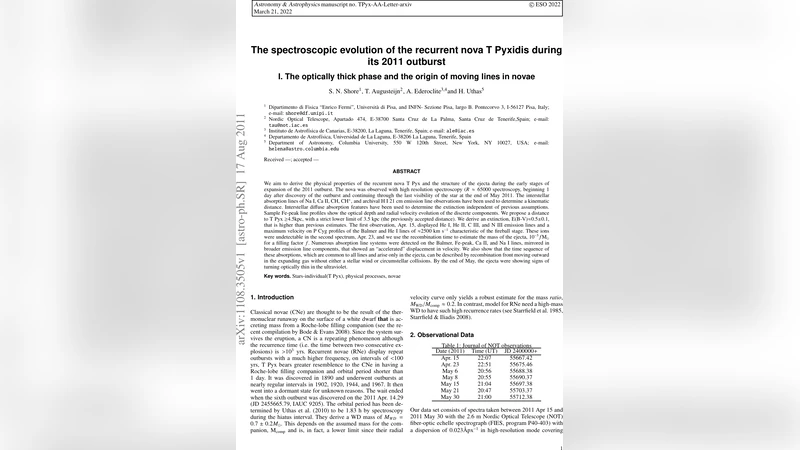
The nova T Pyx was observed with high resolution spectroscopy (R ~ 65000) spectroscopy, beginning 1 day after discovery of the outburst and continuing through the last visibility of the star at the end of May 2011. The interstellar absorption lines of Na I, Ca II, CH, CH$^+$, and archival H I 21 cm emission line observations have been used to determine a kinematic distance. Interstellar diffuse absorption features have been used to determine the extinction independent of previous assumptions. Sample Fe-peak line profiles show the optical depth and radial velocity evolution of the discrete components. We propose a distance to T Pyx $\geq$4.5kpc, with a strict lower limit of 3.5 kpc (the previously accepted distance). We derive an extinction, E(B-V)$\approx0.5\pm$0.1, that is higher than previous estimates. The first observation, Apr. 15, displayed He I, He II, C III, and N III emission lines and a maximum velocity on P Cyg profiles of the Balmer and He I lines of $\approx$2500 km s$^{-1}$ characteristic of the fireball stage. These ions were undetectable in the second spectrum, Apr. 23, and we use the recombination time to estimate the mass of the ejecta, $10^{-5}f$M$_\odot$ for a filling factor $f$. Numerous absorption line systems were detected on the Balmer, Fe-peak, Ca II, and Na I lines, mirrored in broader emission line components, that showed an “accelerated” displacement in velocity. We also show that the time sequence of these absorptions, which are common to all lines and arise only in the ejecta, can be described by recombination front moving outward in the expanding gas without either a stellar wind or circumstellar collisions.
💡 Research Summary
This paper presents a detailed high‑resolution spectroscopic study of the 2011 outburst of the recurrent nova T Pyxidis, covering the period from one day after discovery (April 15, 2011) through the end of May 2011. Using the Nordic Optical Telescope’s FIES echelle spectrograph at a resolving power of R≈65 000, the authors obtained a series of spectra that span the optical range 3635–7364 Å (with additional medium‑resolution coverage from 3680–7300 Å).
The first spectrum, taken on JD 2455667 (April 15), displays the classic “fireball” signature: strong He I, He II, C III, and N III emission together with P Cygni absorption troughs in the Balmer and He I lines extending to ≈ 2500 km s⁻¹. By the second epoch (April 23) these high‑ionisation features have vanished, leaving only low‑ionisation Fe‑peak lines, Ca II H&K, and the Na I D doublet. This rapid evolution indicates a recombination time of roughly one week for the outer ejecta.
To constrain the distance, the authors measured interstellar absorption components of Na I D₁/D₂, Ca II K, CH, and CH⁺, all of which show multiple velocity components between +30 and +50 km s⁻¹. They combined these velocities with the LAB 21 cm H I survey and a Galactic rotation curve (Brand & Blitz 1993) to derive a minimum distance of 4.0 kpc. Additional evidence from the symmetric double‑peaked emission profiles of Fe II and
Comments & Academic Discussion
Loading comments...
Leave a Comment