Magnetosphere-ionosphere coupling in Jupiters middle magnetosphere: computations including a self-consistent current sheet magnetic field model
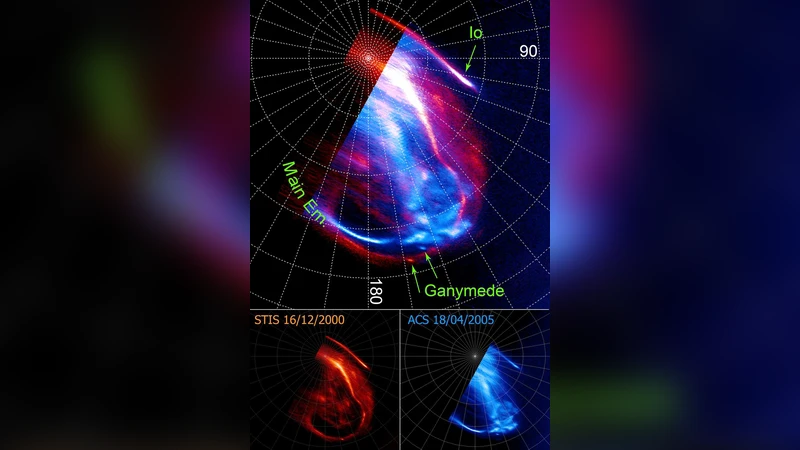
In this paper we consider the effect of a self-consistently computed magnetosdisc field structure on the magnetosphere-ionosphere coupling current system at Jupiter. We find that the azimuthal current intensity, and thus the stretching of the magnetic field lines, is dependent on the magnetosphere-ionosphere coupling current system parameters, i.e. the ionospheric Pedersen conductivity and iogenic plasma mass outflow rate. Overall, however, the equatorial magnetic field profiles obtained are similar in the inner region to those used previously, such that the currents are of the same order as previous solutions obtained using a fixed empirical equatorial field strength model, although the outer fringing field of the current disc acts to reverse the field-aligned current in the outer region. We also find that, while the azimuthal current in the inner region is dominated by hot plasma pressure, as is generally held to be the case at Jupiter, the use of a realistic plasma angular velocity profile actually results in the centrifugal current becoming dominant in the outer magnetosphere. In addition, despite the dependence of the intensity of the azimuthal current on the magnetosphere-ionosphere coupling current system parameters, the location of the peak field-aligned current in the equatorial plane also varies, such that the ionospheric location remains roughly constant. It is thus found that significant changes to the mass density of the iogenic plasma disc are required to explain the variation in the main oval location observed using the Hubble Space Telescope.
💡 Research Summary
The paper presents a self‑consistent model of Jupiter’s middle‑magnetosphere magnetosphere‑ionosphere (M‑I) coupling that incorporates a magnetic‑disc field generated by the iogenic plasma torus. Unlike earlier studies that imposed a fixed magnetic field (either a dipole or an empirical current‑sheet profile), the authors solve for the magnetic field together with the plasma angular velocity using the Hill‑Pontius formulation and the Caudal (1986) magnetodisc model.
Key elements of the model are:
- Hill‑Pontius angular‑velocity equation – the plasma angular velocity ω(ρ) is obtained from a differential equation that balances the ionospheric Pedersen current (parameterized by an effective Pedersen conductance ΣP) against the centrifugal and pressure forces of the outflowing plasma (mass outflow rate Ṁ). The Hill distance ρH, which sets the scale of corotation breakdown, scales as (ΣP/Ṁ)1/4.
- Magnetodisc field – the magnetic field is derived from an Euler‑potential α(r,θ) that satisfies a Poisson‑type equation with a source term g(ρ,α) proportional to the azimuthal current density. The source term includes contributions from hot (∼30 keV) and cold (∼100 eV) plasma populations. Hot plasma pressure dominates the inner region, while the cold plasma’s centrifugal confinement dominates the outer region.
- Current system – the ionospheric Pedersen current iP = 2 ΣP BJ ΩJ ρi (1−ω/ΩJ) maps to a radial current in the equatorial plane iρ = 4 ΣP F e ΩJ ρe (1−ω/ΩJ). The total radial current Iρ = 8π Σ*P ΩJ F e (1−ω/ΩJ) is then differentiated to obtain the field‑aligned current density j∥ = (BJ/2πρe|Bz|) dIρ/dρe. Because the magnetodisc produces a “fringing” field that reverses Bz in the outer region, j∥ also reverses sign, predicting an upward‑to‑downward current transition at large radial distances.
The authors explore the sensitivity of the system to ΣP (ranging from 0.1 to 5 mho) and Ṁ (10⁴–10⁶ kg s⁻¹). Increasing ΣP or decreasing Ṁ pushes the Hill distance outward, allowing the plasma to remain closer to corotation and enhancing the centrifugal current in the outer magnetosphere. Conversely, lower Σ*P or higher Ṁ leads to a stronger azimuthal current driven by hot‑plasma pressure in the inner region.
A central result is that, despite large variations in ΣP and Ṁ, the radial location of the peak field‑aligned current (ρpeak) changes only modestly, implying that the ionospheric footpoint of the main auroral oval remains roughly fixed. This finding contradicts the hypothesis that observed shifts of the main oval (up to ~3° in latitude) can be explained solely by changes in conductance or mass outflow. The model shows that reproducing such latitude shifts would require an order‑of‑magnitude change in the cold‑plasma mass density, far larger than plausible variations in ΣP or Ṁ.
The paper also confirms that in the inner magnetosphere (ρ ≲ 15 RJ) the azimuthal current is dominated by hot‑plasma pressure, consistent with earlier work, while in the outer magnetosphere the centrifugal current becomes dominant when a realistic angular‑velocity profile is used. The reversal of the field‑aligned current in the outer region matches observations of the outer auroral emissions and provides a natural explanation for the observed polarity change.
Overall, by coupling a self‑consistent magnetodisc field to the Hill‑Pontius angular‑velocity solution, the authors achieve a more realistic representation of Jupiter’s M‑I coupling. The work advances our understanding of how ionospheric conductance, plasma source strength, and plasma dynamics jointly control the current system and auroral morphology. It also offers a framework that can be extended to other rapidly rotating magnetized planets, including exoplanets, where similar magnetodisc‑driven coupling may be important for radio emission and auroral signatures.
Comments & Academic Discussion
Loading comments...
Leave a Comment