Bipolar Electric Field Signatures of Reconnection Separatrices for a Hydrogen Plasma at Realistic Guide Fields
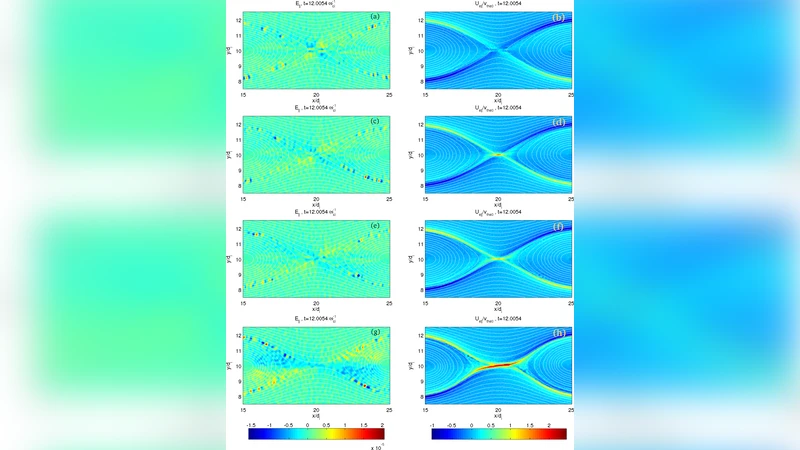
In preparation for the MMS mission we ask the question: how common are bipolar signatures linked to the presence of electron holes along separatrices emanating from reconnection regions? To answer this question, we conduct massively parallel simulations for realistic conditions and for the hydrogen mass ratio in boxes larger than considered in similar previous studies. The magnetic field configuration includes both a field reversal and a out of plane guide field, as typical of many space situations. The guide field is varied in strength from low values (typical of the Earth magnetotail) to high values comparable to the in plane reconnecting field (as in the magnetopause). In all cases, along the separatrices a strong electron flow is observed, sufficient to lead to the onset of streaming instabilities and to form bipolar parallel electric field signatures. The presence of bipolar structures at all guide fields allows the control of the MMS mission to consider the presence of bipolar signatures as a general flag of the presence of a nearby reconnection site both in the nightside and in the dayside of the magnetosphere.
💡 Research Summary
**
This paper addresses a key diagnostic for the NASA Magnetospheric Multi‑Scale (MMS) mission: the occurrence of bipolar parallel electric‑field signatures (often associated with electron holes) along magnetic‑reconnection separatrices. The authors perform a systematic series of fully kinetic, implicit particle‑in‑cell (PIC) simulations using the iPic3D code, employing the physical hydrogen mass ratio (m_i/m_e = 1836) and a realistic Alfvén‑to‑light‑speed ratio (c/v_A = 300). The simulation domain is enlarged to 40 d_i × 20 d_i, which corresponds to roughly 900 electron skin depths (d_e) in the direction of electron motion, thereby eliminating artificial boundary effects that plagued earlier studies with smaller boxes and reduced mass ratios.
The initial equilibrium is a Harris current sheet with a magnetic field reversal in the x‑direction and a uniform guide field B_z added in the out‑of‑plane direction. Six guide‑field strengths are examined: B_z/B_0 = 0, 0.05, 0.1, 0.25, 0.3, and 1.0. Periodic boundaries are used in x, while Dirichlet conditions (E_t = 0, δB_n = 0) are applied in y. The system is 2‑D in space but retains all three velocity components (2D‑3V), allowing the study of in‑plane electron flows along separatrices while keeping the out‑of‑plane dynamics suppressed.
Key findings are:
-
Universal Bipolar Signatures – For every guide‑field case, including the zero‑guide‑field configuration, strong electron streams develop along the separatrices. Their drift speed exceeds the electron thermal speed, triggering streaming instabilities that generate electron holes. These holes manifest as bipolar structures in the parallel electric field (E_∥). The normalized amplitude eE_∥/(m_i c ω_pi) is ≈ 1.5 × 10⁻⁵, matching MMS‑compatible electric fields of 10–30 mV m⁻¹. The spatial extent of the structures is about 16 local Debye lengths, again consistent with satellite observations.
-
Guide‑Field Dependence of Flow Geometry – At low B_z the parallel electron velocity U_e∥ is antisymmetric across the current sheet, producing inward‑directed flows on all four separatrices. As B_z increases, the flow pattern becomes asymmetric: the top‑left and bottom‑right separatrices retain strong inward flow, while the opposite pair reverses to outward flow. This asymmetry explains why earlier small‑box simulations only reported bipolar signatures for strong guide fields; in a sufficiently large domain the electron streams are unimpeded and the instability develops regardless of B_z.
-
Reconnection Rate – The reconnection rate remains robust for all guide fields, decreasing only modestly as B_z grows, consistent with earlier theoretical work that predicts slower reconnection when the guide‑field plasma β falls below unity.
-
Quantitative Agreement with Observations – The simulated electron drift speeds (≈ 10–30 v_the) and electric‑field amplitudes are in good agreement with Cluster and earlier MMS precursor measurements, providing a quantitative benchmark for future MMS data analysis.
The paper’s strengths lie in its realistic parameter set (physical mass ratio, realistic Alfvén speed), the use of a large computational domain that minimizes artificial boundary effects, and a systematic guide‑field scan that resolves a long‑standing discrepancy between simulations and satellite observations. However, several limitations are acknowledged:
- The study is restricted to 2‑D geometry; out‑of‑plane instabilities near the X‑point (e.g., lower‑hybrid drift or Buneman modes) cannot be captured.
- Density and magnetic‑field asymmetries characteristic of the magnetopause are omitted, limiting direct applicability to that environment.
- Only a hydrogen plasma is considered; heavy ion species (e.g., O⁺) that are often present in the magnetosphere are not included.
- No direct statistical comparison with MMS data is performed; the work provides predictions that must be validated once MMS observations become available.
Future work is proposed to extend the simulations to full 3‑D, incorporate magnetopause‑type asymmetries, and include multi‑ion species. The authors also note that even larger supercomputing resources (beyond the 4096 cores used on NASA’s Pleiades) will be required for such endeavors.
In summary, the study convincingly demonstrates that bipolar parallel electric‑field structures are a universal signature of magnetic‑reconnection separatrices for realistic hydrogen plasmas, independent of guide‑field strength. This finding equips the MMS mission with a reliable diagnostic: the detection of bipolar electric fields can be used as a robust flag for the presence of nearby reconnection sites, both in the magnetotail and at the magnetopause.
Comments & Academic Discussion
Loading comments...
Leave a Comment