Spectral properties of transitions between soft and hard state in GX 339-4
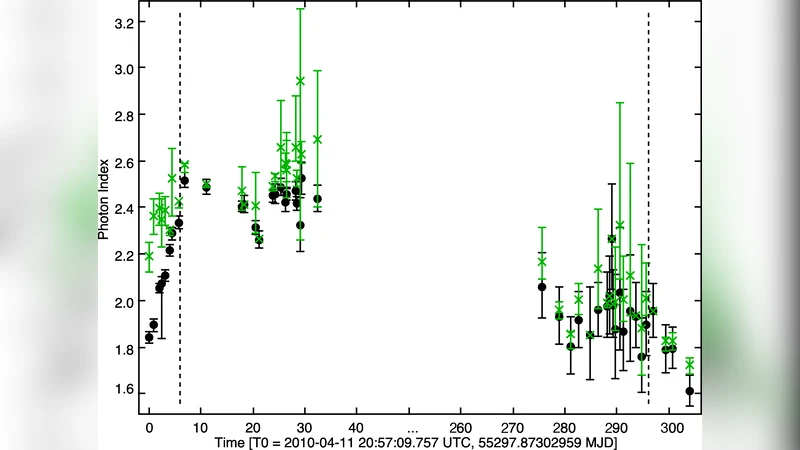
We present a study of the spectral properties during state transition of GX 339-4. Data are taken from the 2010 outburst of GX 339-4, which is densely covered by Rossi X-ray Timing Explorer, providing an excellent coverage of the state transitions between the low/hard state and the high/soft state. We select all observations within a certain hardness ratio range during the soft intermediate state (SIMS). This sample was chosen in such a way to comprise all observations that show a type-B quasi-periodic oscillation (QPO). In addition, we also investigate the spectra of hard intermediate state observations. The spectra, obtained from Proportional Counter Array data in the 10 to 40 keV range, are fitted with a power law and an additional high energy cut-off if needed. We find that the spectra are significantly harder during the SIMS of the soft-to-hard transition than they are during the hard-to-soft transition. This demonstrates that during the SIMS of the soft-to-hard transition not only the luminosity and peak frequencies of type-B QPOs are lower, but that also the photon index is lower, compared to the hard-to-soft transition. Hence, type-B QPOs can be associated to a different spectral shape even though they appear at the same hardness. However, in each branch only certain combinations of centroid frequency and photon index are realised.
💡 Research Summary
This paper presents a detailed investigation of the spectral properties of the black‑hole X‑ray binary GX 339‑4 during its state transitions, focusing on the soft intermediate state (SIMS) observed in both the hard‑to‑soft (rise) and soft‑to‑hard (decay) phases of the 2010 outburst. The authors used the densely sampled Rossi X‑ray Timing Explorer (RXTE) data, selecting all observations that fall within a narrow hardness‑ratio (HR) interval (0.2208–0.2883) and that exhibit a type‑B quasi‑periodic oscillation (QPO). This selection guarantees that the same HR range contains all type‑B QPO detections on both the upper (rising) and lower (decaying) branches of the outburst, allowing a direct comparison of spectra that are nominally at the same hardness.
Power density spectra (PDS) were produced from 16‑second data segments in the 2–15 keV band and fitted with a combination of broad Lorentzians for the noise and narrow Lorentzians (or Gaussians when needed) for the QPOs. Type‑B QPOs were identified by their quality factor and fractional rms (5–10 %). On the upper branch the centroid frequency of the type‑B QPOs clusters around ~5 Hz, whereas on the lower branch it drops to ~2 Hz, indicating a systematic shift in the characteristic oscillation frequency between the two transition directions.
Spectral analysis was confined to the 10–40 keV range of the PCA, where the authors fitted each observation with a simple power‑law model, adding a high‑energy cut‑off when required (mainly for the early hard‑intermediate state). To test whether reflection features around 30 keV could bias the photon index, a power‑law × reflect model was also applied; reflection was only significant in the first few hard‑intermediate observations and negligible for the SIMS data. The key result is that, despite identical HR values, the photon index (Γ) is significantly lower (harder) during the soft‑to‑hard transition (average Γ ≈ 1.95) than during the hard‑to‑soft transition (average Γ ≈ 2.45). Consequently, the high‑energy tail of the spectrum is harder on the decay branch, even though the hardness ratio suggests a similar spectral shape.
The authors interpret this discrepancy as a consequence of differing disc contributions and Comptonisation conditions at different luminosities. During the decay, the disc is cooler and its inner radius likely larger, providing fewer soft seed photons for Compton up‑scattering. This leads to a hotter or more non‑thermal electron population, producing a harder power‑law component. The study therefore demonstrates that hardness ratio alone is insufficient to uniquely characterize the spectral state when the source flux changes substantially; the same HR can correspond to distinct photon‑index intervals depending on whether the source is on the rising or decaying branch.
In the broader context, the work adds to the growing evidence that type‑B QPOs are not tied to a single spectral shape but can appear at the same HR with different photon indices and centroid frequencies. This suggests a more complex coupling between the QPO‑generating region, the corona, and the accretion disc than previously assumed. The findings also have implications for the definition of the “jet line” in hardness‑intensity diagrams, as the jet‑launching conditions may differ between branches even at identical hardness.
Overall, the paper provides a comprehensive, data‑driven comparison of the SIMS on both sides of an outburst, highlighting the importance of considering flux‑dependent spectral changes, QPO properties, and reflection when interpreting state transitions in black‑hole binaries.
Comments & Academic Discussion
Loading comments...
Leave a Comment