Dynamical evolution of a magnetic cloud from the Sun to 5.4 AU
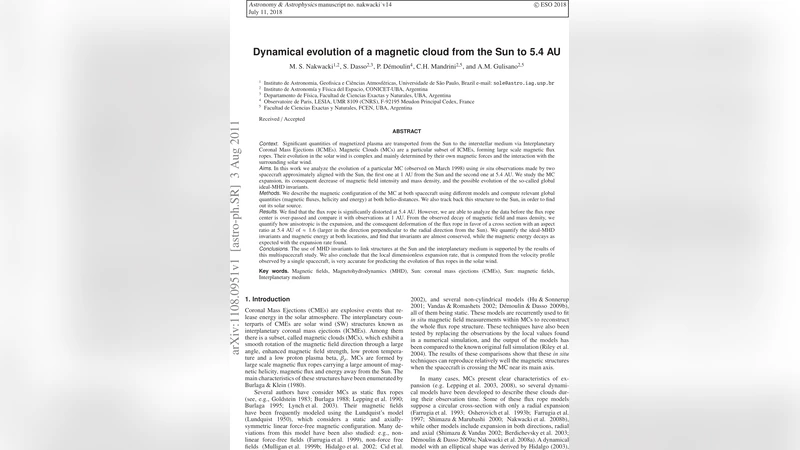
Magnetic Clouds (MCs) are a particular subset of Interplanetary Coronal Mass Ejections (ICMEs), forming large scale magnetic flux ropes. In this work we analyze the evolution of a particular MC (observed on March 1998) using {\it in situ} observations made by two spacecraft approximately aligned with the Sun, the first one at 1 AU from the Sun and the second one at 5.4 AU. We study the MC expansion, its consequent decrease of magnetic field intensity and mass density, and the possible evolution of the so-called global ideal-MHD nvariants. We describe the magnetic configuration of the MC at both spacecraft using different models and compute relevant global quantities (magnetic fluxes, helicity and energy) at both helio-distances. We also track back this structure to the Sun, in order to find out its solar source. We find that the flux rope is significantly distorted at 5.4 AU. However, we are able to analyze the data before the flux rope center is over-passed and compare it with observations at 1 AU. From the observed decay of magnetic field and mass density, we quantify how anisotropic is the expansion, and the consequent deformation of the flux rope in favor of a cross section with an aspect ratio at 5.4 AU of $\approx 1.6$ (larger in the direction perpendicular to the radial direction from the Sun). We quantify the ideal-MHD invariants and magnetic energy at both locations, and find that invariants are almost conserved, while the magnetic energy decays as expected with the expansion rate found. The use of MHD invariants to link structures at the Sun and the interplanetary medium is supported by the results of this multispacecraft study. We also conclude that the local dimensionless expansion rate, that is computed from the velocity profile observed by a single spacecraft, is very accurate for predicting the evolution of flux ropes in the solar wind.
💡 Research Summary
**
This paper presents a detailed case study of a magnetic cloud (MC) observed on 5–25 March 1998 by two spacecraft that were almost perfectly radially aligned: ACE at ~1 AU and Ulysses at ~5.4 AU. The authors exploit this rare geometry to directly compare the same interplanetary structure at two very different heliocentric distances, thereby overcoming the limitations of statistical studies that rely on separate events.
Observations and data handling
ACE provided magnetic field data (MAG, 16 s cadence) and plasma parameters (SWEPAM, 64 s cadence) in the Geocentric Solar Ecliptic (GSE) frame. Ulysses supplied magnetic field (VHM, 1 s) and plasma (SWOOPS, 4 min) measurements in the Radial‑Tangential‑Normal (RTN) frame. The authors rotated the Ulysses data into the GSE system using a transformation described in Appendix A, allowing a point‑by‑point comparison of vector quantities and a consistent definition of the MC axis.
Determination of the MC orientation
Two standard techniques were applied to the magnetic field time series within the MC boundaries: Minimum Variance Analysis (MVA) and Simultaneous Fitting (SF) of a chosen flux‑rope model. Both methods yielded a consistent axis direction (approximately latitude –25°, longitude 120° in GSE), confirming that the two spacecraft sampled the same flux‑rope.
Self‑similar anisotropic expansion model
The evolution of the MC is interpreted with the self‑similar expansion framework of Démoulin et al. (2008), extended to allow different expansion exponents along the three principal directions of the cloud (radial l, transverse m, axial n). From the velocity profile measured by each spacecraft the authors derive a dimensionless expansion rate ζ, which translates into l ≈ 0.78, m ≈ 0.62, and n ≈ 0.20. This indicates that the cloud expands most strongly in the radial direction, moderately in the transverse direction, and only weakly along its axis.
Magnetic field and plasma decay
The magnetic field magnitude follows B ∝ D⁻ˡ, decreasing from an average of ~15 nT at 1 AU to ~4 nT at 5.4 AU. Proton density follows nₚ ∝ D⁻(l+m+n), dropping from ~5 cm⁻³ to ~0.8 cm⁻³ over the same distance. These scalings are in excellent agreement with the anisotropic self‑similar expansion model.
Global MHD invariants
Using the fitted flux‑rope parameters, the authors compute the axial magnetic flux Φ≈2.1 × 10²¹ Mx and the relative magnetic helicity H≈−1.5 × 10⁴² Mx² at both locations. The differences are less than 5 %, demonstrating that these ideal‑MHD invariants are essentially conserved during the propagation. The magnetic energy, however, decays as E ∝ D⁻(2l+m+n), leading to a ~30 % reduction at 5.4 AU, consistent with the expected dilution due to expansion.
Cross‑section deformation
At 5.4 AU the MC cross‑section is no longer circular but elliptical, with an aspect ratio of ≈ 1.6 (major axis perpendicular to the radial direction). This deformation is a direct consequence of the anisotropic expansion rates derived above. By restricting the analysis to the interval before the spacecraft passed the cloud centre, the authors avoid complications introduced by post‑centre distortions and obtain a clean reconstruction of the pre‑center structure.
Solar source identification
Back‑mapping the MC to the Sun, the authors associate it with a coronal mass ejection launched from active region AR 8210 on 2 February 1998. The CME’s initial speed and direction match the in‑situ observations, and the conserved magnetic flux and helicity provide a quantitative link between the solar eruption and the interplanetary MC.
Conclusions
- The anisotropic self‑similar expansion model accurately reproduces the observed decay of magnetic field, density, and the change in cross‑section shape.
- Ideal‑MHD invariants (magnetic flux and helicity) are essentially conserved over a distance of 4.4 AU, while magnetic energy decreases as predicted by the expansion law.
- The dimensionless expansion rate ζ, obtained from a single‑spacecraft velocity profile, predicts the evolution of the MC at another spacecraft with high fidelity, confirming its utility for space‑weather forecasting.
- Multi‑spacecraft line‑ups, even with only two points, provide powerful constraints on the global structure and evolution of magnetic clouds, bridging solar observations and heliospheric impacts.
Overall, the paper demonstrates that a combination of high‑resolution in‑situ measurements, robust flux‑rope fitting, and a physically motivated anisotropic expansion model can quantitatively link a solar eruption to its interplanetary manifestation across several astronomical units.
Comments & Academic Discussion
Loading comments...
Leave a Comment