Causal categories: relativistically interacting processes
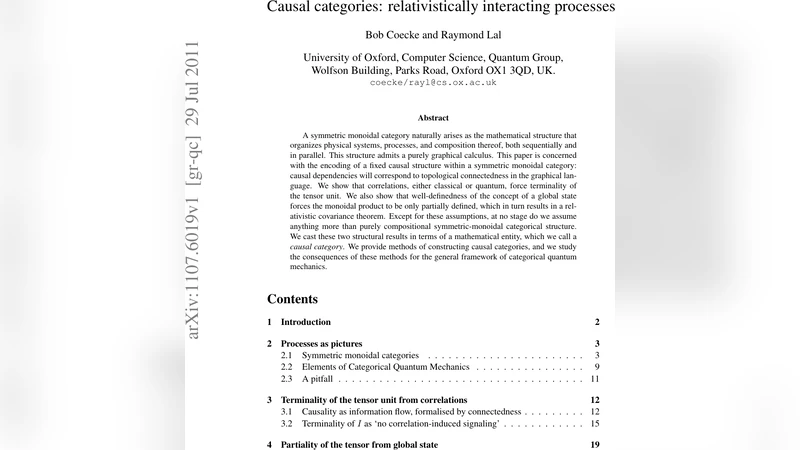
A symmetric monoidal category naturally arises as the mathematical structure that organizes physical systems, processes, and composition thereof, both sequentially and in parallel. This structure admits a purely graphical calculus. This paper is concerned with the encoding of a fixed causal structure within a symmetric monoidal category: causal dependencies will correspond to topological connectedness in the graphical language. We show that correlations, either classical or quantum, force terminality of the tensor unit. We also show that well-definedness of the concept of a global state forces the monoidal product to be only partially defined, which in turn results in a relativistic covariance theorem. Except for these assumptions, at no stage do we assume anything more than purely compositional symmetric-monoidal categorical structure. We cast these two structural results in terms of a mathematical entity, which we call a `causal category’. We provide methods of constructing causal categories, and we study the consequences of these methods for the general framework of categorical quantum mechanics.
💡 Research Summary
The paper develops a new categorical framework called a “causal category” (caucat) that embeds a fixed causal structure directly into the language of symmetric monoidal categories (SMCs). Starting from the well‑established use of SMCs in categorical quantum mechanics (CQM), the authors observe that the two primitive forms of composition—sequential (∘) and parallel (⊗)—already hint at temporal and spatial aspects of physical processes. They formalize this intuition by equating causal dependence with topological connectedness in the graphical calculus of SMCs.
Two central structural results are proved. First, the presence of any non‑trivial correlation—classical or quantum—forces the tensor unit I to be a terminal object. In concrete terms, every morphism f : A → I is unique, which the authors interpret as “no correlation‑induced signalling”. This mirrors the no‑signalling condition familiar from relativistic quantum information, but here it emerges purely from categorical considerations without reference to probabilities or measurements.
Second, the authors show that a globally well‑defined notion of state (a morphism from the tensor product of all systems to I) can only exist if the tensor product ⊗ is not globally defined on all objects. Instead, ⊗ must be a partially defined operation, allowed only for those pairs of objects whose causal relationship permits a joint system. This partiality yields a relativistic covariance theorem: changing the underlying causal graph (e.g., by a Lorentz transformation) does not alter the form of the global state, because the state is defined only on causally admissible composites.
These two properties define a causal category: an SMC where (i) the unit object is terminal, and (ii) the monoidal product is partial, respecting a given causal graph. The paper then investigates how causal categories relate to other categorical structures, especially dagger‑compact categories that underpin much of CQM. It is shown that the dagger structure is generally incompatible with the terminality of the unit and the partiality of ⊗; consequently, many of the familiar compact‑closed identities break down in a causal category. Nonetheless, essential CQM features such as the state‑effect duality and the uniqueness of scalars survive.
To construct causal categories, the authors present three systematic methods. The first “normalizing” step modifies any SMC so that its unit becomes terminal, essentially by quotienting out non‑terminal behaviour. The second method, called “carving”, starts from a causal set (causet) and removes those tensor products that would violate the causal ordering, thereby enforcing partiality. The third method combines a given causet with an existing SMC to produce a new causal category directly, preserving as much of the original monoidal structure as the causet permits. These constructions illustrate how one can start from familiar quantum or classical process theories and systematically embed relativistic causal constraints.
Finally, the authors discuss the implications for the broader program of categorical quantum mechanics. By showing that the core algebraic machinery of CQM can be retained (states, effects, scalars) while simultaneously enforcing relativistic causality, the paper bridges two traditionally separate lines of research: the abstract diagrammatic treatment of quantum processes and the operational constraints of relativistic space‑time. The causal category framework thus offers a unified language for reasoning about quantum information protocols, quantum field‑theoretic processes, and even classical probabilistic systems under relativistic constraints. It opens avenues for further work on compositional models of quantum gravity, causal inference in quantum networks, and the development of programming languages that respect both quantum mechanics and relativistic causality.
Comments & Academic Discussion
Loading comments...
Leave a Comment