Measurement of the cosmic-ray antiproton spectrum at solar minimum with a long-duration balloon flight over Antarctica
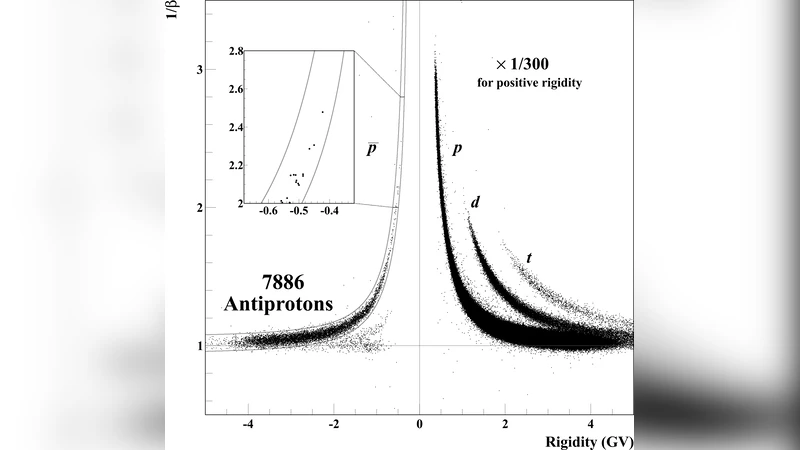
The energy spectrum of cosmic-ray antiprotons from 0.17 to 3.5 GeV has been measured using 7886 antiprotons detected by BESS-Polar II during a long-duration flight over Antarctica near solar minimum in December 2007 and January 2008. This shows good consistency with secondary antiproton calculations. Cosmologically primary antiprotons have been investigated by comparing measured and calculated antiproton spectra. BESS-Polar II data show no evidence of primary antiprotons from evaporation of primordial black holes.
💡 Research Summary
The BESS‑Polar II experiment performed a long‑duration balloon flight over Antarctica during the solar minimum of December 2007–January 2008, collecting 7 886 antiproton ( p̄) events in the kinetic energy range 0.17–3.5 GeV. The instrument consists of a 0.8 T superconducting solenoid, 52 drift‑chamber tracking layers, upper and lower time‑of‑flight (TOF) scintillators, a middle TOF for low‑energy particles, and a silica‑aerogel Cherenkov counter (ACC) that suppresses electron and muon backgrounds by >10⁴. The overall geometric acceptance is 0.133 m² sr at 0.2 GeV and 0.159 m² sr at 2 GeV; the rigidity resolution is 0.4 % at 1 GV with a maximum detectable rigidity of 240 GV.
During the 24.5‑day flight at 34–38 km altitude (average residual atmosphere 5.8 g cm⁻²), 4.7 × 10⁹ triggers were recorded. After applying dE/dx, ACC, and β‑1 selections, a clean antiproton sample was obtained with negligible electron/muon contamination (0–2.3 %). The detection efficiency for antiprotons drops from 81.4 % at 0.2 GeV to 60.0 % at 2 GeV, while the survival probability through the residual atmosphere rises from 85.6 % to 89.8 %. Atmospheric secondary production contributes 17.6 %–27.6 % of the observed counts, depending on energy.
The resulting top‑of‑atmosphere (TOA) fluxes range from (3.56 ± 0.88 ± 0.42) × 10⁻³ (m⁻² sr⁻¹ s⁻¹ GeV⁻¹) at 0.20 GeV to (1.64 ± 0.18 ± 0.22) × 10⁻² (m⁻² sr⁻¹ s⁻¹ GeV⁻¹) at 3.28 GeV. Statistical uncertainties are ≤5 %, while the dominant systematic errors arise from atmospheric subtraction (≈18 %) and detection efficiency (≈10 %).
The measured spectrum was compared with several secondary‑production models: Mitsui et al. (force‑field modulation 600 MV), Bieber et al. (drift model with A < 0, tilt angle 15°), GALPROP, and others. χ² values between 0.5 and 1.7 indicate good agreement in both shape and absolute normalization when the models are normalized at the 2 GeV peak. Unlike the earlier BESS95+97 data, which showed a slight low‑energy flattening, BESS‑Polar II exhibits a smooth decline, reflecting the much larger statistics (14–30× more events below 1 GeV).
To search for a primary component, the authors fitted the difference between the data and the best‑fit secondary model with a primordial black‑hole (PBH) evaporation spectrum (Maki et al.). The resulting local PBH evaporation rate is R = 5.0 × 10⁻⁴ pc⁻³ yr⁻¹ with a 1σ uncertainty of ±4.0 × 10⁻⁴, far below the R ≈ 4.2 × 10⁻³ pc⁻³ yr⁻¹ suggested by BESS95+97. A 90 % confidence upper limit of R ≈ 1.2 × 10⁻³ pc⁻³ yr⁻¹ is obtained, essentially independent of solar‑modulation parameters (500–700 MV). Consequently, the BESS‑Polar II data exclude a PBH‑induced primary antiproton flux at the >9σ level.
In summary, the BESS‑Polar II long‑duration Antarctic flight provides the most precise measurement to date of the cosmic‑ray antiproton spectrum in the 0.2–3.5 GeV range. The results confirm that the observed antiprotons are overwhelmingly secondary products of cosmic‑ray interactions, with no detectable contribution from exotic primary sources such as dark‑matter annihilation or PBH evaporation. Future missions targeting lower energies (≲100 MeV) and longer exposure will be required to push the limits on primordial black‑hole evaporation even further.
Comments & Academic Discussion
Loading comments...
Leave a Comment