Seepage flow-stability analysis of the riverbank of Saigon river due to river water level fluctuation
The Saigon River, which flows through the center of Ho Chi Minh City, is of critical importance for the development of the city as forms as the main water supply and drainage channel for the city. In
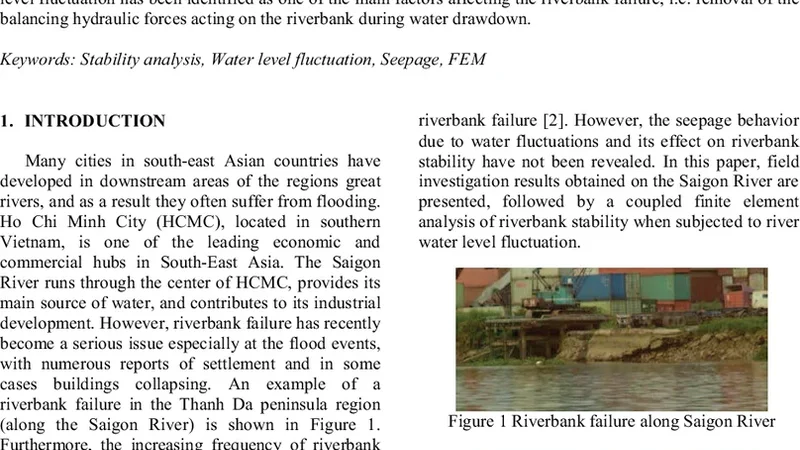
The Saigon River, which flows through the center of Ho Chi Minh City, is of critical importance for the development of the city as forms as the main water supply and drainage channel for the city. In recent years, riverbank erosion and failures have become more frequent along the Saigon River, causing flooding and damage to infrastructures near the river. A field investigation and numerical study has been undertaken by our research group to identify factors affecting the riverbank failure. In this paper, field investigation results obtained from multiple investigation points on the Saigon River are presented, followed by a comprehensive coupled finite element analysis of riverbank stability when subjected to river water level fluctuations. The river water level fluctuation has been identified as one of the main factors affecting the riverbank failure, i.e. removal of the balancing hydraulic forces acting on the riverbank during water drawdown.
💡 Research Summary
This paper investigates the stability of the Saigon River bank in Ho Chi Minh City under the influence of river water level fluctuations, combining extensive field investigations with coupled finite‑element analyses. Five representative sites along the river were surveyed; standard penetration tests, cone penetration tests, and laboratory triaxial tests provided detailed soil profiles. The upper three meters consist of low‑permeability silty‑clay (unit weight 1.6–1.8 g/cm³, shear strength 30–45 kPa, hydraulic conductivity ≈1 × 10⁻⁸ m/s), overlain by a medium‑sand layer (unit weight 1.9 g/cm³, shear strength 60–80 kPa, hydraulic conductivity ≈5 × 10⁻⁶ m/s).
A two‑dimensional PLAXIS model was constructed with three material layers (water, silty‑clay, sand) and a rigid bedrock foundation. The Mohr‑Coulomb failure criterion and a nonlinear elastic‑plastic constitutive model were assigned to each soil. The “Seepage‑Stability” module enabled a fully coupled seepage‑mechanics analysis. Water‑level fluctuations observed in the field—an increase of up to 2 m followed by a drawdown of 1.5 m over a 48‑hour cycle—were imposed as boundary conditions. The analysis tracked pore‑water pressure, effective stress, shear‑strength reduction, and factor of safety (FOS) over time.
Results show that rapid drawdown dramatically reduces hydraulic pressure on the bank, causing a sudden drop in total stress and a corresponding rise in pore‑water suction within the low‑permeability clay. Effective stress therefore decreases, shear‑strength drops by up to 30 %, and the FOS falls from about 1.2 in the high‑water stage to below 1.0 when the water level recedes by more than 0.5 m. This creates a critical window where the bank is highly susceptible to failure. Conversely, water‑level rise temporarily increases external hydraulic pressure, providing a short‑term stabilising effect, but prolonged saturation leads to swelling of the clay and a gradual loss of shear resistance.
Sensitivity analyses reveal that the bank’s stability is most sensitive to the shear‑strength parameters of the clay layer; reducing cohesion below 20 kPa triggers rapid FOS decline. Hydraulic conductivity also influences the response: a lower conductivity (≈10⁻⁹ m/s) delays pore‑pressure dissipation, mitigating the drawdown effect, whereas higher conductivity accelerates destabilisation.
Based on these findings, the authors recommend a suite of mitigation measures: (1) Strengthening the clay layer through grouting, cement mixing, or geotextile reinforcement to raise shear strength; (2) Installing vertical drainage wells or horizontal drainage blankets to relieve negative pore pressures during drawdown; (3) Implementing real‑time water‑level and pore‑pressure monitoring with early‑warning thresholds; and (4) Incorporating dynamic hydraulic loading due to water‑level changes into bank‑protection design standards.
The study concludes that river water level fluctuations are a primary driver of Saigon River bank failures, and that coupled seepage‑stability finite‑element modelling, calibrated with site‑specific geotechnical data, is essential for accurate risk assessment and the design of effective countermeasures. Future work should extend the analysis to three‑dimensional models, consider anisotropic soil behaviour, and evaluate combined loading scenarios involving rainfall‑induced runoff and flood events.
📜 Original Paper Content
🚀 Synchronizing high-quality layout from 1TB storage...