Intelligent escalation and the principle of relativity
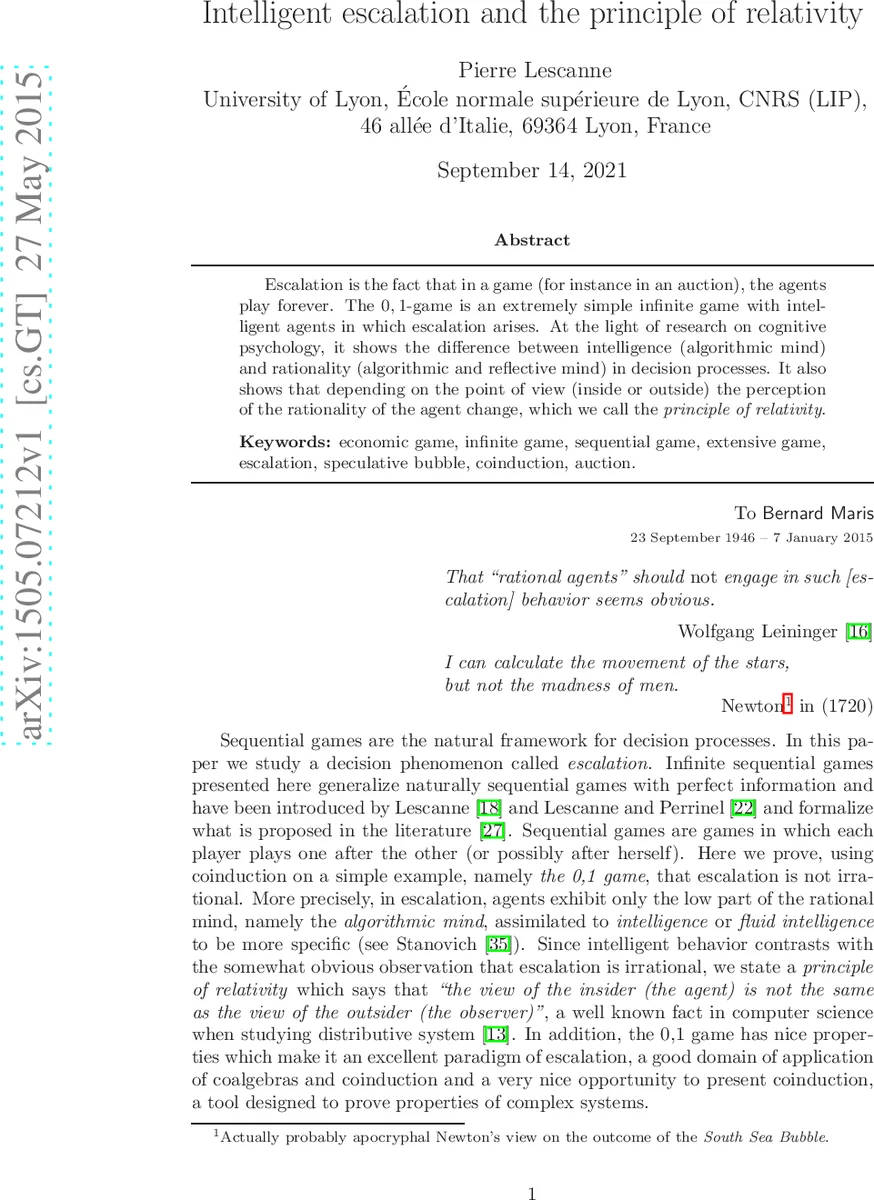
Escalation is the fact that in a game (for instance in an auction), the agents play forever. The $0,1$-game is an extremely simple infinite game with intelligent agents in which escalation arises. It shows at the light of research on cognitive psychology the difference between intelligence (algorithmic mind) and rationality (algorithmic and reflective mind) in decision processes. It also shows that depending on the point of view (inside or outside) the rationality of the agent may change which is proposed to be called the principle of relativity.
💡 Research Summary
The paper “Intelligent Escalation and the Principle of Relativity” investigates the phenomenon of escalation—continuous play without termination—in infinite sequential games, using the extremely simple 0‑1 game as a case study. Traditional game theory treats escalation as irrational because it extrapolates finite‑game reasoning (backward induction) to infinite settings, assuming continuity that does not hold. The author critiques this “cut‑and‑extrapolate” approach and proposes coinduction as the proper logical tool for reasoning about infinite structures.
The 0‑1 game involves two agents, A and B, each repeatedly choosing between two actions: “down” (d) or “right” (r). Formally, the game is a final coalgebra satisfying the isomorphism
Game ≅ ℝ^P + P × Game × Game
where P = {A, B}. Strategy profiles are similarly defined as a final coalgebra:
StratProf ≅ ℝ^P + P × Choice × StratProf × StratProf
with Choice = {d, r}. This coalgebraic formulation allows the author to treat both finite and infinite games uniformly.
Using coinduction, the paper demonstrates that there exist infinite strategy profiles in which both players always choose “continue” (the r‑branch) indefinitely. These profiles satisfy the definition of a subgame‑perfect equilibrium (SPE) because at every finite node the local choice is optimal given the continuation. Hence, from the perspective of the algorithmic mind—purely computational, step‑by‑step optimization—the escalation is rational.
The author then distinguishes two layers of rationality inspired by cognitive psychology: (1) the algorithmic mind, which performs immediate optimal calculations, and (2) the reflective mind, which evaluates one’s own reasoning from a meta‑level and can recognize long‑term consequences. In escalation scenarios, the internal agent operates only with the algorithmic mind, justifying the “always continue” strategy, while an external observer, equipped with a reflective stance, judges the same behavior as irrational.
This divergence of viewpoints is formalized as the “principle of relativity”: the rationality assessment of an agent depends on whether it is made from the insider’s (agent’s) perspective or the outsider’s (observer’s) perspective. The principle mirrors known results in distributed computing where internal and external views of a system differ.
Beyond the theoretical contribution, the paper connects escalation to real‑world economic phenomena such as bubbles, crashes, and volatility bursts, which occur across multiple time scales and cannot be captured by models that assume smooth continuity. By applying coinductive reasoning, the author argues that economists can better model these inherently non‑continuous processes.
The structure of the paper proceeds as follows: Section 2 introduces infinite games and infinite strategy profiles via coalgebraic definitions; Section 3 details the 0‑1 game; Sections 4 and 5 develop equilibrium concepts and prove, using coinduction, the existence of escalating SPEs; Section 6 discusses the nature of escalation; Section 7 interprets the findings through cognitive science, emphasizing the algorithmic versus reflective mind distinction; the Appendix treats finite 0‑1 games and finite strategy profiles.
Overall, the work makes three major contributions: (1) it shows that escalation can be a rational outcome when agents rely solely on algorithmic reasoning; (2) it introduces the principle of relativity to capture the dependence of rationality judgments on perspective; and (3) it demonstrates that coinduction provides a robust framework for analyzing infinite games, offering a bridge between formal game theory and empirical observations of economic bubbles. The paper thus re‑frames escalation from a pathological anomaly to an intelligible, perspective‑dependent rational behavior.
Comments & Academic Discussion
Loading comments...
Leave a Comment