Existence of Equilibrium Points and their Linear Stability in the Generalized Photogravitational Chermnykh-Like Problem with Power-law Profile
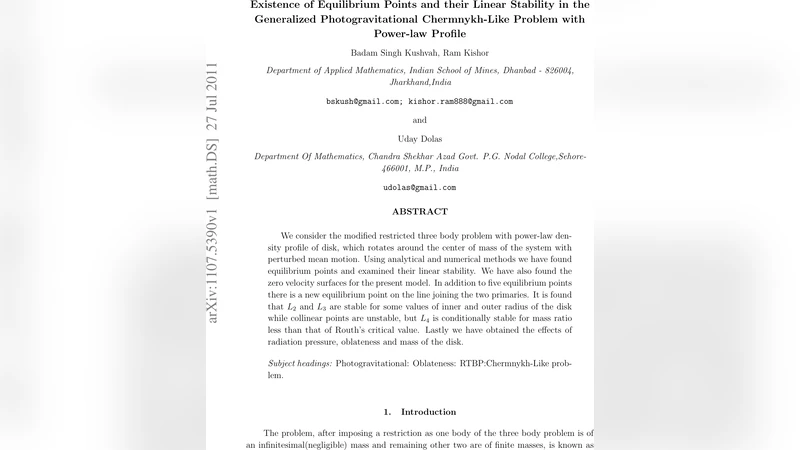
We consider the modified restricted three body problem with power-law density profile of disk, which rotates around the center of mass of the system with perturbed mean motion. Using analytical and numerical methods we have found equilibrium points and examined their linear stability. We have also found the zero velocity surfaces for the present model. In addition to five equilibrium points there is a new equilibrium point on the line joining the two primaries. It is found that $L_2$ and $L_3$ are stable for some values of inner and outer radius of the disk while collinear points are unstable, but $L_4$ is conditionally stable for mass ratio less than that of Routh’s critical value. Lastly we have obtained the effects of radiation pressure, oblateness and mass of the disk.
💡 Research Summary
The paper investigates a generalized photogravitational Chermnykh‑like restricted three‑body problem (RTBP) in which a thin disk with a power‑law density profile (ρ∝r³) rotates around the centre of mass of the two primaries. The larger primary is a radiating body, the smaller one is an oblate spheroid (oblateness coefficient A₂), and the disk’s gravitational field modifies the mean motion of the primaries to a perturbed value n>1. After normalising the total mass (G(m₁+m₂)=1) and the distance between the primaries to unity, the authors derive the equations of motion in a rotating frame, including Coriolis terms, the effective potential Ω, and the Jacobi constant C=−(ẋ²+ẏ²)+2Ω. The potential Ω contains contributions from the Newtonian attraction of the primaries, the radiation pressure factor q₁=1−β (β being the radiation‑pressure coefficient), the oblateness term −(3/2)µA₂/r₂⁵, and the disk’s gravitational potential V and its radial force f_b(r), which depend on the inner and outer radii a and b of the disk and involve logarithmic and inverse‑power terms.
Equilibrium points are obtained by solving Ωₓ=Ω_y=0. For collinear points (y=0) the problem reduces to a tenth‑order algebraic equation K(x)=0. The authors split the x‑axis into four intervals relative to the primaries (x>1−µ, 0≤x<1−µ, −µ<x<0, x<−µ) and treat the absolute‑value signs accordingly. Assuming the mass parameter µ≪1, they expand the distance variable ρ in a series of µ¹⁄⁴ and substitute into K(x), yielding polynomial equations (13)–(23) with coefficients B_i, C_i that contain n, β, A₂, a, b. This analysis reveals the classical five Lagrange points (L₁, L₂, L₃, L₄, L₅) and an additional equilibrium point located on the line joining the two primaries, whose existence depends on the disk parameters.
Linear stability is examined by linearising the equations about each equilibrium point, leading to the characteristic equation
λ⁴+(4n²−Ωₓₓ−Ω_y_y)λ²+(ΩₓₓΩ_y_y−Ωₓ_y²)=0. The discriminant Δ and the sign of the λ² term determine stability. The study finds that the collinear points L₁, L₂, L₃ are generally unstable, but L₂ and L₃ become linearly stable for certain ranges of the inner and outer disk radii (a, b) where the disk’s additional gravity balances the centrifugal and tidal forces. The triangular points L₄ and L₅ are conditionally stable only when the mass ratio µ is below Routh’s critical value (≈0.03852). Increasing the radiation‑pressure coefficient β or the oblateness A₂ reduces the stability domain of L₄/L₅. The newly discovered collinear point is typically unstable, though limited stability windows may appear for specific disk configurations.
Numerical simulations illustrate zero‑velocity surfaces for various parameter sets, showing how the disk mass and radii reshape the forbidden regions and shift the equilibrium locations. Larger disk mass (larger n) pushes the classical Lagrange points farther from the centre and accentuates the new equilibrium point between the primaries. The authors also discuss astrophysical implications, such as resonance capture in Kuiper‑belt objects, planet formation in protoplanetary disks, and the dynamics of extrasolar planetary systems where massive circumstellar disks are present.
In summary, the inclusion of a power‑law disk, radiation pressure, and oblateness introduces rich dynamical behaviour into the RTBP. The paper provides analytical expressions for the equilibrium positions, delineates the parameter regimes for linear stability, and highlights the significant role of disk parameters in modifying classical three‑body dynamics, offering useful insights for celestial mechanics and astrophysical applications.
Comments & Academic Discussion
Loading comments...
Leave a Comment