The final parsec problem: aligning a binary with an external accretion disc
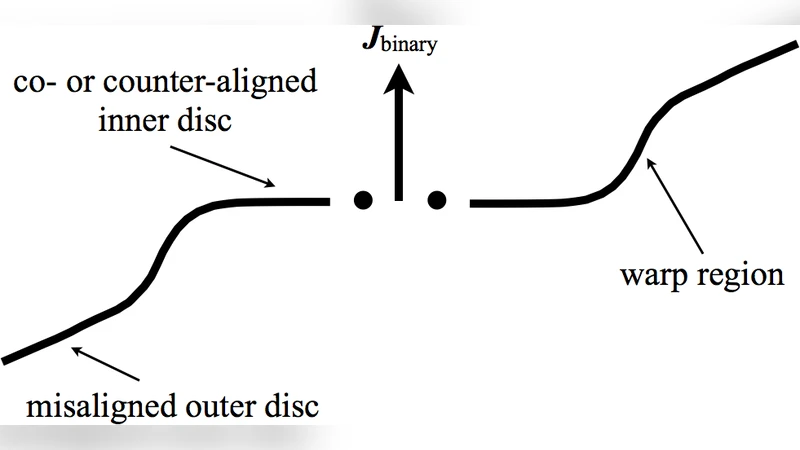
We consider the interaction between a binary system (e.g. two supermassive black holes or two stars) and an external accretion disc with misaligned angular momentum. This situation occurs in galaxy merger events involving supermassive black holes, and in the formation of stellar–mass binaries in star clusters. We work out the gravitational torque between the binary and disc, and show that their angular momenta J_b, J_d stably counteralign if their initial orientation is sufficiently retrograde, specifically if the angle theta between them obeys cos(theta) < -J_d/2J_b, on a time short compared with the mass gain time of the central accretor(s). The magnitude J_b remains unchanged in this process. Counteralignment can promote the rapid merger of supermassive black hole binaries, and possibly the formation of coplanar but retrograde planets around stars in binary systems.
💡 Research Summary
The paper investigates the dynamical interaction between a binary system—either a pair of super‑massive black holes (SMBHs) or two stars—and an external accretion disc whose angular momentum vector is misaligned with that of the binary. This configuration is expected in galaxy mergers that produce SMBH binaries and in the formation of stellar binaries within dense clusters, where there is no a‑priori reason for the binary and disc to be coplanar.
The authors start by modelling the binary as two point masses, M₁≫M₂, with the secondary orbiting at radius a in the (R, φ) plane. They consider a test particle in the disc at a much larger radius R≫a. By expanding the binary’s gravitational potential to second order in the small parameters a/R and M₂/M₁, they isolate the axisymmetric (m = 0) term, which represents the long‑term secular effect of the binary on the disc. This term can be interpreted as a ring of mass M₂ uniformly spread over the secondary’s orbit. The resulting effective potential (eq. 4) yields an orbital frequency Ω and a vertical epicyclic frequency ν; their difference Ωₚ = Ω − ν is the nodal precession rate of a disc ring.
The derived precession frequency (eq. 7) scales as Ωₚ ∝ M₂ a² R⁻⁵ (M₁+M₂)¹ᐟ², i.e. it falls off more steeply with radius (R⁻⁷ᐟ²) than the Lense–Thirring (LT) precession (R⁻³). Crucially, the precession rate is multiplied by |cos θ|, where θ is the inclination between the binary angular momentum J_b and the disc angular momentum J_d. Thus the sign of the torque does not depend on whether the disc is prograde (θ<π/2) or retrograde (θ>π/2); only the magnitude changes.
Because Ωₚ varies strongly with radius, inner disc annuli precess faster than outer ones, producing differential precession. Viscous stresses in the disc dissipate the resulting warp, exerting a back‑reaction torque on the binary. The torque can be written in the same form as for LT precession (eq. 9):
dJ_b/dt = −K₁ (J_b × J_d) − K₂
Comments & Academic Discussion
Loading comments...
Leave a Comment