The Hanle Effect of the Hydrogen Ly-alpha Line for Probing the Magnetism of the Solar Transition Region
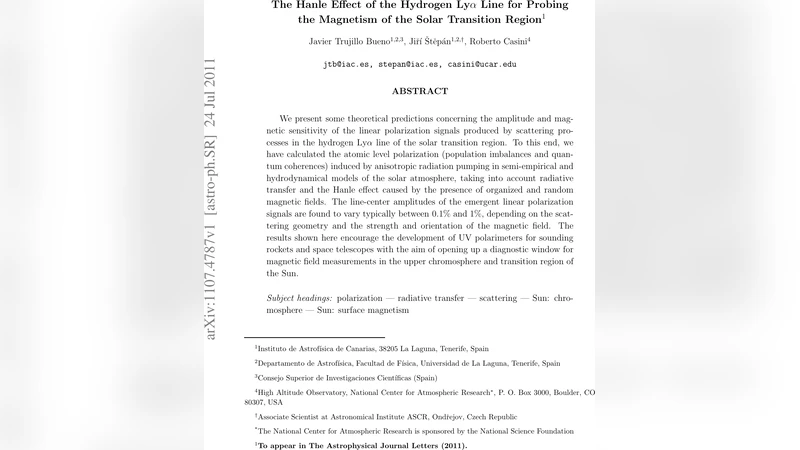
We present some theoretical predictions concerning the amplitude and magnetic sensitivity of the linear polarization signals produced by scattering processes in the hydrogen Ly-alpha line of the solar transition region. To this end, we have calculated the atomic level polarization (population imbalances and quantum coherences) induced by anisotropic radiation pumping in semi-empirical and hydrodynamical models of the solar atmosphere, taking into account radiative transfer and the Hanle effect caused by the presence of organized and random magnetic fields. The line-center amplitudes of the emergent linear polarization signals are found to vary typically between 0.1% and 1%, depending on the scattering geometry and the strength and orientation of the magnetic field. The results shown here encourage the development of UV polarimeters for sounding rockets and space telescopes with the aim of opening up a diagnostic window for magnetic field measurements in the upper chromosphere and transition region of the Sun.
💡 Research Summary
The paper presents a comprehensive theoretical study of the linear polarization produced by scattering processes in the hydrogen Lyman‑α (Ly α) line formed in the solar transition region, and demonstrates how the Hanle effect can be exploited to diagnose magnetic fields in this elusive layer. The authors begin by emphasizing the importance of probing the magnetic structure of the upper chromosphere and transition region, where the plasma changes from being gas‑pressure dominated to magnetically dominated. Traditional magnetic diagnostics based on the Zeeman effect are ineffective in the far‑UV because the Zeeman splitting is tiny compared with the Doppler width, making the circular polarization (Stokes V) and the quadratic linear polarization (Stokes Q,U) essentially undetectable.
Instead, the paper focuses on the Hanle effect, which modifies the atomic level alignment created by anisotropic radiation pumping. In the case of Ly α, the only level that can be aligned is the upper 2p ³⁄₂ level (j = 3⁄2, Landé factor g = 4⁄3). Anisotropy of the incident radiation field, quantified by the ratio (\bar J^{2}{0}/\bar J^{0}{0}), induces population imbalances and quantum coherences among the magnetic sub‑states. The authors compute this anisotropy using two atmospheric models: the semi‑empirical FAL‑C model and the time‑dependent 1‑D hydrodynamical model of Carlsson & Stein. Both models show that, in the transition‑region height (≈ 2200 km), the source function decreases sharply with height, producing a negative anisotropy of order –0.02 to –0.05. This negative value means that the incoming radiation is predominantly horizontal, leading to a negative Stokes Q signal in the absence of magnetic fields.
The radiative transfer problem is solved under the complete frequency redistribution (CRD) approximation, which is adequate for estimating line‑center polarization. Collisional depolarization by electrons and protons, as well as Stark broadening, are included. The resulting line‑center fractional linear polarization (Q/I) is found to lie between 0.1 % and 1 % depending on the line‑of‑sight (LOS) angle (μ = cos θ).
The Hanle effect is then introduced by imposing magnetic fields of various strengths and orientations. The critical Hanle field for Ly α is (B_H ≈ 50 G); the line is most sensitive to fields in the range 0.2 (B_H)–5 (B_H) (≈ 10–250 G). For a horizontal magnetic field of 20–30 G, the authors calculate Stokes Q and U profiles for LOS close to the limb (μ = 0.3) and for disk‑center viewing (μ = 1). Near the limb the Hanle effect mainly depolarizes the negative Q/I signal, while U/I becomes non‑zero and changes sign with the azimuth of the magnetic field, providing a clear diagnostic of field direction. At disk center, the Hanle effect actually creates a positive Q/I signal, because the inclined field rotates the atomic alignment away from the symmetry axis of the incident radiation.
The paper also examines the case of a random (azimuthally isotropic) horizontal field. In this situation the ensemble‑averaged U/I vanishes, but Q/I still decreases monotonically with increasing field strength, allowing the mean field magnitude to be inferred from the amount of depolarization. The authors estimate that a polarimetric sensitivity of at least 0.1 % is required to detect a 30 G horizontal field in the bulk of the transition region.
These theoretical predictions have direct implications for instrument development. The calculated polarization amplitudes are within reach of upcoming UV polarimeters such as CLASP (Chromospheric Lyman‑Alpha Spectro‑Polarimeter) and proposed space‑based missions (e.g., Solar‑C). Because the Hanle effect is independent of Doppler broadening, it offers a unique magnetic diagnostic in the far‑UV where Zeeman‑based methods fail. The authors conclude that measuring the linear polarization of Ly α across the solar disk will enable the first systematic mapping of magnetic fields in the upper chromosphere and transition region, opening a new window on solar magnetism and its role in heating the corona and driving the solar wind. Future work should incorporate three‑dimensional magnetohydrodynamic simulations and actual observations to refine inversion techniques and assess the impact of unresolved magnetic structuring.
Comments & Academic Discussion
Loading comments...
Leave a Comment