Chemical evolution of a protoplanetary disk
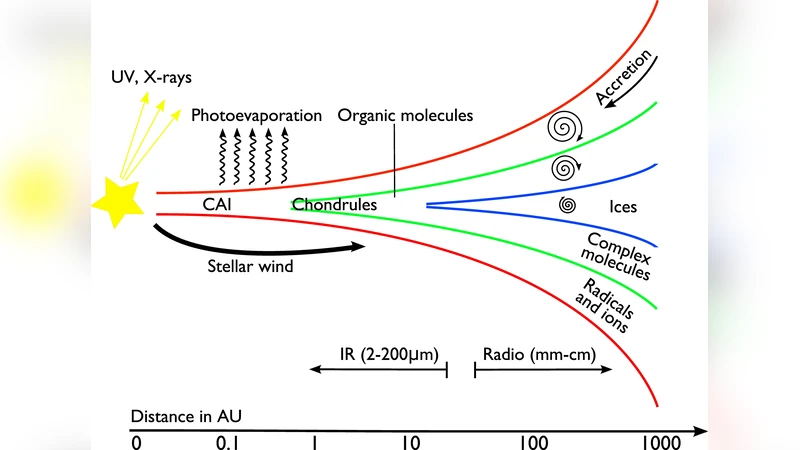
In this paper we review recent progress in our understanding of the chemical evolution of protoplanetary disks. Current observational constraints and theoretical modeling on the chemical composition of gas and dust in these systems are presented. Strong variations of temperature, density, high-energy radiation intensities in these disks, both radially and vertically, result in a peculiar disk chemical structure, where a variety of processes are active. In hot, dilute and heavily irradiated atmosphere only the most photostable simple radicals and atoms and atomic ions exist, formed by gas-phase processes. Beneath the atmosphere a partly UV-shielded, warm molecular layer is located, where high-energy radiation drives rich ion-molecule and radical-radical chemistry, both in the gas phase and on dust surfaces. In a cold, dense, dark disk midplane many molecules are frozen out, forming thick icy mantles where surface chemistry is active and where complex polyatomic (organic) species are synthesized. Dynamical processes affect disk chemical composition by enriching it in abundances of complex species produced via slow surface processes, which will become detectable with ALMA.
💡 Research Summary
The paper provides a comprehensive review of the chemical evolution of protoplanetary disks (PPDs), integrating recent observational constraints with state‑of‑the‑art theoretical modeling. It begins by emphasizing that PPDs are ubiquitous around young stars and that their gas‑and‑dust composition critically influences planet formation timescales and efficiencies. The authors outline how strong radial and vertical gradients in temperature, density, and high‑energy radiation (UV, X‑ray, cosmic rays) create a layered chemical structure that can be divided into four principal zones: (1) the hot inner region (< 20 AU) observable in the infrared, where neutral‑neutral reactions dominate and the gas is largely thermally driven; (2) the cold midplane (10–20 K, densities 10⁷–10¹⁰ cm⁻³) that is heavily shielded from radiation, leading to extensive freeze‑out of volatile species onto dust grains and a chemistry dominated by surface hydrogenation, radical addition, and non‑thermal desorption processes; (3) the warm molecular layer (30–70 K) that is partially UV‑shielded, where ion‑molecule and radical‑radical reactions are active, producing abundant ions such as HCO⁺, N₂H⁺, CN, and HCN; and (4) the tenuous, highly irradiated disk atmosphere (> 100 K) where only the most photostable atoms, simple radicals, and atomic ions survive, and photochemistry proceeds on timescales of ∼100 yr.
Observationally, the paper surveys millimeter interferometric detections of CO and its isotopologues, HCO⁺, CN, HCN, CS, DCO⁺, DCN, and a few complex organics, highlighting how line intensities and spatial distributions constrain temperature, density, ionization rates, and the degree of UV shielding. Notably, cold CO reservoirs (6–17 K) observed in disks such as DM Tau require non‑thermal desorption (e.g., photodesorption) or radial mixing to explain their presence. The authors stress that ALMA’s full capabilities, combined with forthcoming JWST infrared spectroscopy, will dramatically improve sensitivity to faint lines of complex organics and ices.
The chemical network employed in modern disk models includes up to 600 species and 4,000–7,000 reactions, yet only 10–20 % of rate coefficients have been measured or computed with high confidence, underscoring substantial uncertainties. The paper categorizes reactions into radiative association, three‑body processes, bond formation/destruction, ion‑molecule, neutral‑neutral, photodissociation, photoionization, and cosmic‑ray/X‑ray induced processes. Ion‑molecule chemistry is highlighted as the dominant driver in the molecular layer, with typical rate coefficients of ∼10⁻⁹ cm³ s⁻¹ that often increase at low temperatures. Surface chemistry on dust grains proceeds via slow radiative association and hydrogenation, forming simple ices (H₂O, CO, CO₂, NH₃, CH₄) and more complex organics (e.g., CH₃OH, H₂CO). These processes operate on timescales of 10⁵–10⁶ yr in the outer disk, while dynamical mixing (turbulence, grain growth, vertical settling) can transport ice‑mantle products into the upper layers, enriching the gas phase with complex molecules detectable by ALMA.
Photochemistry is examined in detail, contrasting the UV spectra of T Tauri stars (strong Lyman‑α, non‑thermal UV) with those of Herbig Ae/Be stars (hot thermal UV). The authors note that species such as CO, H₂, and CN are dissociated by photons < 1100 Å, while others (e.g., HCN) require longer wavelengths. The intensity of stellar UV at 100 AU can reach 10³–10⁵ times the interstellar field, profoundly influencing the depth of photodissociation fronts and the location of the molecular layer. X‑rays and cosmic rays provide a baseline ionization rate of 10⁻¹⁰–10⁻⁹ s⁻¹ throughout much of the disk, sustaining ion–molecule chemistry even in shielded regions.
The paper concludes that current models reproduce the qualitative trends observed in CO, HCO⁺, CN, HCN, and CS column densities, but quantitative discrepancies remain for complex organics and deuterated species. The authors advocate for coordinated laboratory measurements of surface reaction barriers, photodesorption yields, and high‑energy cross sections, as well as for high‑resolution, multi‑line ALMA surveys and JWST ice spectroscopy to refine model parameters. Ultimately, the interplay of radiation, dynamics, and grain surface chemistry shapes the chemical landscape of PPDs, setting the initial conditions for planet formation and the delivery of prebiotic molecules to nascent planetary systems.
Comments & Academic Discussion
Loading comments...
Leave a Comment