PSR J0007+7303 in the CTA1 SNR: New Gamma-ray Results from Two Years of Fermi-LAT Observations
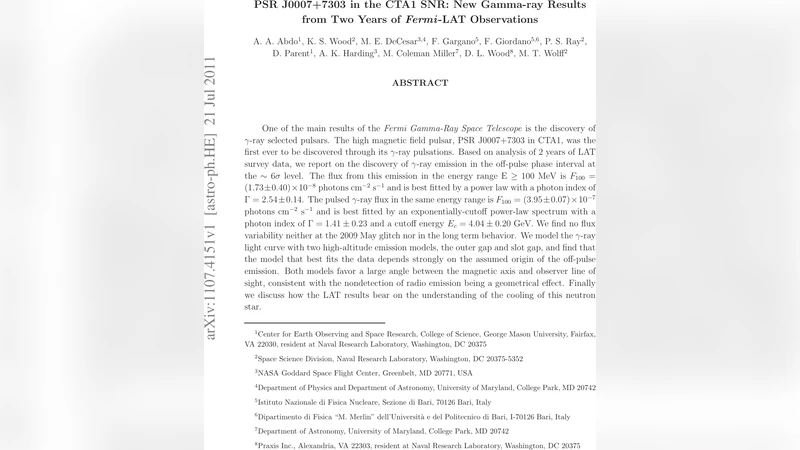
One of the main results of the Fermi Gamma-Ray Space Telescope is the discovery of {\gamma}-ray selected pulsars. The high magnetic field pulsar, PSR J0007+7303 in CTA1, was the first ever to be discovered through its {\gamma}-ray pulsations. Based on analysis of 2 years of LAT survey data, we report on the discovery of {\gamma}-ray emission in the off-pulse phase interval at the ~ 6{\sigma} level. The flux from this emission in the energy range E \geq 100 MeV is F_100 = (1.73\pm0.40)\times10^(-8) photons/cm^2/s and is best fitted by a power law with a photon index of {\Gamma} = 2.54\pm0.14. The pulsed {\gamma}-ray flux in the same energy range is F_100 = (3.95\pm0.07)\times10^(-7) photons/cm^2/s and is best fitted by an exponentially-cutoff power-law spectrum with a photon index of {\Gamma} = 1.41 \pm 0.23 and a cutoff energy E_c = 4.04 \pm 0.20 GeV. We find no flux variability neither at the 2009 May glitch nor in the long term behavior. We model the {\gamma}-ray light curve with two high-altitude emission models, the outer gap and slot gap, and find that the model that best fits the data depends strongly on the assumed origin of the off-pulse emission. Both models favor a large angle between the magnetic axis and observer line of sight, consistent with the nondetection of radio emission being a geometrical effect. Finally we discuss how the LAT results bear on the understanding of the cooling of this neutron star.
💡 Research Summary
**
This paper presents a comprehensive analysis of the γ‑ray emission from the high‑magnetic‑field pulsar PSR J0007 7303, located within the CTA 1 supernova remnant, using two years of survey data from the Fermi Large Area Telescope (LAT). The authors first construct a precise timing solution by extracting 72 pulse times‑of‑arrival (TOAs) over the 2008‑2010 interval, employing events above 170 MeV within a 1.3° radius of the Chandra position. The timing model includes position, spin frequency (ν), and its first three derivatives (ν̇, ν̈, ν‴), yielding white residuals and revealing a clear glitch on 2009 May 2 (MJD 54952.652) with Δν/ν ≈ 5.5 × 10⁻⁷ and Δν̇/ν̇ ≈ 9.7 × 10⁻⁴. The measured ν̈ implies a braking index n ≈ 10, far above the canonical value of 3, indicating substantial timing noise typical of young pulsars.
To isolate off‑pulse emission, the authors perform a likelihood‑based phase‑bin analysis, defining the off‑pulse window as φ ∈
Comments & Academic Discussion
Loading comments...
Leave a Comment