Three dimensional structure from intensity correlations
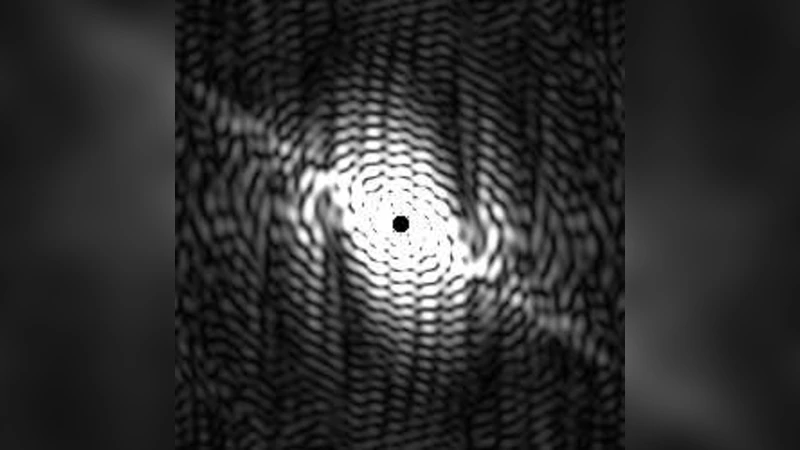
We develop the analysis of x-ray intensity correlations from dilute ensembles of identical particles in a number of ways. First, we show that the 3D particle structure can be determined if the particles can be aligned with respect to a single axis having a known angle with respect to the incident beam. Second, we clarify the phase problem in this setting and introduce a data reduction scheme that assesses the integrity of the data even before the particle reconstruction is attempted. Finally, we describe an algorithm that reconstructs intensity and particle density simultaneously, thereby making maximal use of the available constraints.
💡 Research Summary
The paper extends Kam’s original idea of extracting structural information from intensity fluctuations in X‑ray scattering by focusing on ensembles of identical particles that are partially oriented. The authors assume that each particle is adsorbed on a substrate such that a single axis (the substrate normal) is fixed relative to the particle, while the particle may rotate freely about this axis by a random angle α. The substrate itself can be tilted by a known angle θ with respect to the incident beam, providing a controllable degree of freedom.
In the data‑collection stage, the experiment records the intensity at two detector pixels (labeled 1 and 2) together with the substrate tilt θ, yielding a five‑dimensional data set (x₁, y₁; x₂, y₂; θ). The covariance C(x₁, y₁; x₂, y₂; θ) = cov(I₁, I₂) is measured over many pulses. By expressing the scattered wave vectors in the particle‑fixed frame and assuming a uniform distribution of α, the covariance can be written in terms of the particle’s intensity Iₚ(r, φ, z) (the squared magnitude of its Fourier transform). The number of particles intersected by the beam varies as N(θ)=1/ cosθ, reflecting the geometric effect of tilting the substrate.
Data reduction proceeds by expanding Iₚ in angular harmonics about the fixed axis: Iₚ(r, φ, z)=∑ₘ e^{imφ} Iₘ(r, z). Averaging the measured covariance over the azimuthal parameter φ₁ (chosen such that |A|<1, where A=r₁z₂/(r₂z₁)) decouples the equations and yields, for each harmonic m, a Hermitian matrix Cₘ(r₁, z₁; r₂, z₂)=Iₘ(r₁, z₁) Iₘ* (r₂, z₂). The Jacobian J(φ₁)=1−A cosφ₁ /√(1−A² sin²φ₁) is included to guarantee uniform sampling of the effective phase difference ϕ(φ₁)=φ₁−φ₂(φ₁). Because the theoretical rank of Cₘ is one, its dominant eigenvector Vₘ (with eigenvalue λₘ) directly provides the harmonic amplitudes: Iₘ(r, z)=√λₘ Vₘ(r, z). The ratio σₘ=‖Cₘ‖_∞ /‖Cₘ‖_1 (spectral norm over trace norm) serves as an internal consistency check; σₘ≈1 indicates that the data are essentially noise‑free, whereas lower values signal the need to reduce resolution, truncate the harmonic series, or improve background subtraction.
At this point, however, the phases of the harmonics are still ambiguous: for a maximum harmonic order M, there remain M/2 unknown overall phase factors. The authors resolve this by exploiting the compact‑support constraint of the real‑space particle density ρ(x). They propose an iterative algorithm that simultaneously refines the unknown harmonic phases and reconstructs ρ. In each iteration, the current set of Iₘ is inverse‑Fourier transformed to generate a provisional density; the density is then projected onto the space of real, non‑negative functions confined within a known support volume. The forward Fourier transform of this projected density yields updated intensity harmonics, whose phases are adjusted to reduce the discrepancy with the measured Cₘ. This loop continues until convergence, effectively solving two coupled phase‑retrieval problems: (i) the traditional phase problem linking intensity to density, and (ii) the additional M/2 phase ambiguities inherent in the angular harmonic decomposition.
The authors discuss practical considerations such as the sampling density in (r, z) space (set by the speckle size of a single‑particle diffraction pattern), the maximum harmonic order M (determined by the angular speckle scale at the detector edge), and the necessity of interpolating the correlation function at θ = π/2 where the beam is parallel to the substrate. They also note that the method is particularly suited to systems where partial orientation is naturally achieved, e.g., dice‑like particles that preferentially land on one face, or membrane proteins embedded in lipid bilayers that align their symmetry axis with the membrane normal.
In summary, the paper makes three major contributions: (1) it demonstrates theoretically that 3‑D structure can be recovered from intensity correlations when particles are partially oriented about a single axis; (2) it introduces a PCA‑like data‑reduction and consistency‑checking scheme that validates the raw correlation data before any phase reconstruction; and (3) it provides a novel joint reconstruction algorithm that simultaneously determines the missing harmonic phases and the real‑space density, leveraging the compact‑support constraint. These advances could significantly simplify single‑particle X‑ray imaging experiments, especially for biological macromolecules that can be adsorbed on substrates with a preferred orientation, thereby reducing the need for full 3‑D orientation sampling and improving data efficiency.
Comments & Academic Discussion
Loading comments...
Leave a Comment