Pan-STARRS1 Discovery of Two Ultra-Luminous Supernovae at z ~ 0.9
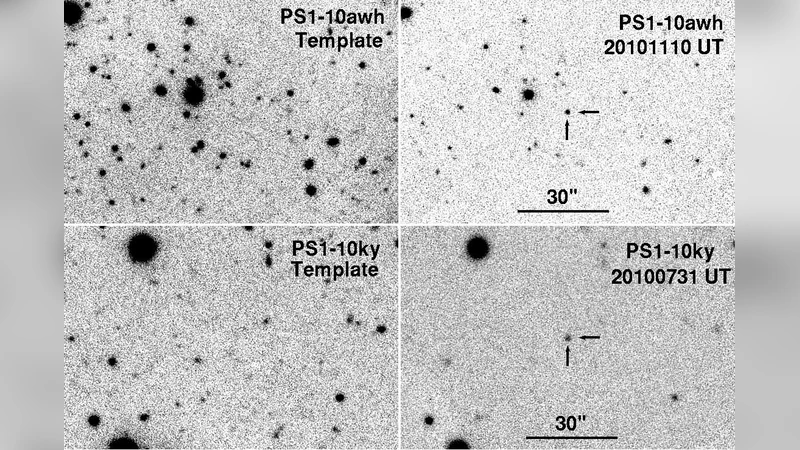
We present the discovery of two ultra-luminous supernovae (SNe) at z ~ 0.9 with the Pan-STARRS1 Medium-Deep Survey. These SNe, PS1-10ky and PS1-10awh, are amongst the most luminous SNe ever discovered, comparable to the unusual transients SN 2005ap and SCP 06F6. Like SN 2005ap and SCP 06F6, they show characteristic high luminosities (M_bol ~ -22.5 mag), blue spectra with a few broad absorption lines, and no evidence for H or He. We have constructed a full multi-color light curve sensitive to the peak of the spectral energy distribution in the rest-frame ultraviolet, and we have obtained time-series spectroscopy for these SNe. Given the similarities between the SNe, we combine their light curves to estimate a total radiated energy over the course of explosion of (0.9-1.4) x 10^51 erg. We find photospheric velocities of 12,000-19,000 km/s with no evidence for deceleration measured across ~3 rest-frame weeks around light-curve peak, consistent with the expansion of an optically-thick massive shell of material. We show that, consistent with findings for other ultra-luminous SNe in this class, radioactive decay is not sufficient to power PS1-10ky, and we discuss two plausible origins for these events: the initial spin-down of a newborn magnetar in a core-collapse SN, or SN shock breakout from the dense circumstellar wind surrounding a Wolf-Rayet star.
💡 Research Summary
The paper reports the discovery and detailed analysis of two ultra‑luminous supernovae (ULSNe), PS1‑10ky and PS1‑10awh, identified in the Pan‑STARRS1 (PS1) Medium‑Deep Survey at redshifts z ≈ 0.9. Both transients reach an absolute bolometric magnitude of M_bol ≈ ‑22.5 mag, corresponding to a total radiated energy of (0.9–1.4) × 10^51 erg—an order of magnitude higher than typical core‑collapse supernovae. Multi‑band photometry (g_P1, r_P1, i_P1, z_P1, y_P1) provides well‑sampled light curves that capture the rise and decline phases. By aligning the light curves in time, the authors construct a composite light curve that is symmetric with a rise and fall time of roughly 15–20 rest‑frame days, much slower than ordinary supernovae.
Spectroscopic follow‑up with the MMT and Gemini telescopes reveals narrow Mg II λλ2796,2803 absorption lines, giving precise redshifts of z = 0.956 for PS1‑10ky and z = 0.908 for PS1‑10awh. The spectra are characterized by a blue continuum and a handful of broad absorption features identified with light elements (C, O, Si). No hydrogen or helium lines are detected, aligning these events with the class of hydrogen‑poor, Type Ib/c‑like transients. The measured photospheric velocities are high (12,000–19,000 km s⁻¹) and show no significant deceleration over ~3 weeks around peak, suggesting an optically thick, massive shell expanding at nearly constant speed.
The authors evaluate possible power sources. Radioactive decay of ^56Ni would require several solar masses of nickel, which is inconsistent with the observed luminosity evolution and energetics. Two alternative mechanisms are explored:
-
Magnetar spin‑down – A newly born magnetar with an initial spin period of ~1–2 ms and a magnetic field of 10^14–10^15 G can inject energy into the ejecta on a spin‑down timescale of 10–30 days, reproducing both the peak luminosity and the flat velocity evolution.
-
Circumstellar interaction – A dense Wolf‑Rayet wind (mass‑loss rate ≈0.1–1 M_⊙ yr⁻¹, wind speed ≈1000 km s⁻¹) surrounding the progenitor creates an optically thick shell. The supernova shock breakout through this wind converts kinetic energy into radiation over a similar timescale, also accounting for the lack of velocity decline.
Both scenarios are compatible with the data, but distinguishing between them requires further observations, such as high‑resolution UV/optical spectroscopy to detect signatures of interaction (e.g., narrow emission lines) or late‑time nebular spectra that could reveal the magnetar’s influence.
In conclusion, PS1‑10ky and PS1‑10awh expand the sample of high‑redshift ultra‑luminous supernovae, demonstrate that radioactive decay alone cannot power such events, and support models involving either magnetar spin‑down or dense circumstellar interaction. The paper underscores the importance of rapid, multi‑wavelength follow‑up for future discoveries to discriminate between these competing mechanisms.
Comments & Academic Discussion
Loading comments...
Leave a Comment