Fractal Structure of Equipotential Curves on a Continuum Percolation Model
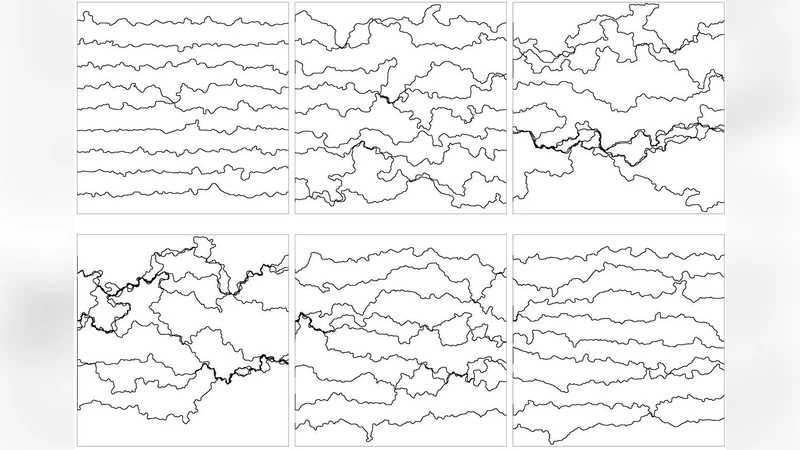
We numerically investigate the electric potential distribution over a two-dimensional continuum percolation model between the electrodes. The model consists of overlapped conductive particles on the background with an infinitesimal conductivity. Using the finite difference method, we solve the generalized Laplace equation and show that in the potential distribution, there appear the {\it{quasi-equipotential clusters}} which approximately and locally have the same values like steps and stairs. Since the quasi-equipotential clusters has the fractal structure, we compute the fractal dimension of equipotential curves and its dependence on the volume fraction over $[0,1]$. The fractal dimension in [1.00, 1.257] has a peak at the percolation threshold $p_c$.
💡 Research Summary
This paper investigates the electric potential distribution and the fractal nature of equipotential lines in a two‑dimensional continuum percolation model (CPM). The model consists of overlapping conductive disks of equal radius placed randomly in a square domain, while the surrounding matrix is assigned an infinitesimal conductivity (σ_inf = 10⁻⁴) to emulate an insulating background. Conductive disks have σ_mat = 1, creating a strong contrast between the two phases. The upper and lower boundaries are held at potentials φ = 1 and φ = 0 respectively, and natural (no‑flux) boundary conditions are imposed on the lateral sides.
Numerical solutions of the generalized Laplace equation ∇·σ∇φ = 0 are obtained using a finite‑difference method (FDM). Three system sizes are examined: L = 40.96, 81.92, and 163.84, discretized on 1024², 2048², and 4096² grids respectively, with each disk spanning about 25 lattice points. By fixing a random seed, the volume fraction p is increased incrementally, so that configurations for larger p contain those for smaller p, enabling a systematic study across the full range p ∈
Comments & Academic Discussion
Loading comments...
Leave a Comment