Infrared and radio study of the W43 cluster: resolved binaries and non-thermal emission
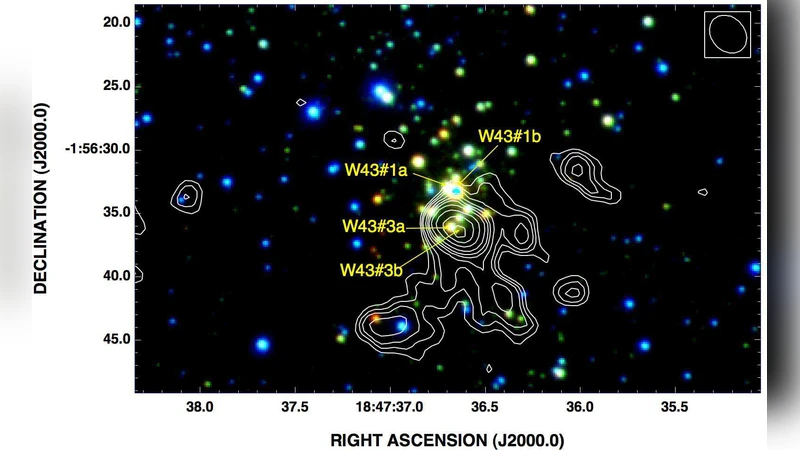
Context: The recent detection of very high-energy (VHE) gamma-ray emission from the direction of the W43 star-forming region prompted us to investigate its stellar population in detail in an attempt to see wether or not it is possible an association. Aims: We search for the possible counterpart(s) of the gamma-ray source or any hints of them, such as non-thermal synchrotron emission as a tracer of relativistic particles often involved in plausible physical scenarios for VHE emission. Methods: We data-mined several archival databases with different degrees of success. The most significant results came from radio and near-infrared archival data. Results: The previously known Wolf-Rayet star in the W43 central cluster and another cluster member appear to be resolved into two components,suggesting a likely binary nature. In addition, extended radio emission with a clearly negative spectral index is detected in coincidence with the W43 cluster. These findings could have important implications for possible gamma-ray emitting scenarios, which we also briefly discuss.
💡 Research Summary
The massive star‑forming complex W43, located at a distance of roughly 9 kpc, hosts a compact open cluster that contains three of the brightest members: a Wolf‑Rayet (WR) star (W43 #1, also catalogued as WR 121a) and two luminous O‑type stars (W43 #2 and W43 #3). The detection of very‑high‑energy (VHE) gamma‑ray emission by H.E.S.S. (source HESS J1848‑018) spatially coincident with the cluster prompted the authors to search for lower‑energy counterparts that could trace relativistic particles, such as non‑thermal radio synchrotron emission or X‑ray signatures of colliding‑wind binaries.
Using archival data from the European Southern Observatory (ESO) and the National Radio Astronomy Observatory (NRAO), the authors performed a detailed multi‑wavelength analysis. Near‑infrared images obtained with the VLT/ISAAC instrument in the J and Kₛ bands (seeing ≈0.4″) were reduced with IRAF and astrometrically calibrated against 2MASS. The high angular resolution allowed the authors to resolve W43 #1 into two components (designated #1a and #1b) separated by 0.598 ± 0.003 arcsec at a position angle of 255° ± 1°. Similarly, W43 #3 was found to consist of two sources (#3a and #3b) with a separation of 0.640 ± 0.100 arcsec (PA = 271° ± 7°). Photometry (J ≈ 16.1 mag for #1a, J ≈ 15.8 mag for #1b; Kₛ ≈ 13.5 mag for #3a, Kₛ ≈ 13.6 mag for #3b) suggests that #1a is the WR component while #1b is an O‑type companion; #3a and #3b are consistent with an O‑type supergiant and a main‑sequence O star, respectively. The probability of a chance alignment of two unrelated stars within the cluster is estimated at ~5 %, supporting a genuine binary nature.
Radio observations from the VLA in three configurations (B at 1.465 GHz, C at 4.860 GHz, and D at 8.460 GHz) were re‑processed with AIPS to produce images with matched synthesized beams (~1.6″ × 1.3″). The radio source coincident with the cluster exhibits an extended morphology (deconvolved size ≈3.8″ × 3.1″, PA ≈ 61°) and a clearly non‑thermal spectrum. A power‑law fit yields Sν = (0.48 ± 0.02) Jy (ν/GHz)⁻⁰·⁴⁷ ± 0·⁰⁴, corresponding to a total radio luminosity of ~1 × 10³³ erg s⁻¹ (integrated from 0.1 to 100 GHz) and a brightness temperature of ~7 × 10⁴ K. This luminosity exceeds typical non‑thermal emission from single WR or O stars by three orders of magnitude, indicating that the emission likely originates from the collective effect of multiple stellar winds within the cluster.
The authors note that the peak of the non‑thermal radio emission is offset from the WR binary by ~3″, lying closer to the O‑type star W43 #3. Chandra X‑ray data reveal a source (CXO J184736.6‑0156) that coincides precisely with W43 #1b, supporting the interpretation that the X‑ray emission arises from the wind‑wind collision zone of the WR + O binary.
In the discussion, the paper evaluates possible mechanisms for the observed VHE gamma‑rays. Colliding‑wind binaries can accelerate electrons to relativistic energies, producing synchrotron radio emission and, via inverse‑Compton scattering, gamma‑rays. However, the radio luminosity and extended morphology suggest a larger scale accelerator, possibly the combined wind‑driven turbulence of the whole cluster. Assuming equipartition between relativistic particles and magnetic fields (Pacholczyk 1970), the total energy content is estimated at 2.2 × 10⁴⁵ erg with a magnetic field of ~6.8 × 10⁻⁴ G. These values are compatible with theoretical models that predict TeV particle acceleration in massive star clusters (e.g., Romero 2010). The authors also consider, and largely dismiss, an extragalactic background source scenario, citing source count statistics that give a probability of ~10⁻⁶ for a background object of this brightness to lie within the cluster’s angular extent.
The paper concludes that (1) the WR star W43 #1 is confirmed as a binary system, with one component coincident with an X‑ray source; (2) W43 #3 is likely also a binary of two O‑type stars; (3) extended non‑thermal radio emission is detected from the cluster, plausibly arising from collective wind interactions; and (4) these findings provide strong support for associating W43 with the HESS J1848‑018 gamma‑ray source. The authors recommend further high‑resolution radio interferometry, infrared spectroscopy, and gamma‑ray monitoring to refine binary orbital parameters, wind characteristics, and to test for variability that would cement the physical link between the stellar cluster and the VHE emission.
Comments & Academic Discussion
Loading comments...
Leave a Comment