The VLA Survey of the Chandra Deep Field South. V. Evolution and Luminosity Functions of sub-mJy radio sources and the issue of radio emission in radio-quiet AGN
We present the evolutionary properties and luminosity functions of the radio sources belonging to the Chandra Deep Field South VLA survey, which reaches a flux density limit at 1.4 GHz of 43 microJy at the field center and redshift ~5, and which includes the first radio-selected complete sample of radio-quiet active galactic nuclei (AGN). We use a new, comprehensive classification scheme based on radio, far- and near-IR, optical, and X-ray data to disentangle star-forming galaxies from AGN and radio-quiet from radio-loud AGN. We confirm our previous result that star-forming galaxies become dominant only below 0.1 mJy. The sub-mJy radio sky turns out to be a complex mix of star-forming galaxies and radio-quiet AGN evolving at a similar, strong rate; non-evolving low-luminosity radio galaxies; and declining radio powerful (P > 3 10^24 W/Hz) AGN. Our results suggest that radio emission from radio-quiet AGN is closely related to star formation. The detection of compact, high brightness temperature cores in several nearby radio-quiet AGN can be explained by the co-existence of two components, one non-evolving and AGN-related and one evolving and star-formation-related. Radio-quiet AGN are an important class of sub-mJy sources, accounting for ~30% of the sample and ~60% of all AGN, and outnumbering radio-loud AGN at < 0.1 mJy. This implies that future, large area sub-mJy surveys, given the appropriate ancillary multi-wavelength data, have the potential of being able to assemble vast samples of radio-quiet AGN by-passing the problems of obscuration, which plague the optical and soft X-ray bands.
💡 Research Summary
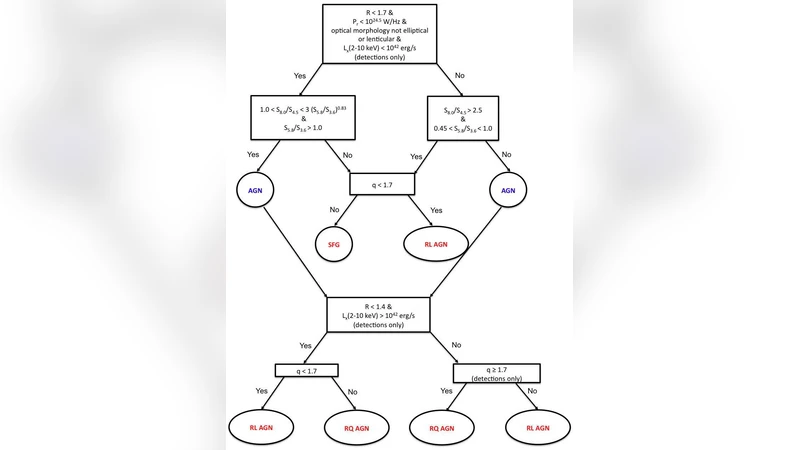
This paper presents a comprehensive study of the evolutionary properties and luminosity functions (LFs) of radio sources detected in the VLA survey of the Chandra Deep Field South (CDFS). The survey reaches a 1.4 GHz flux density limit of 43 µJy at the field centre and includes sources out to redshift ≈ 5. A total of 256 radio sources are considered, of which 193 constitute a complete, flux‑limited sample. The authors develop an updated classification scheme that combines radio, near‑ and mid‑infrared (IRAC), optical, and X‑ray information to separate star‑forming galaxies (SFGs) from active galactic nuclei (AGN) and, within the AGN, to distinguish radio‑quiet (RQ) from radio‑loud (RL) objects.
Traditional radio‑to‑optical flux ratio (R) and radio power criteria are shown to be insufficient for a clean separation of RQ AGN and SFGs, especially at sub‑mJy levels where both populations can have low R and low radio power. By incorporating IRAC colour–colour diagnostics (S8.0/S4.5 versus S5.8/S3.6) and X‑ray luminosities (L_X > 10^42 erg s⁻¹ as an AGN indicator), the authors achieve a more reliable taxonomy. Most AGN candidates occupy the “Lacy wedge” characteristic of power‑law mid‑IR spectra, while SFGs cluster in a vertical band dominated by PAH emission.
The evolutionary analysis employs both the V/V_max method and maximum‑likelihood fitting to derive density evolution parameters for each class. Star‑forming galaxies and RQ AGN both exhibit strong positive evolution, well described by (1+z)^k with k≈2.7–2.9, persisting up to z≈5. In contrast, low‑luminosity radio galaxies (FR I) show little to no evolution, and high‑luminosity radio AGN (P > 3×10^24 W Hz⁻¹) display a declining space density with redshift.
Luminosity functions reveal that below a flux density of 0.1 mJy the radio sky is a roughly equal mix of SFGs and RQ AGN. RQ AGN account for about 30 % of the total sub‑mJy sample and roughly 60 % of all AGN, overtaking RL AGN at flux densities <0.1 mJy. This demonstrates that RQ AGN constitute a major component of the faint radio population, contrary to earlier assumptions that star‑formation alone dominates at these levels.
The authors discuss the physical origin of the radio emission in RQ AGN. They propose a two‑component model: (1) a non‑evolving, compact, high‑brightness‑temperature core directly linked to the central engine, and (2) an evolving component associated with star‑formation processes (e.g., supernova remnants). Supporting evidence comes from VLBI detections of compact cores in several nearby RQ AGN, which exhibit brightness temperatures >10^6 K.
The study has significant implications for future large‑area, deep radio surveys such as those planned with the Square Kilometre Array (SKA). By leveraging multi‑wavelength ancillary data, these surveys will be able to assemble vast, unbiased samples of RQ AGN, bypassing the obscuration problems that affect optical and soft X‑ray selections. The paper thus provides a robust framework for interpreting the faint radio sky and for probing the co‑evolution of star formation and supermassive black holes across cosmic time.
Comments & Academic Discussion
Loading comments...
Leave a Comment