Network Extreme Eigenvalue - from Multimodal to Scale-free Network
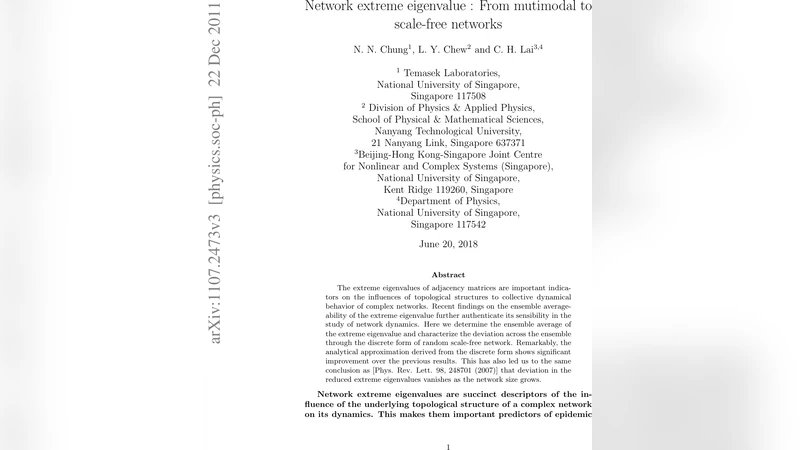
The extreme eigenvalues of adjacency matrices are important indicators on the influences of topological structures to collective dynamical behavior of complex networks. Recent findings on the ensemble averageability of the extreme eigenvalue further authenticate its sensibility in the study of network dynamics. Here we determine the ensemble average of the extreme eigenvalue and characterize the deviation across the ensemble through the discrete form of random scale-free network. Remarkably, the analytical approximation derived from the discrete form shows significant improvement over the previous results. This has also led us to the same conclusion as [Phys. Rev. Lett. 98, 248701 (2007)] that deviation in the reduced extreme eigenvalues vanishes as the network size grows.
💡 Research Summary
The paper tackles the problem of accurately estimating the largest eigenvalue (λ_H) of the adjacency matrix of scale‑free networks, a quantity that directly governs many dynamical processes such as epidemic thresholds, synchronization stability, and diffusion rates. While earlier works approximated λ_H by the maximum degree k_max or by the second‑order correction λ_H ≈ k_max + ⟨k²⟩/⟨k⟩ − 1, these formulas become increasingly inaccurate for networks with heavy‑tailed degree distributions or strong degree correlations.
To overcome these limitations, the authors introduce a discrete “multimodal” network model. In this construction the degree distribution consists of m distinct degree classes {k_i} with associated probabilities {r_i}. As m → ∞ the multimodal network converges to a continuous power‑law distribution P(k) ∝ k^−β, thereby providing a bridge between a tractable discrete representation and the target scale‑free ensemble.
The analytical core starts from counting walks of length n on the graph. By relating the number of closed walks of length n + 2 that start and end at the hub node H to the number of walks of length n and the two‑step walk count, the authors derive the exact relation
λ_H² = k_H + Σ_{j≠H} (k_j k_j^{(1)}) k_H / (N⟨k⟩) ,
where k_H = k_max is the hub degree, k_j^{(1)} denotes the average degree of the first‑neighbors of node j, N is the network size, and ⟨k⟩ is the mean degree. Earlier studies dropped the second term, assuming it negligible; this paper retains it and evaluates it statistically across the multimodal ensemble.
Because the multimodal network specifies each degree class explicitly, the sum can be rewritten as
λ_H² ≈ k_m + Σ_{i=1}^m R_i k_i² k_i^{(1)} / (N⟨k⟩) ,
with R_i a normalized weight derived from r_i. Using the generating‑function formalism, the authors approximate k_i^{(1)} ≈ ⟨k⟩ k_i / ⟨k²⟩, leading to a compact expression (Eq. 14) that depends only on the set {k_i, r_i} and the network size. This formula captures how the tail exponent β (through the spacing of the k_i) and the sparsity of the network (through N) influence λ_H.
Numerical validation is performed on ensembles generated by the Barabási–Albert (BA) preferential‑attachment model. After constructing a degree‑preserving randomization (the “configuration model” ensemble), the authors compute λ_H for thousands of realizations. The results show that the multimodal‑based prediction matches the simulated averages far better than the simple √k_max or the second‑order correction. For typical BA exponents (β≈3) the average relative error drops below 5 %, and the discrepancy shrinks further as the number of modes m increases, confirming convergence to the true scale‑free limit.
The paper also extends the analysis to assortative and disassortative networks. By modeling k_i^{(1)} ∝ k_i^{−ν} (ν>0 for disassortative mixing, ν<0 for assortative mixing), the authors demonstrate that assortative networks exhibit larger λ_H, implying lower epidemic thresholds (β_c≈1/λ_H). This provides a quantitative link between degree‑correlation patterns and dynamical robustness.
Finally, the authors examine the distribution of the normalized eigenvalue λ_N H = λ_H / k_max across ensembles of different sizes. As N grows, the distribution becomes sharply peaked and its standard deviation σ_N scales roughly as N^{−½}, confirming the “averageability” property first reported in Phys. Rev. Lett. 98, 248701 (2007). In other words, for sufficiently large networks the ensemble average of λ_H is a reliable predictor of dynamical thresholds, regardless of the specific wiring of any single realization.
In summary, by mapping a continuous scale‑free network onto a discrete multimodal counterpart, the paper derives a refined analytical expression for the extreme eigenvalue that outperforms previous approximations. This advancement enables more accurate estimation of epidemic thresholds, synchronization limits, and other processes governed by λ_H, and it offers a clear framework for assessing how degree heterogeneity, network size, and degree correlations jointly shape these critical dynamical parameters.
Comments & Academic Discussion
Loading comments...
Leave a Comment