A Sino-German $lambda$6 cm polarization survey of the Galactic plane VI. Discovery of supernova remnants G178.2-4.2 and G25.1-2.3
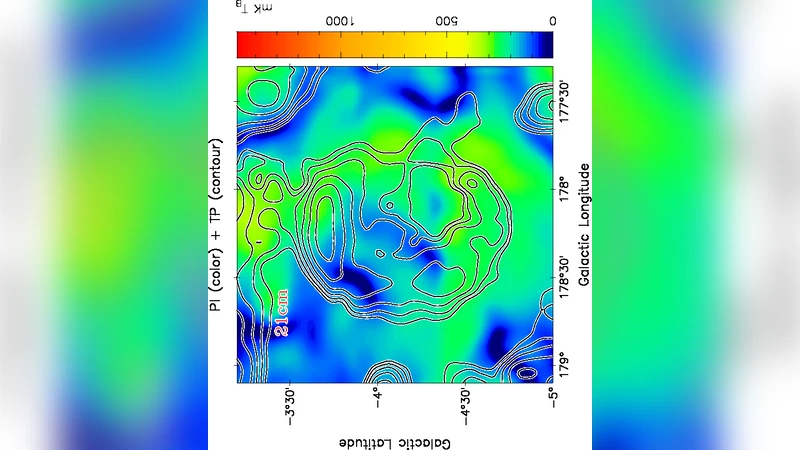
Supernova remnants (SNRs) were often discovered in radio surveys of the Galactic plane. Because of the surface-brightness limit of previous surveys, more faint or confused SNRs await discovery. The Sino-German $\lambda$6\ cm Galactic plane survey is a sensitive survey with the potential to detect new low surface-brightness SNRs. We want to identify new SNRs from the $\lambda$6\ cm survey map of the Galactic plane. We searched for new shell-like objects in the $\lambda$6\ cm survey maps, and studied their radio emission, polarization, and spectra using the $\lambda$6\ cm maps together with the $\lambda$11\ cm and $\lambda$21\ cm Effelsberg observations. Extended polarized objects with non-thermal spectra were identified as SNRs. We have discovered two new, large, faint SNRs, G178.2-4.2 and G25.1-2.3, both of which show shell structure. G178.2-4.2 has a size of 72 arcmin x 62 arcmin with strongly polarized emission being detected along its northern shell. The spectrum of G178.2-4.2 is non-thermal, with an integrated spectral index of $\alpha = -0.48\pm0.13$. Its surface brightness is $\Sigma_{1 GHz} = 7.2 x 10^{-23}{Wm^{-2} Hz^{-1} sr^{-1}}$, which makes G178.2-4.2 the second faintest known Galactic SNR. G25.1-2.3 is revealed by its strong southern shell which has a size of 80 arcmin x 30\arcmin. It has a non-thermal radio spectrum with a spectral index of $\alpha = -0.49\pm0.13$. Two new large shell-type SNRs have been detected at $\lambda$6\ cm in an area of 2200 deg^2 along the the Galactic plane. This demonstrates that more large and faint SNRs exist, but are very difficult to detect.
💡 Research Summary
The paper reports the discovery of two new Galactic supernova remnants (SNRs), G178.2‑4.2 and G25.1‑2.3, identified in the Sino‑German λ 6 cm polarization survey of the Galactic plane. The survey covers longitudes 10° ≤ ℓ ≤ 230° and latitudes |b| ≤ 5° with an angular resolution of 9.5′ and a sensitivity of ≈0.3 mK TB, which is sufficient to detect surface brightnesses down to Σ₁GHz ≈ 4.9 × 10⁻²³ W m⁻² Hz⁻¹ sr⁻¹—lower than the faintest previously known SNR.
Methodology
The authors employed a “background‑filtering” technique, using a filter beam larger than the target objects to suppress large‑scale Galactic emission. They visually inspected the filtered 6 cm maps for shell‑like structures, then cross‑checked candidates with Effelsberg λ 11 cm and λ 21 cm surveys. Point‑like sources identified from the NVSS catalog and from the maps themselves were modeled with Gaussian components and subtracted, ensuring that the remaining emission represented the extended objects. Polarization maps at 6 cm, 11 cm, and (where available) 21 cm were examined; only regions showing both total intensity and linear polarization were considered credible SNR shells.
Results – G178.2‑4.2
Located at ℓ ≈ 178.2°, b ≈ ‑4.2°, this remnant spans 72′ × 62′ and exhibits a clear circular shell, especially bright along its northern rim. Integrated flux densities are S₆cm = 1.0 ± 0.1 Jy, S₁₁cm = 1.6 ± 0.2 Jy, and S₂₁cm = 1.8 ± 0.2 Jy. A power‑law fit yields a spectral index α = ‑0.48 ± 0.13, consistent with non‑thermal synchrotron emission from an adiabatic SNR. TT‑plots between 6–11 cm and 6–21 cm give brightness‑temperature indices β ≈ ‑2.5, confirming α = β + 2. Polarization is strong along the northern shell; B‑vectors are tangential to the rim, indicating ordered magnetic fields compressed by the shock. The rotation measure derived from the 20° difference in polarization angle between 6 cm and 11 cm is ≈ 36 rad m⁻², comparable to nearby regions. The calculated 1 GHz surface brightness Σ₁GHz = 7.2 × 10⁻²³ W m⁻² Hz⁻¹ sr⁻¹ makes it the second faintest known Galactic SNR.
Results – G25.1‑2.3
Situated at ℓ ≈ 25.1°, b ≈ ‑2.3°, this object is an elongated shell 80′ × 30′ in size, with the bright southern rim clearly visible after background filtering. Integrated fluxes are S₆cm = 3.7 ± 0.4 Jy, S₁₁cm = 4.7 ± 0.5 Jy, and S₂₁cm = 6.7 ± 0.7 Jy, giving a spectral index α = ‑0.49 ± 0.13. TT‑plot analyses yield β ≈ ‑2.45 to ‑2.59, again consistent with synchrotron emission. Polarized emission is detected at 6 cm and 11 cm along the southern shell; however, no 21 cm polarization data are available, limiting a precise RM determination. The 1 GHz surface brightness is Σ₁GHz = 5.0 × 10⁻²² W m⁻² Hz⁻¹ sr⁻¹, still low compared with most catalogued SNRs.
Implications
Both remnants are large (tens of arcminutes) and have surface brightnesses near or below the detection limits of earlier surveys, explaining why they were previously missed. Their discovery demonstrates that the λ 6 cm survey’s sensitivity and inclusion of polarization information are powerful tools for uncovering faint, extended SNRs. The identification of G178.2‑4.2 as the second faintest known SNR suggests that many more low‑surface‑brightness remnants remain undetected, supporting theoretical estimates that the Galaxy should contain 1 000–10 000 SNRs, far more than the ~274 currently catalogued.
Future Work
The authors recommend extending the search to the full 2200 deg² surveyed area, employing multi‑frequency data to refine spectral and polarization analyses, and complementing radio observations with X‑ray or γ‑ray studies to confirm the SNR nature and to investigate their environments and ages. Improved RM synthesis and higher‑resolution polarization mapping could further elucidate magnetic field structures in these faint remnants.
Comments & Academic Discussion
Loading comments...
Leave a Comment