Canalization in the Critical States of Highly Connected Networks of Competing Boolean Nodes
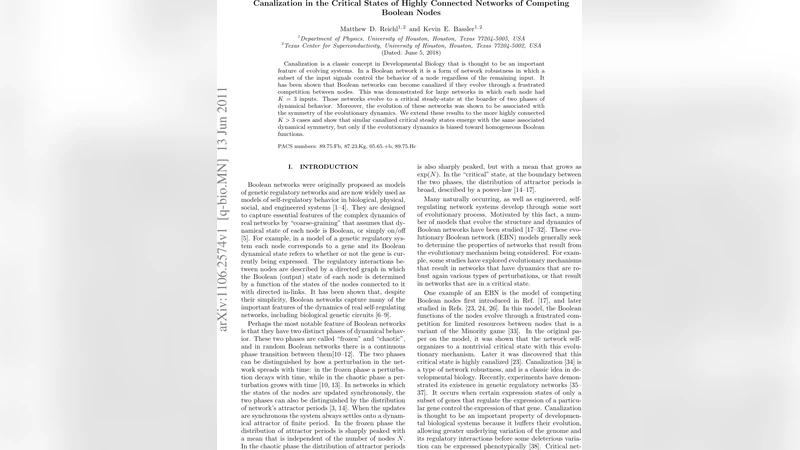
Canalization is a classic concept in Developmental Biology that is thought to be an important feature of evolving systems. In a Boolean network it is a form of network robustness in which a subset of the input signals control the behavior of a node regardless of the remaining input. It has been shown that Boolean networks can become canalized if they evolve through a frustrated competition between nodes. This was demonstrated for large networks in which each node had K=3 inputs. Those networks evolve to a critical steady-state at the boarder of two phases of dynamical behavior. Moreover, the evolution of these networks was shown to be associated with the symmetry of the evolutionary dynamics. We extend these results to the more highly connected K>3 cases and show that similar canalized critical steady states emerge with the same associated dynamical symmetry, but only if the evolutionary dynamics is biased toward homogeneous Boolean functions.
💡 Research Summary
The paper investigates how canalization—a form of robustness in which a subset of inputs determines a node’s output regardless of the remaining inputs—emerges in Boolean networks that are highly connected (K > 3) and evolve under competitive dynamics. Earlier work had shown that networks with K = 3 inputs per node evolve to a critical steady state at the boundary between ordered and chaotic dynamical regimes, and that this critical state is characterized by a high degree of canalization. The present study extends those findings to networks with larger connectivity, asking whether similar canalized critical states can arise and under what conditions.
Model and Evolutionary Rules
Each node receives K binary inputs and implements a Boolean function chosen from the full space of 2^{2^K} possible functions. The network starts with random functions and evolves through a “frustrated competition” process: pairs of nodes exert opposing selective pressures (e.g., minimizing error versus maximizing diversity). At each evolutionary step a node may mutate its Boolean function; selection favors configurations that improve a global fitness measure defined by the competition. Crucially, the authors introduce a homogeneity bias in the mutation step: mutations that lead to homogeneous output (all‑0 or all‑1) or to simple symmetric functions such as AND, OR, NAND, and NOR are given higher probability. This bias is the central control parameter examined.
Criticality and Canalization
The authors monitor the average sensitivity (the expected number of output changes caused by flipping a random input) as a proxy for dynamical phase. Networks converge to a regime where average sensitivity ≈ 1, the hallmark of the critical boundary between ordered and chaotic dynamics. In this regime many nodes become canalized: a single input (or a small set of inputs) alone fixes the node’s output, rendering the remaining K − 1 inputs irrelevant. The proportion of canalized nodes remains substantial (30–45 %) even as K increases from 4 to 6, provided the homogeneity bias is active.
When the bias is removed, the system’s sensitivity rises well above 1 (1.3–1.7), indicating a drift into the chaotic phase. Canalization collapses, and the network’s dynamics become highly sensitive to perturbations. This demonstrates that high connectivity alone does not guarantee canalization; a directed evolutionary pressure toward simpler, more homogeneous Boolean functions is required.
Symmetry of Evolutionary Dynamics
A second major contribution is the analysis of symmetry in the evolutionary process. The authors show that the dynamics preserve two key symmetries: (1) input permutation symmetry, where swapping input labels leaves the evolutionary outcome invariant, and (2) output negation symmetry, where flipping all output bits of a function yields an equivalent evolutionary trajectory. These symmetries generate a group under which canalized functions form orbits. The preservation of these symmetries ensures that the search space is effectively reduced, allowing the network to locate canalized configurations efficiently even in the vastly larger function space associated with higher K.
Simulation Results
Extensive simulations were performed for K = 4, 5, 6 on ensembles of 10⁴ networks each, evolved for up to 10⁵ time steps. Metrics recorded include average sensitivity, fraction of canalized nodes, distribution of core inputs (the inputs that dominate a node’s output), and fitness trajectories. With homogeneity bias, all ensembles settle at the critical point, maintain a stable fraction of canalized nodes, and exhibit robust fitness plateaus. Without bias, the ensembles diverge, sensitivity grows, canalization disappears, and fitness fluctuates wildly.
Implications
The findings have several important implications. First, canalization is not a peculiarity of sparsely connected networks; it can arise in densely connected systems if evolutionary pressures favor simplicity. Second, the homogeneity bias can be interpreted biologically as a selection for developmental stability—genes that produce uniform outcomes despite genetic or environmental noise are favored. Third, the identified symmetries provide a theoretical framework for understanding why certain evolutionary pathways are more accessible, suggesting that designing artificial networks (e.g., in synthetic biology or robust machine‑learning architectures) could benefit from imposing analogous symmetry constraints. Finally, the work bridges developmental biology concepts with statistical‑physics approaches to complex systems, offering a unified view of how robustness and criticality co‑emerge in evolving networks.
In summary, the paper demonstrates that highly connected Boolean networks can self‑organize into canalized, critical steady states, but only when the evolutionary dynamics are biased toward homogeneous, low‑complexity Boolean functions. The preservation of input‑permutation and output‑negation symmetries underlies this robustness, providing both a mechanistic explanation and a potential design principle for engineered complex systems.
Comments & Academic Discussion
Loading comments...
Leave a Comment