One invariant measure and different Poisson brackets for two nonholonomic systems
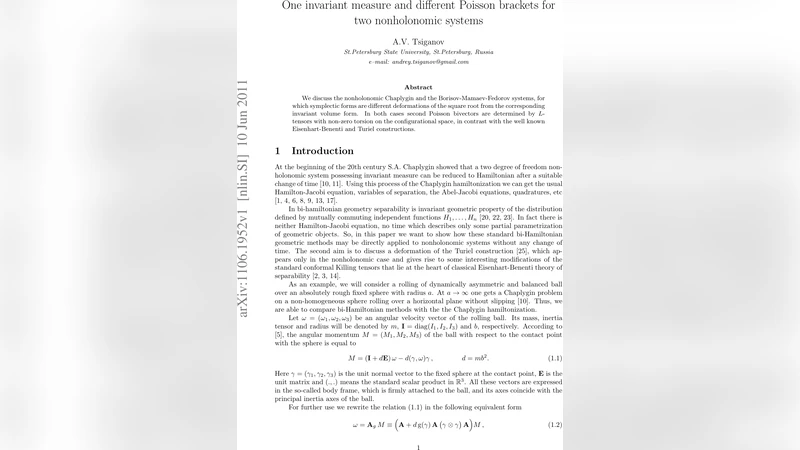
We discuss the nonholonomic Chaplygin and the Borisov-Mamaev-Fedorov systems, for which symplectic forms are different deformations of the square root from the corresponding invariant volume form. In both cases second Poisson bivectors are determined by $L$-tensors with non-zero torsion on the configurational space, in contrast with the well known Eisenhart-Benenti and Turiel constructions.
💡 Research Summary
The paper investigates two classic nonholonomic mechanical systems – the Chaplygin rolling ball and the Borisov‑Mamaev‑Fedorov (BMF) system – and demonstrates that, despite sharing the same invariant volume form, they admit distinct Poisson structures. The authors begin by recalling Chaplygin’s early 20th‑century result that a two‑degree‑of‑freedom nonholonomic system with an invariant measure can be rendered Hamiltonian after a suitable time reparameterization. They argue that such a time change is not essential: one can work directly with the invariant measure and construct Poisson brackets that satisfy the required geometric conditions without altering the time variable.
Both systems are described in a unified geometric setting. The configuration space is the unit sphere S², parametrized by spherical coordinates (φ,θ) and their conjugate momenta (p_φ, p_θ). The dynamical variables are the angular velocity ω, the angular momentum M, and the unit normal γ to the fixed sphere. The equations of motion are compactly written as (\dot M = M \times ω) and (\dot γ = κ γ \times ω), where κ = a/(a+b) distinguishes the Chaplygin case (κ = +1) from the BMF case (κ = –1). In both cases there exist three basic integrals H₁ = (M,ω), H₂ = (M,M) and C₁ = (γ,γ)=1; for κ = ±1 an additional integral C₂ = (γ, B M) appears.
The invariant measure is μ = √g dq dp, where g(γ) = 1/(1 – d (γ, Aγ)) and d = m b² is a parameter involving the ball’s mass and radius. The authors treat μ as the fundamental object and seek Poisson bivectors P that are compatible with the canonical symplectic form and whose Schouten bracket vanishes. They first recall the standard construction: any torsion‑free (1,1) tensor L on the configuration space defines a Poisson bivector P_L via the Turiel formula (2.4). When L is the identity, P_L reduces to the canonical Poisson bivector P.
For the Chaplygin system (κ = +1) they introduce a conformal scaling L_g = (1/√g) I, which yields a deformed Poisson bivector P_g (equation 2.7). This bivector reproduces the known Chaplygin Hamiltonization: the Hamiltonian flow generated by H₁ with respect to P_g coincides with the original nonholonomic flow after the time change dt_g = √g dt. Consequently, H₁ and H₂ are in involution with respect to P_g, and the associated volume form ν = P_g⁻² = –2g dq dp is invariant under the new Hamiltonian flow.
In contrast, for the BMF system (κ = –1) the same P_g fails to make H₁ and H₂ commute. To resolve this, the authors construct a new (1,1) tensor L_η = (1/√g) diag(1, 1+η), where η(θ) is a rather intricate function of the polar angle, the parameter d, and the inertia coefficients b_i (equation 2.12). L_η possesses non‑zero torsion, a departure from the classical Turiel construction. Nevertheless, the associated bivector P_η (equation 2.11) satisfies the Poisson condition and is compatible with P_g (
Comments & Academic Discussion
Loading comments...
Leave a Comment