Poisson Yang-Baxter maps with binomial Lax matrices
A construction of multidimensional parametric Yang-Baxter maps is presented. The corresponding Lax matrices are the symplectic leaves of first degree matrix polynomials equipped with the Sklyanin bracket. These maps are symplectic with respect to the…
Authors: Theodoros E. Kouloukas, Vassilios G. Papageorgiou
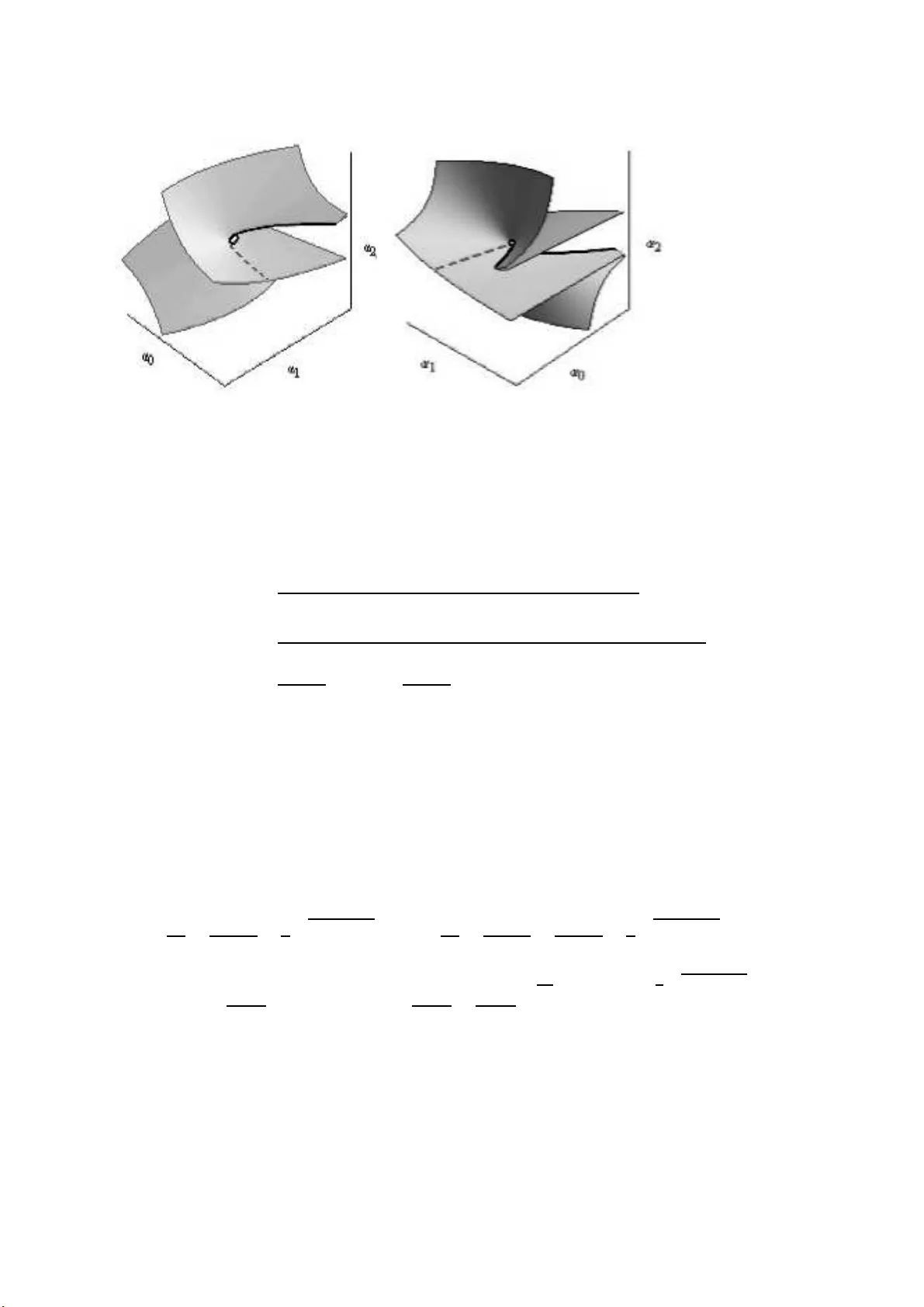
P oisson Y ang-Baxter maps with binomial Lax mat rices Theo doros E. Koulouk as , Departmen t of M a thematics, Univ ersit y of P atras, P atras, GR-265 00 Greece V assili os G. Pap ageorgiou , Departmen t of M a thematics, Univ ersit y of P atras, GR-265 00 P atras, Greece Octob er 24, 201 8 Abstract A construction of mu ltidimensio nal parametric Y ang- Baxter maps is presented. The corres p o nding Lax matrices are the symplectic leaves of first degre e matr ix p olyno mials equipp e d with the Skly anin bracket. These maps ar e symplectic with resp ect t o t he reduced symplectic structure on these lea ves and provide examples of integrable map- pings. An interesting family of quadrir ational sy mplectic YB ma ps on C 4 × C 4 with 3 × 3 Lax matrices is also presented. Con ten ts 1 In tro duction 2 2 Y ang-Baxter Maps and lax matrices 3 3 Symplectic Y ang–B axt er maps associate d to binomial 2 × 2 Lax mat rices 5 3.1 P oisson Y ang–Baxter maps from matrix re-factorization . . . . . . . . . . . 5 3.2 Reduction on symplectic lea v es . . . . . . . . . . . . . . . . . . . . . . . . . 8 3.3 Classification . . . . . . . . . . . . . . . . . . . . . . . . . . . . . . . . . . . 10 3.4 Degenerate YB maps . . . . . . . . . . . . . . . . . . . . . . . . . . . . . . . 12 4 Higher dimensional Y ang-Baxter maps 14 4.1 8-dimensional quadrirational symplectic YB maps with 3 × 3 Lax matrices 16 4.1.1 A 4-parametric symplectic Y-B map . . . . . . . . . . . . . . . . . . 17 4.1.2 The Boussinesq Y-B map ( α 0 = α 3 , α 1 = 3 α 2 , α 2 = 3 α ) . . . . . . . 19 4.1.3 The Goncharenk o–V ese lov map ( α 0 = − α 3 , α 1 = − α 2 , α 2 = α ) . . . 19 5 Conclusion 20 1 1 In tro duc tion Set theoretical solutions o f the qu an tum Y ang-Baxter equation h a ve extensiv ely b een stud ied b y m any authors after the p ioneer w ork of Drinfeld [5]. Ev en b efore that, examples of such solutions app eared in [20] by Sklya n in. W einstein and Xu [24] prop osed a co n struction of suc h solutions using the dressing action of Poi s s on Lie groups [1 8 ]. This wa s generalized later in [11], in order to construct s olutions on an y group that acts on itself and the action satisfies a compatibilit y condition. T he alge b raic asp ects of the Y ang-Baxt er equation we r e dev elop ed b y Etingof, Sc hedler and Solo viev [6 ]. V eselo v [22, 23] connected the set theoretical solutions of the quan tum Y ang-Baxte r equations w ith in tegrable mappings. More sp ecifically , he pro v ed that for su ch a solution, that admits a Lax matrix, there is a hierarch y of comm uting transfer maps whic h pr eserve the sp ectrum o f the corresp onding mono drom y matrix. F u rthermore he prop osed the shorter term ‘Y ang Baxter maps’ for the set theoretical s olutions of the quantum Y ang- Baxter equation. Y ang-Ba xter maps are closely related with in tegrable equations on quad-graphs. This is due to the multidimensional c onsistency pr op erty of these equations, introd uced in [4, 12], whic h in a wa y seems to b e equiv alen t with the Y ang-Baxte r prop erty . An explicit classification of equati ons on quad-graphs with fields in C that satisfy the 3- d imensional consistency prop er ty and of the Y ang-Baxter maps on CP 1 × CP 1 is giv en in [1] and [2] resp ectiv ely (see also [14]). Higher dimensional Y ang-Baxter maps are obtained fr om m ulti- field in tegrable lattice equations thr ough symm etry reduction [15, 16]. Lo op groups equipp ed with the Sklyanin brac k et p ro vide a natur al fr amew ork in order to deriv e Y ang-B axter maps with p olynomial Lax matrices. In [17] one of the most fundamen tal examples of a p arametric Y ang-Baxte r map, Adler’s map, is give n b y Hamiltonian reduction of the lo op group LGL 2 ( R ). Based on these id eas, a construction of P oisson parametric Y ang-Ba xter maps with first deg r ee p olynomial 2 × 2 La x matrices wa s presen ted b y the authors [9] from a r e-factorization p r o cedure guided b y the conserv ation of the Casimir functions un der the maps. By considering a complete set of Casimir functions, sym p lectic m ultiparametric Y ang-Baxter maps were d eriv ed w ith explicit f ormulae in terms of matrix op erations. The purp ose of this w ork is to generalize the metho d of [9] in order to derive sym p lectic Y ang-Ba xter maps with Lax matrices that are obtained by reduction on symplectic lea v es of b inomial matrices. The necessary d efinitions and n otation ab ou t YB maps and L ax m atrices, are giv en in section 2. Section 3 con tains th e main th eory of th e constru ction of sym plectic Y ang-Ba xter maps asso ciated to 2 × 2 Lax m atrices. Th is is generalize d in higher dimensions in section 4 using furth er assumptions. A general r e-factoriza tion f ormula of n × n binomial matrices is present ed. A reduction pro cedure of 3 × 3 binomial matrices to four d imensional symplectic lea v es, pro vid es a family of quadrirational, symplectic YB maps on C 4 × C 4 . Finally we conclude in section 5 by giving some comments and p ersp ectiv es f or future work. 2 2 Y ang-Baxter Maps and lax matrices Let X b e an y set. A map R : X × X → X × X , R : ( x, y ) 7→ ( u ( x, y ) , v ( x, y )), that satisfies the Y ang-Baxter e quation : R 23 R 13 R 12 = R 12 R 13 R 23 (1) is called Y ang-Baxter M ap (YB) [22]. Here b y R ij for i, j = 1 , ..., 3, w e denote the m ap that acts as R on th e i and j facto r of X × X × X and identic ally on the others i.e. R 12 ( x, y , z ) = ( u ( x, y ) , v ( x, y ) , z ) , R 13 ( x, y , z ) = ( u ( x, z ) , y , v ( x, z )) , R 23 ( x, y , z ) = ( x, u ( y , z ) , v ( y , z )) , for x, y , z ∈ X . F rom our p oin t of view, w e consider that the set X has the structure of an algebraic v ariet y . Th e YB map R is calle d non-de gener ate if the maps u ( · , y ) : X → X and v ( x, · ) : X → X are b ijectiv e maps and quadrir ational [2] if they are rational b ijectiv e maps. P arametric YB maps a p p ear in the stud y of in tegrable equations on quad-graphs. A p ar ametric YB ma p is a YB map: R : (( x, α ) , ( y , β )) 7→ (( u, α ) , ( v , β )) = (( u ( x, α, y , β ) , α ) , ( v ( x, α, y , β ) , β )) (2) where x, y ∈ X and the parameters α, β ∈ C n . W e usually k eep the parameters separately and d enote R ( x, α, y , β ) b y R α,β ( x, y ). Acco r ding to [21] a L ax Matrix for the YB map (2) is a matrix L ( x, α, ζ ) th at dep ends on the p oint x , the parameter α and a sp ectral parameter ζ (w e usually denote it just b y L ( x ; α )), such that L ( u ; α ) L ( v ; β ) = L ( y ; β ) L ( x ; α ) , (3) for an y ζ ∈ C . F ur th ermore if equation (3) is equiv alen t to ( u, v ) = R α,β ( x, y ) th en w e will call L ( x ; α ) str ong L ax matrix . A parametric YB map can b e rep r esen ted as a map assigned to the edges of an elemen- tary quadrilateral lik e in Fig.1. ( x ; α ) ( y ; β ) ( u ; α ) ( v ; β ) R α,β Figure 1: A map assigned to the edges of a quadrilateral W e can also represen t the maps R 23 R 13 R 12 and R 12 R 13 R 23 as c hains of maps at the faces of a cub e lik e in Fig.2 . The firs t map co r r esp ond s to th e c omp osition of t h e do wn , b ac k, left faces, while the second one to the right, fron t an d up p er faces. A ll the p arallel edges 3 to the x (resp. y , z ) axis carry the parameter α (resp . β , γ ). If w e denote by ( x ′′ , y ′′ , z ′′ ) and b y ( ˜ ˜ x, ˜ ˜ y , ˜ ˜ z ) the corresp ond ing v alues R 23 R 13 R 12 ( x, y , z ) and R 12 R 13 R 23 ( x, y , z ), then Eq.(1) assures that x ′′ = ˜ ˜ x, y ′′ = ˜ ˜ y and z ′′ = ˜ ˜ z . x y z ˜ z ˜ y ˜ x ˜ ˜ z ˜ ˜ y ˜ ˜ x x y z x ′ y ′ x ′′ z ′ y ′′ z ′′ R 23 R 13 R 12 R 12 R 13 R 23 ( i ) R 23 R 13 R 12 ( ii ) R 12 R 13 R 23 Figure 2: C ubic represent ation of the Y ang–Baxte r prop ert y The fol lowing prop osition [22, 9 ] giv es a sufficien t condition for a solutio n of the L ax equation (3), in order to satisfy th e Y ang-Baxter p rop erty . Prop osition 2.1. L et u = u α,β ( x, y ) , v = v α,β ( x, y ) and A ( x ; α ) a matrix dep ending on a p oint x , a p ar ameter α and a sp e ctr al p ar ameter ζ , such that A ( u ; α ) A ( v ; β ) = A ( y ; β ) A ( x ; α ) . If the e quation A ( ˆ x ; α ) A ( ˆ y ; β ) A ( ˆ z ; γ ) = A ( x ; α ) A ( y ; β ) A ( z ; γ ) (4) implies tha t ˆ x = x, ˆ y = y and ˆ z = z , then the map R α,β ( x, y ) = ( u, v ) is a p ar ametric Y ang-Baxter map with L ax matrix A ( x ; α ) . In a m ore g eneral setting concerning in tegrable lattice s (not necessary YB m aps), instead of the notion of a Lax matrix, th e n otion of a L ax p air is more suitable. A Lax pair for a map Φ α,β : (( x, α ) , ( y, β )) 7→ (( u, α ) , ( v, β )) = (( u ( x, α, y , β ) , α ) , ( v ( x, α, y , β ) , β )) is a pair of matrices L, M dep ending on a p oin t in X , a parameter and a s p ectral parameter ζ suc h that L ( u, α, ζ ) M ( v , β , ζ ) = M ( y , β , ζ ) L ( x, α, ζ ) , (5) for an y ζ ∈ C . Combinations of Lax pairs can provide so lu tions of the en t win ing Y ang- Baxter equation [10]. The d ynamical asp ects of the Y ang-Baxte r maps ha ve b een extensiv ely in vestig ated in [22] and [23] where commuting tr an s fer maps, that pr eserv e the sp ectrum of the corre- sp ond ing mono dromy matrices, are in tro duced for eac h YB map. These maps are b eliev ed to b e inte grable in the Liouville sense, i.e. symplectic mapp ings M 2 n → M 2 n that admit n functionally indep enden t in tegrals in inv olution. 4 3 Symplectic Y ang–Baxter maps asso ciated to binomial 2 × 2 Lax matrices A general matrix re-facto r ization pro cedure provides a w ay of constructing ratio n al multi- parametric Y ang-Baxte r maps on C 4 × C 4 with 2 × 2 Lax matrices in the form of first-degree matrix p olynomials. These maps are Poi s s on with resp ect to the S k lyanin brack et. By reduction on symplectic lea v es we d eriv e 4-dimensional symplectic parametric YB maps. The wh ole pro cedu re generalizes t h e one p resen ted in [9], where the leading terms of the matrix p olynomials w ere assum ed equal. 3.1 P oisson Y ang–Baxter maps from matrix re-factorization W e consider the set L 2 of 2 × 2 p olynomial matrices of the form L ( ζ ) = X − ζ A , ζ ∈ C equipp ed with the Skly anin b rac ke t [19]: { L ( ζ ) ⊗ , L ( η ) } = [ r ζ − η , L ( ζ ) ⊗ L ( η )] , (6) where r denotes the p erm utation matrix: r ( x ⊗ y ) = y ⊗ x . F or X = x 1 x 2 x 3 x 4 and A = a 1 a 2 a 3 a 4 , the brac ket s b et wee n the co ordinate fu nctions are giv en by the an tisymmetric P oisson struc- ture matrix : J A ( X ) = 0 − x 2 a 1 + x 1 a 2 x 3 a 1 − x 1 a 3 x 3 a 2 − x 2 a 3 ∗ 0 x 4 a 1 − x 1 a 4 x 4 a 2 − x 2 a 4 ∗ ∗ 0 − x 4 a 3 + x 3 a 4 ∗ ∗ ∗ 0 (7) where J A ( X ) ij = { x i − ζ a i , x j − ζ a j } , for i, j = 1 , ..., 4 . There are six linear indep endent Casimir fun ctions of L 2 whic h are the elemen ts a i , i = 1 , ..., 4, of the matrix A and the fu nctions: f 0 ( X ; A ) = det X , f 1 ( X ; A ) = a 4 x 1 − a 3 x 2 − a 2 x 3 + a 1 x 4 , i.e. the co efficients of the p olynomial p A X ( ζ ) := det ( X − ζ A ) = f 2 ( X ; A ) ζ 2 − f 1 ( X ; A ) ζ + f 0 ( X ; A ) with f 2 ( X ; A ) = det A (of course f 2 ( X ; A ) is also Casimir). F or any constant matrix A w e denote b y i A the im m ersion i A : X 7→ X − ζ A and by L 2 A the lev el set L 2 A = { X − ζ A | X ∈ M at (2 × 2) } . F urthermore for any pair of matrices A, B ∈ GL 2 ( C ), we define the matrix fun ctions Π 1 A,B , Π 2 A,B , with Π 1 A,B ( X, Y ) = f 2 ( X ; A )( Y A + B X ) − f 1 ( X ; A ) AB , (8) Π 2 A,B ( X, Y ) = f 2 ( X ; A ) Y X − f 0 ( X ; A ) AB . (9) 5 Prop osition 3.1. (r e-factorization) L et A, B b e invertible 2 × 2 matric es, su ch that AB = B A and X, Y ∈ M at (2 × 2) with det Π 1 A,B ( X, Y ) 6 = 0 . Then ( U − ζ A )( V − ζ B ) = ( Y − ζ B )( X − ζ A ) , (10) and p A U ( ζ ) = p A X ( ζ ) (e quivalently p B V ( ζ ) = p B Y ( ζ ) ), iff U = U A,B ( X, Y ) := Π 2 A,B ( X, Y )Π 1 A,B ( X, Y ) − 1 A, (11) V = V A,B ( X, Y ) := A − 1 ( Y A + B X − U ( X , Y ) B ) . (12) The pro of of this p rop osition is giv en in [10]. Lemma 1. L et A i , i = 1 , 2 , 3 b e thr e e inv e rtible matric es such that A i A j = A j A i , for i, j = 1 , 2 , 3 . Then ( X ′ 1 − ζ A 1 )( X ′ 2 − ζ A 2 )( X ′ 3 − ζ A 3 ) = ( X 1 − ζ A 1 )( X 2 − ζ A 2 )( X 3 − ζ A 3 ) (13) and p A i X ′ i ( ζ ) = p A i X i ( ζ ) for every X i ∈ M at (2 × 2) , i = 1 , 2 , 3 and ζ ∈ C , iff X ′ 1 = X 1 , X ′ 2 = X 2 X ′ 3 = X 3 . The pro of of this lemma can b e traced in th e app endix of [10]. Prop osition 3.2. L et K : C d → GL 2 ( C ) , b e a d–p ar ametric family of c ommuting matric es. F or every α, β ∈ C d the map R α,β ( X, Y ) = ( U K ( α ) ,K ( β ) ( X, Y ) , V K ( α ) ,K ( β ) ( X, Y )) := ( U, V ) (14) define d by (11), (12), is a p ar ametric Y ang-Baxter map with L ax matrix L ( X ; α ) = i K ( α ) ( X ) such tha t p K ( α ) U ( ζ ) = p K ( α ) X ( ζ ) and p K ( β ) V ( ζ ) = p K ( β ) Y ( ζ ) . Pro of: F o r U = U K ( α ) ,K ( β ) ( X, Y ), V = V K ( α ) ,K ( β ) ( X, Y ) an d L ( X ; α ) = i K ( α ) ( X ), from prop osition 3.1 w e hav e that L ( U ; α ) L ( V ; β ) = L ( Y ; β ) L ( X ; α ) and p K ( α ) U ( ζ ) = p K ( α ) X ( ζ ), p K ( β ) V ( ζ ) = p K ( β ) Y ( ζ ). No w , if w e set R 12 α,β ( X, Y , Z ) = ( X ′ , Y ′ , Z ) , R 13 α,γ ◦ R 12 α,β ( X, Y , Z ) = ( X ′′ , Y ′ , Z ′ ) , R 23 β ,γ ◦ R 13 α,γ ◦ R 12 α,β ( X, Y , Z ) = ( X ′′ , Y ′′ , Z ′′ ) , then L ( Y ; β ) L ( X ; α ) = L ( X ′ ; α ) L ( Y ′ ; β ), and p K ( α ) X ′ ( ζ ) = p K ( α ) X ( ζ ), p K ( β ) Y ′ ( ζ ) = p K ( β ) Y ( ζ ). So L ( Z ; γ ) L ( Y ; β ) L ( X ; α ) = ( L ( Z ; γ ) L ( X ′ ; α )) L ( Y ′ ; β ) = L ( X ′′ ; α )( L ( Z ′ ; γ ) L ( Y ′ ; β )) = L ( X ′′ ; α ) L ( Y ′′ β ) L ( Z ′′ ; γ ) 6 and p K ( α ) X ′′ ( ζ ) = p K ( α ) X ( ζ ) , p K ( β ) Y ′′ ( ζ ) = p K ( β ) Y ( ζ ) , p K ( γ ) Z ′′ ( ζ ) = p K ( γ ) Z ( ζ ) . On th e other hand for R 23 β ,γ ( X, Y , Z ) = ( X , ˜ Y , ˜ Z ) , R 13 α,γ ◦ R 23 β ,γ ( X, Y , Z ) = ( ˜ X , ˜ Y , ˜ ˜ Z ) , R 12 α,β ◦ R 13 α,γ ◦ R 23 β ,γ ( X, Y , Z ) = ( ˜ ˜ X, ˜ ˜ Y , ˜ ˜ Z ) w e get L ( Z ; γ ) L ( Y ; β ) L ( X ; α ) = L ( ˜ ˜ X ; α ) L ( ˜ ˜ Y ; β ) L ( ˜ ˜ Z ; γ ) and p K ( α ) ˜ ˜ X ( ζ ) = p K ( α ) X ( ζ ), p K ( β ) ˜ ˜ Y ( ζ ) = p K ( β ) Y ( ζ ), p K ( γ ) ˜ ˜ Z ( ζ ) = p K ( γ ) Z ( ζ ) . So fin ally we h a v e th at L ( X ′′ ; α ) L ( Y ′′ β ) L ( Z ′′ ; γ ) = L ( ˜ ˜ X ; α ) L ( ˜ ˜ Y ; β ) L ( ˜ ˜ Z ; γ ) , p K ( α ) X ′′ ( ζ ) = p K ( α ) ˜ ˜ X ( ζ ) , p K ( β ) Y ′′ ( ζ ) = p K ( β ) ˜ ˜ Y ( ζ ) , p K ( γ ) Z ′′ ( ζ ) = p K ( γ ) ˜ ˜ Z ( ζ ) and from lemma 1 we derive X ′′ = ˜ ˜ X, Y ′′ = ˜ ˜ Y , Z ′′ = ˜ ˜ Z , i.e. R 23 β ,γ ◦ R 13 α,γ ◦ R 12 α,β = R 12 α,β ◦ R 13 α,γ ◦ R 23 β ,γ . W e will refer to the Y ang-Baxter m ap of Prop. 3.2 as the gener al p ar ametric Y ang- Baxter map asso ciate d with the function K . W e hav e to notice that in general the Lax matrix L ( X ; α ) = i K ( α ) ( X ) is not a strong Lax matrix. F or example by consid er in g K ( α ) = B for a constan t B ∈ GL 2 ( C ), the equation i B ( U ) i B ( V ) = i B ( Y ) i B ( X ) except of the corresp onding solution (11),(12), admits also the trivial solution U = Y , V = X (elemen tary inv olution). No w w e return to the P oisson structure (7). W e can extend the Poisson br ac k et of L 2 to the Cartesian p ro duct L 2 × L 2 as follo ws : { x i , x j } = J A ( X ) ij , { y i , y j } = J B ( Y ) ij , { x i , y j } = 0 , (15) for an y ( X − ζ A, Y − ζ B ) ∈ L 2 × L 2 where x i , x j , y i , y j for i = 1 , ..., 4 are the elemen ts of th e matrices X, Y r esp ectiv ely . Prop osition 3.3. The map R : L 2 K ( α ) × L 2 K ( β ) → L 2 K ( α ) × L 2 K ( β ) , R : ( X − ζ K ( α ) , Y − ζ K ( β )) 7→ ( U K ( α ) ,K ( β ) ( X, Y ) − ζ K ( α ) , V K ( α ) ,K ( β ) ( X, Y ) − ζ K ( β )) (16) is a Poisson map . Pro of: A direct computation of the Poisson br ac k ets of th e elemen ts of U = U K ( α ) ,K ( β ) ( X, Y ) and V = V K ( α ) ,K ( β ) ( X, Y ) defined b y (11), (12) giv es: { u i , u j } = J K α ( U ) ij , { v i , v j } = J K β ( V ) ij , { u i , v j } = 0 , for i = 1 , ..., 4. If w e co n sider the permutatio n map r : ( X , Y ) 7→ ( Y , X ) and t h e m ultiplication map m : ( X, Y ) 7→ X Y , then R is th e unique map d efined b y the comm u tative diagram: 7 L 2 k ( α ) × L 2 k ( β ) r R / / L 2 k ( α ) × L 2 k ( β ) m L 2 k ( β ) × L 2 k ( α ) m / / L 2 2 C ommutativ e diag r am Here L 2 2 denotes the second d egree p olynomial 2 × 2 matrices. F rom prop osition 3.3 and the m ultiplication prop erty of the Sklya n in b r ac k et w e conclude that eac h map of this diagram is P oisson. 3.2 Reduction on symplectic lea ves In the p revious section it was p oin ted out that the matrix A of a generic element X − ζ A = x 1 x 2 x 3 x 4 − ζ a 1 a 2 a 3 a 4 ∈ L 2 , b elongs to the cen ter of the Sklyanin algebra. I n the four d imensional Po isson subman if old L 2 A there are tw o Casimir fun ctions f 0 ( X ; A ) = det X f 1 ( X ; A ) = a 4 x 1 − a 3 x 2 − a 2 x 3 + a 1 x 4 . W e restrict on the lev el set of the Casimir f unctions by solving the system f 0 ( X ; A ) = α 0 , f 1 ( X ; A ) = α 1 with resp ect to t w o elements x i , x j of X . So w e consider t wo fun ctions h A , g A , defined on an op en set D ⊂ C 4 , suc h that x i = h ( x k , x l , α 0 , α 1 ) and x j = g A ( x k , x l , α 0 , α 1 ) , k , l / ∈ { i, j } . (17) W e denote b y pr k ,l the p ro jection of a matrix to its k , l elemen ts (b y orderin g the elemen ts of a matrix f rom one to f our as b efore) and b y P r the map P r = pr k ,l × p r k ,l : ( X, Y ) 7→ ( pr k ,l ( X ) , pr k ,l ( Y )) . By sub stituting the x i , x j to the m atrix X we define the parametric matrix L ′ A ( x k , x l ; α 0 , α 1 ). F or simp licit y we ren u m b er x k 7→ x 1 , x l 7→ x 2 and w e come up to the matrix L ′ A ( x 1 , x 2 ; α 0 , α 1 ) that satisfies the f ollo wing equations f 0 ( L ′ A ( x 1 , x 2 ; α 0 , α 1 ); A ) = α 0 f 1 ( L ′ A ( x 1 , x 2 ; α 0 , α 1 ); A ) = α 1 . The connected comp onents of Σ A ( α 0 , α 1 ) = { L ′ A ( x 1 , x 2 ; α 0 , α 1 ) − ζ A | x 1 , x 2 ∈ D ⊂ C } are t wo d imensional s ymplectic lea v es of L 2 A . By the next p rop osition th e general YB map R α,β of Prop. 3.2 is r ed uced on the symplectic lea v es Σ K ( α ) ( α 0 , α 1 ) × Σ K ( β ) ( β 0 , β 1 ) of L 2 × L 2 . 8 Prop osition 3.4. L et K : C d 7→ GL 2 ( C ) b e a d–p ar ametric family of c ommuting matric es. F or every α, β ∈ C d , the map R ¯ α, ¯ β (( x 1 , x 2 ) , ( y 1 , y 2 )) = P r ◦ R α,β ( L ′ K ( α ) ( x 1 , x 2 ; α 0 , α 1 ) , L ′ K ( β ) ( y 1 , y 2 ; β 0 , β 1 )) , (18) is a non-de gene r ate symple ctic Y ang-B axter map with ve ctor p ar ameters ¯ α = ( α, α 0 , α 1 ) , ¯ β = ( β , β 0 , β 1 ) ∈ V × C 2 and str ong L ax matrix L ( x 1 , x 2 ; ¯ α ) = i K ( α ) ( L ′ K ( α ) ( x 1 , x 2 ; α 0 , α 1 )) = L ′ K ( α ) ( x 1 , x 2 ; α 0 , α 1 ) − ζ K ( α ) . (19) Pro of: F o r X = L ′ K ( α ) ( x 1 , x 2 ; α 0 , α 1 ) and Y = L ′ K ( β ) ( y 1 , y 2 ; β 0 , β 1 ) we d efine the matrices U = U K ( α ) ,K ( β ) ( X, Y ) , V = V K ( α ) ,K ( β ) ( X, Y )) by (11), (12) ( U, V ) = R α,β ( X, Y ) = R α,β ( L ′ K ( α ) ( x 1 , x 2 ; α, α 0 , α 1 ) , L ′ K ( β ) ( y 1 , y 2 ; β , β 0 , β 1 )) . Since f i ( U ; K ( α )) = f i ( X ; K ( α )) = α i and f i ( V ; K ( β )) = f i ( Y ; K ( β )) = β i for i = 0 , 1, then U = L ′ K ( α ) ( u 1 , u 2 ; α 0 , α 1 ) and V = L ′ K ( β ) ( v 1 , v 2 ; β 0 , β 1 ). The p ro jection P r ( U, V ) giv es the corresp onding elemen ts u = ( u 1 , u 2 ) and v = ( v 1 , v 2 )). So the YB prop erty of the map R ¯ α, ¯ β : (( x 1 , x 2 ; ¯ α ) , ( y 1 , y 2 ; ¯ β )) 7→ (( u 1 , u 2 , ¯ α ) , ( v 1 , v 2 , ¯ β )), is immediately derive d from the YB prop ert y of the P oisson map R α,β . F urthermore p rop osition 3.2 implies that i K ( α ) ( U ) i K ( β ) ( V ) = i K ( β ) ( Y ) i K ( α ) ( X ), so ( L ′ K ( α ) ( u 1 , u 2 ; α 0 , α 1 ) − ζ K α )( L ′ K ( β ) ( v 1 , v 2 ; β 0 , β 1 ) − ζ K β ) = ( L ′ K ( β ) ( y 1 , y 2 ; β 0 , β 1 ) − ζ K β )( L ′ K ( α ) ( x 1 , x 2 ; α 0 , α 1 ) − ζ K α ) (20) whic h means that L ( x 1 , x 2 ; ¯ α ) = L ′ K ( α ) ( x 1 , x 2 ; α 0 , α 1 ) − ζ K α is a Lax matrix for R ¯ α, ¯ β . Also, from prop osition 3.1 we conclud e that L ( x 1 , x 2 ; ¯ α ) is a strong Lax matrix. Finally we notice that equation (20) is d ir ectly solv able with resp ect to v = ( v 1 , v 2 ) and x = ( x 1 , x 2 ), since K − 1 β L ′ K β ( v ; ˆ β ) = ( L ′ K α ( u ; ˆ α ) K β − L ′ K β ( y ; ˆ β ) K α ) − 1 L ′ K β ( y ; ˆ β ) K − 1 β ( L ′ K α ( u ; ˆ α ) K β − L ′ K β ( y ; ˆ β ) K α ) , K − 1 α L ′ K α ( x ; ˆ α ) = ( L ′ K β ( y ; ˆ β ) K α − L ′ K α ( u ; ˆ α ) K β ) − 1 L ′ K α ( u ; ˆ α ) K − 1 α ( L ′ K β ( y ; ˆ β ) K α − L ′ K α ( u ; ˆ α ) K β ) for y = ( y 1 , y 2 ), u = ( u 1 , u 2 ), ˆ α = ( α 0 , α 1 ) and ˆ β = ( β 0 , β 1 ). That p ro ves the n on-degeneracy of th e YB map (18). R emark 3.5 . F rom the construction of the Lax matrix L ( x 1 , x 2 ; ¯ α ) and lemma 1 we can pro ve that the equation: L ( x ′ 1 , x ′ 2 ; ¯ α ) L ( y ′ 1 , y ′ 2 ; ¯ β ) L ( z ′ 1 , z ′ 2 ; ¯ γ ) = L ( x 1 , x 2 ; ¯ α ) L ( y 1 , y 2 ; ¯ β ) L ( z 1 , z 2 ; ¯ γ ) implies x ′ = x, y ′ = y and z ′ = z (with ou t further assumptions). So the YB pr op ert y of the m ap (18) can b e deriv ed directly from Prop. 2.1. R emark 3.6 . If w e set α 0 = β 0 = k on the YB map (18) w e obtain the parametric YB map R ¯ α, ¯ β with parameters ¯ α = ( α, a 1 ) , ¯ β = ( β , b 1 ) ∈ V × C and Lax matrix L ( x 1 , x 2 ; α, α 1 ) := L ( x 1 , x 2 ; α, k , α 1 ). W e ha v e analogous results if w e id en tify any other pair of p arameters. If w e set ¯ α = ¯ β then we derive the trivial solution U = Y , V = X , b ecause this is the only solution of E q .(10 ) with A = B , f 0 ( U ; A ) = f 0 ( Y ; A ) and f 1 ( U ; A ) = f 1 ( Y ; A ). 9 3.3 Classification In this section w e classify the qu adrirational YB maps w ith 2 × 2 binomial Lax matrices of our construction. In [9] a classification b y Jordan normal forms w as giv en for the case K ( α ) = K ( β ) = B , with B a 2 × 2 constant matrix. Here w e giv e a more general classification in order to include all the cases that we considered. First we begin by determining the functions K of prop osition 3.2. Actually w e are going to co n sider the problem of families of commuting m atrices up to conjugation. One can brin g one mem b er of the f amily to its J ordan ca n onical form and find all matrices comm uting with it. F rom this analysis w e conclude that, up to conju gation, there are only tw o (non-disjoint ) famili es of comm u ting pairs of matrices I ) A = a 1 0 0 a 2 , B = b 1 0 0 b 2 and I I ) A = a 1 a 2 0 a 1 , B = b 1 b 2 0 b 1 . Since the equation (3) and th e YB maps are inv arian t under conju gation w e can restrict to these t wo general cases of the function K : C 2 → GL 2 ( C ). The last step to w ard s th e classification is to examine the relev ance of the choic e of v ariables in the construction of the L ax matrix that w e present ed in the previous section. In the fi rst case, w here K ( α ) is a matrix of the first family for an y α ∈ C 2 , the equations f 0 ( X ; K ( α )) = α 0 , f 1 ( X ; K ( α )) = α 1 (21) are sol v able with resp ect to an y pair ( x i , x j ), for i, j = 1 , ..., 4 , i 6 = j , except of the pair ( x 2 , x 3 ), w hile for a matrix K ( α ) of the second family the equations are solv able with resp ect to an y pair ( x i , x j ), i, j = 1 , ..., 4 , i 6 = j . No w, let us supp ose that, by solving equations (21) in a differen t wa y , we ha v e deriv ed tw o matrices L ′ K ( α ) ( x 1 , x 2 ; α 0 , α 1 ), M ′ K ( α ) ( x ′ 1 , x ′ 2 ; α 0 , α 1 ) suc h that f 0 ( L ′ K ( α ) ( x 1 , x 2 ; α 0 , α 1 ); K ( α )) = α 0 , f 1 ( L ′ K ( α ) ( x 1 , x 2 ; α 0 , α 1 ); K ( α )) = α 1 and f 0 ( M ′ K ( α ) ( x ′ 1 , x ′ 2 ; α 0 , α 1 ); K ( α )) = α 0 , f 1 ( M ′ K ( α ) ( x ′ 1 , x ′ 2 ; α 0 , α 1 )); K ( α )) = α 1 . Then there is a local diffeomorphism φ ¯ α : C 2 → C 2 ( ¯ α = ( α, α 0 , α 1 ) ∈ C 4 ), s u c h that φ ¯ α : ( x 1 , x 2 ) 7→ ( x ′ 1 , x ′ 2 ) and M ′ K ( α ) ( φ ¯ α ( x 1 , x 1 ); α 0 , α 1 ) = L ′ K ( α ) ( x 1 , x 2 ; α 0 , α 1 ) . No w if we denote b y R ¯ α, ¯ β , R ′ ¯ α, ¯ β the parametric YB maps with strong Lax matrices L ( x 1 , x 2 ; ¯ α ) = L ′ K ( α ) ( x 1 , x 2 ; α 0 , α 1 ) − ζ K ( α ) and M ( x ′ 1 , x ′ 2 ; ¯ α ) = M ′ K ( α ) ( x ′ 1 , x ′ 2 ; α 0 , α 1 ) − ζ K ( α ) resp ectiv ely , then ( φ ¯ α × φ ¯ β ) ◦ R ′ ¯ α, ¯ β = R ¯ α, ¯ β ◦ ( φ ¯ α × φ ¯ β ) . (22) F rom the ab ov e analysis w e conclud e that ev ery f our p arametric n on-degenerate YB map on C 2 × C 2 , of p rop osition 3.4, can b e reduced up to equiv alence (22) and reparametrizatio n (see also remark 3.6) into one of the follo win g t wo cases. 10 Case I W e consider the generic element X − ζ K 1 ( α 1 , α 2 ) ∈ L 2 K 1 ( α 1 ,α 2 ) with X = x 1 x 2 x 3 x 4 and K 1 ( α 1 , α 2 ) = α 1 0 0 α 2 . The Casimir functions in this case are f 1 ( X ; K 1 ( α 1 , α 2 )) = α 2 x 1 + α 1 x 4 , f 0 ( X ; K 1 ( α 1 , α 2 )) = x 1 x 4 − x 2 x 3 . By setting f 0 ( X ; α 1 , α 2 ) = α 3 , f 1 ( X ; α 1 , α 2 ) = α 4 and solving with r esp ect to x 3 , x 4 , for α 1 , x 2 6 = 0, w e derive the matrix L ′ K 1 ( ˆ α ) ( x 1 , x 2 ; α 3 , α 4 ) = x 1 x 2 x 1 ( α 4 − α 2 x 1 ) − α 1 α 3 α 1 x 2 α 4 − α 2 x 1 α 1 ! with ˆ α = ( α 1 , α 2 ) (23) and the 8-parametric quadrirational YB map of prop osition 3.4 R 1 ¯ α, ¯ β (( x 1 , x 2 ) , ( y 1 , y 2 )) = P r ◦ R 1 ˆ α, ˆ β ( L ′ K 1 ( ˆ α ) ( x 1 , x 2 ; α 3 , α 4 ) , L ′ K 1 ( ˆ β ) ( y 1 , y 2 ; β 3 , β 4 )) . Here R 1 ˆ α, ˆ β is the general p arametric YB map (14) asso ciated with the function K 1 , the pro jection P r = pr 1 , 2 × pr 1 , 2 (pro jections at the elemen ts of the first arro w of a mat r ix) and the p arameters are ¯ α = ( α 1 , α 2 , α 3 , α 4 ), ¯ β = ( β 1 , β 2 , β 3 , β 4 ). According to prop. 3.4 , this map ad m its the strong Lax matrix L 1 ( x 1 , x 2 ; ¯ α ) = L ′ K 1 ( ˆ α ) ( x 1 , x 2 ; α 3 , α 4 ) − ζ K 1 ( α 1 , α 2 ) , and for α 1 , β 1 6 = 0 it is a symp lectic rational map on { ( x 1 , x 2 ) , ( y 1 , y 2 ) ∈ C 2 × C 2 | x 2 , y 2 6 = 0 } , with resp ect to th e reduced symplectic form defined b y the brack ets: { x 1 , x 2 } = − α 1 x 2 , { y 1 , y 2 } = − β 1 y 2 , { x i , y j } = 0 for i = 1 , 2 . Case I I F or K 2 ( α 1 , α 2 ) = α 1 α 2 0 α 1 w e set again f 0 ( X ; K 2 ( α 1 , α 2 )) = α 3 , f 1 ( X ; K 2 ( α 1 , α 2 )) = α 4 and solv e with resp ect to to x 3 , x 4 to get L ′ K 2 ( ˆ α ) ( x 1 , x 2 ; α 3 , α 4 ) = x 1 x 2 α 4 x 1 − α 1 ( x 1 2 + α 3 ) α 1 x 2 − α 2 x 1 α 2 α 3 − α 4 x 2 + α 1 x 1 x 2 α 2 x 1 − α 1 x 2 ! , with ˆ α = ( α 1 , α 2 ) (24) and the corresp onding YB map R 2 ¯ α, ¯ β (( x 1 , x 2 ) , ( y 1 , y 2 )) = P r ◦ R 2 ˆ α, ˆ β ( L ′ K 2 ( ˆ α ) ( x 1 , x 2 ; α 3 , α 4 ) , L ′ K 2 ( ˆ β ) ( y 1 , y 2 ; β 3 , β 4 )) , with ¯ α = ( α 1 , α 2 , α 3 , α 4 ) , ¯ β = ( β 1 , β 2 , β 3 , β 4 ) , P r = pr 1 , 2 × pr 1 , 2 and R 2 ˆ α, ˆ β the gen- eral parametric YB map associated with K 2 . This map admits th e strong Lax matrix 11 L 2 ( x 1 , x 2 ; ¯ α ) = L ′ K 2 ( ˆ α ) ( x 1 , x 2 ; α 3 , α 4 ) − ζ K 2 ( α 1 , α 2 ). The reduced Skly anin brac ket in this case is giv en by brac kets of the co ord inates { x 1 , x 2 } = α 2 x 1 − α 1 x 2 , { y 1 , y 2 } = β 2 y 1 − β 1 y 2 , { x i , y j } = 0 for i, j = 1 , 2 . As it was pointed out, YB maps with less parameters can b e co n structed from these t wo cases by setting α i = β i = k f or some i ∈ { 1 , 2 } . Also, b y using appropriate scalings, one can reduce the n u m b er of parameters. Ho wev er, we d o not do this here, ha ving in mind degenerate ca ses in sub section 3.4 b elo w, as we ll as consideration of con tinuous limits in the f uture. Remark. If we ar e inter e ste d in r e al L ax matric es we ha ve to include als o t he c ase wher e K 3 ( α 1 , α 2 ) = α 1 − α 2 α 2 α 1 and the c orr esp onding YB map of pr op osition 3.4. 3.4 Degenerate YB map s Degenerate YB maps can arise w hen K ( α ) is not inv ertible. A wa y of constru cting degener- ate YB map s as limits of the non-degenerate ones w as presented in [9] f or K ( α ) = K ( β ) = C onstant . W e will apply this metho d here as w ell for K ( α ) 6 = K ( β ). W e consider a fun ction K : V → GL 2 ( C ), V ⊂ C 4 , d ep endin g fr om a parameter ε , suc h that K ( α, ε ) K ( β , ε ) = K ( β , ε ) K ( α, ε ) and lim ε → 0 det K ( α, ε ) = 0 for ev ery α, β ∈ C m , m ≤ 4. W e construct th e corresp ond ing non-degenerate YB m ap R ¯ α, ¯ β ( ε ) of pr op osition 3.4. Th e limit o f R ¯ α, ¯ β ( ε ), for ε → 0, ca n lead to a r ational dege n erate YB map on C 2 × C 2 . The induced Poisson structure is defined by the limit of the S kly anin brac k et. W e apply this construction in the n ext concrete example. A generalization of t he Adler-Y amilo v map W e consider the function K : C → GL 2 ( C ) with K ( α 1 ) = K α 1 = α 1 0 0 ε . The Casimir functions on L 2 K ( α 1 ) are : f 0 ( X ; K ( α 1 )) = x 11 x 22 − x 12 x 21 , f 1 ( X ; K ( α 1 )) = εx 11 + α 1 x 22 . (Here we denote b y x ij the elemen ts of the matrix X ). If we set f 0 ( X ; K ( α 1 )) = α 2 , f 1 ( X ; K ( α 1 )) = α 3 and solve with r esp ect to x 11 , x 22 w e hav e x 11 = 1 2 ε ( α 3 − ( α 2 3 − 4 α 1 ε ( α 2 + x 12 x 21 )) 1 / 2 ) , x 22 = 1 2 α 1 ( α 3 + ( α 2 3 − 4 α 1 ε ( α 2 + x 12 x 21 )) 1 / 2 ) . By su bstituting this v alues to X − ζ K ( α 1 ) and ren aming x 12 , x 21 as x 1 and x 2 resp ectiv ely , w e obtain the three-parametric Lax matrix L ( x 1 , x 2 ; ¯ α ) = α 3 − ( α 2 3 − 4 α 1 ε ( α 2 + x 1 x 2 )) 1 / 2 2 ε − α 1 ζ x 1 x 2 α 3 +( α 2 3 − 4 α 1 ε ( α 2 + x 1 x 2 )) 1 / 2 2 α 1 − εζ ! (25) 12 with ¯ α = ( α 1 , α 2 , α 3 ), of the n on-degenerate YB m ap of prop osition 3.4 R ¯ α, ¯ β (( x 1 , x 2 ) , ( y 1 , y 2 )) = (( u 1 , u 2 ) , ( v 1 , v 2 )) . (26) Here u 1 , u 2 , v 1 , v 2 are the corresp ondin g elemen ts u 12 , u 21 , v 12 , v 21 of the matrices: [ u ij ] := U = ( α 1 εY X − α 2 K α 1 K β 1 )(( α 1 ε ( Y K α 1 + K β 1 X ) − α 3 K α 1 K β 1 ) − 1 K α 1 [ v ij ] := V = K − 1 α 1 ( Y K α 1 + K β 1 X − U K β 1 ) , for X = L ′ K ( α 1 ) ( x 1 , x 2 ; ¯ α ) ≡ L ( x 1 , x 2 ; ¯ α ) + ζ K α and Y = L ′ K ( α 1 ) ( y 1 , y 2 ; ¯ β ) ≡ L ( y 1 , y 2 ; ¯ β ) + ζ K β . The limit of (26), f or ε → 0, giv es the degenerate 6-parametric Y ang-Baxter map ˜ R ¯ α, ¯ β (( x 1 , x 2 ) , ( y 1 , y 2 )) = (( ¯ u 1 , ¯ u 2 ) , ( ¯ v 1 , ¯ v 2 )) , where ¯ u 1 = β 1 α 1 β 3 ( α 3 y 1 − Qx 1 ) , ¯ u 2 = α 1 β 1 y 2 , ¯ v 1 = β 1 α 1 x 1 , ¯ v 2 = α 1 β 1 α 3 ( β 3 x 2 − Qy 2 ) , and Q = α 1 β 1 ( α 2 β 3 − α 3 β 2 ) α 3 β 3 + α 1 β 1 x 1 y 2 . This map is symplectic with resp ect to th e symplectic form obtained b y taking the li m it, for ε → 0, of J K α ( L ′ ( x 1 , x 2 ; ¯ α )) and J K α ( L ′ ( y 1 , y 2 ; ¯ β )), { x 1 , x 2 } = α 3 , { y 1 , y 2 } = β 3 , { x i , y j } = 0 , (27) and admits the strong Lax matrix M ( x 1 , x 2 ; ¯ α ) = lim ε → 0 L ( x 1 , x 2 ; ¯ α ) = α 1 α 3 ( α 2 + x 1 x 2 ) − α 1 ζ x 1 x 2 α 3 α 1 . If we set α 3 = β 3 = 1 on the m ap ˜ R ¯ α, ¯ β w e deriv e th e 4-parametric YB map ˜ R ( α 1 ,α 2 ) , ( β 1 ,β 2 ) with strong Lax matrix M ( x 1 , x 2 ; α 1 , α 2 , 1). The induced symplectic form in this c ase is the ca n onical one. Moreo v er by setting α 1 = β 1 = α 3 = β 3 = 1, ¯ R ¯ α, ¯ β is reduced to the Adler-Y amilo v map [3, 9]. According t o [13, 10] the mono drom y matrix of the 1-p erio d ic ‘sta ircase’ initial v alue problem on a qu adrilateral lattice is M 1 ( x 1 , x 2 , y 1 , y 2 ) ≡ M ( y 1 , y 2 ; ¯ β ) M ( x 1 , x 2 ; ¯ α ). The trace of the mono dromy matrix giv es the t wo functionally indep end en t in tegrals : J 1 ( x 1 , x 2 , y 1 , y 2 ) = α 1 β 1 α 3 x 1 x 2 + α 1 β 1 β 3 y 1 y 2 J 2 ( x 1 , x 2 , y 1 , y 2 ) = x 2 y 1 + x 1 y 2 + α 1 β 1 α 3 β 3 ( α 2 + x 1 x 2 )( β 2 + y 1 y 2 ) . W e can verify that these in tegrals are in in v olution with resp ect to (27). So w e conclude that th e map ˜ R ¯ α, ¯ β (( x 1 , x 2 ) , ( y 1 , y 2 )) 7→ (( ¯ u 1 , ¯ u 2 ) , ( ¯ v 1 , ¯ v 2 )) is integrable in the Liouville sense. F or the Adler-Y amilo v map the corresp ond ing in tegrals are giv en by setting α 1 = β 1 = α 3 = β 3 = 1 in J 1 and J 2 . 13 4 Higher dimensional Y ang-Baxter maps In order to generate higher dimen s ional Y ang-Baxter maps we consider the set L n of n order p olynomial matrices of the form X − ζ A . There are n ( n + 1) fu nctionally indep en den t Casimir functions on L n with resp ect to th e S kly anin b rac k et (6 ), whic h are again the n 2 elemen ts of A and th e n fun ctions f i , i = 0 , ..., n − 1, defined as the co efficien ts of the p olynomial p A X ( ζ ) = det ( X − ζ A ), p A X ( ζ ) = ( − 1) n f n ( X ; A ) ζ n + ( − 1) n − 1 f n − 1 ( X ; A ) ζ n − 1 + ... + ( − 1) f 1 ( X ; A ) ζ + f 0 ( X ; A ) where f n ( X ; A ) = detA and f 0 ( X ; A ) = detX . As in the 2 × 2 case, w e consider K : C d → GL n ( C ) a d –parametric family of commuting matrices. Next, for α ∈ C d , we denote the v alue K ( α ) by K α and the v alues of the Casimirs f i ( X ; K ( α )) by f i ( X ; α ), i = 0 , ..., n . Prop osition 4.1. L et U and V b e n × n matric es that satisfy the fol lowing two c onditions (i) f i ( U ; α ) = f i ( X ; α ) a nd f i ( V ; β ) = f i ( Y ; β ) for i = 0 , ..., n − 1 , (ii) ( U − ζ K α )( V − ζ K β ) = ( Y − ζ K β )( X − ζ K α ) , identic al ly in ζ ∈ C for X , Y ∈ M at ( n × n ) suc h that det P n i =1 ( − 1) i f i ( X ; α ) M i − 1 6 = 0 } . Then U = − f 0 ( X ; α ) I − n X i =1 ( − 1) i f i ( X ; α ) N i − 1 ! n X i =1 ( − 1) i f i ( X ; α ) M i − 1 ! − 1 K α (28) V = K − 1 α ( Y K α + K β X − U K β ) , (29) wher e M i , N i ar e give n by: M 0 = I , N 0 = 0 , M 1 = ( Y K α + K β X ) K − 1 β K − 1 α , N 1 = − Y X K − 1 β K − 1 α , M i = M 1 M i − 1 + N i − 1 , N i = N 1 M i − 1 , f or i = 2 , ..., n. Pro of: Since f i ( U ; α ) = f i ( X ; α ), for i = 1 , ..., n , th en p K α U ( ζ ) = p K α X ( ζ ). Ca yley-Hamilt on theorem states that p K α U ( U K − 1 α ) = p K α X ( U K − 1 α ) = 0. So n X i =1 ( − 1) i f i ( X ; α )( U K − 1 α ) i = − f 0 ( X ; α ) I , i = 1 , ..., n. (30) F urthermore from ( ii ) w e derive the system: U V = Y X , U K β + K α V = Y K α + K β X (31) whic h implies ( U K − 1 α ) 2 = U K − 1 α ( Y K α + K β X ) K − 1 β K − 1 α − Y X K − 1 β K − 1 α . (32) 14 F or simplicit y w e s et ˜ U = U K − 1 α , M 1 = ( Y K α + K β X ) K − 1 β K − 1 α and N 1 = − Y X K − 1 β K − 1 α . So equation (32) can b e written as ˜ U 2 = ˜ U M 1 + N 1 . Also if w e se t M 0 = I , N 0 = 0 and define M i , N i from the r ecurrence relations: M i = M 1 M i − 1 + N i − 1 , N i = N 1 M i − 1 f or i = 1 , ..., n, (33) then we can ev aluate the p ow ers of ˜ U k as ˜ U k = ˜ U M k − 1 + N k − 1 for k = 1 , ..., n . So equation (30) b ecomes: n X i =1 ( − 1) i f i ( X ; α )( ˜ U M i − 1 + N i − 1 ) = − f 0 ( X ; α ) I , and finally w e hav e ˜ U = − f 0 ( X ; α ) I − n X i =1 ( − 1) i f i ( X ; α ) N i − 1 ! n X i =1 ( − 1) i f i ( X ; α ) M i − 1 ! − 1 So U = ˜ U K α and from(31) V = K − 1 α ( Y K α + K β X − U K β ) . R emark 4.2 . If w e write the fi rst equ ation of (31) as U K − 1 α K α V = Y X and replace K α V from the second one, we get that U K − 1 α ( Y K α − U K β ) = ( Y K α − U K β ) K − 1 α X. In a similar w a y w e can show that ( U K β − Y K α ) K − 1 β V = Y K − 1 β ( U K β − Y K α ). So if det( U K β − Y K α ) 6 = 0 (equiv alen tly det( K α V − K β X ) 6 = 0 sin ce U K β − Y K α = K α V − K β X ) then the matrice s U K − 1 α , K − 1 β V are similar with the matrices K − 1 α X and Y K − 1 β resp ectiv ely , and subsequently p K α U ( ζ ) = p K α X ( ζ ) , p K β V ( ζ ) = p K β Y ( ζ ). Therefore th e condition ( i ) of prop osition 4.1 can b e replaced b y the assu m ption d et( U K β − Y K α ) 6 = 0 (equiv alen tly det( K α V − K β X ) 6 = 0). R emark 4.3 . Prop osition 4.1 holds also if w e replace K α , K β b y t wo in ve r tible matrices A and B resp ectiv ely suc h that AB = B A . Th e reason f or restricting to the fu nction K is that w e are in terested to consider L ( X ; α ) = X − ζ K α as a Lax matrix of a YB map, otherwise we would ha v e a Lax pair L ( X ; A ) = X − ζ A, M ( Y ; B ) = Y − ζ B with L 6 = M as in [10]. The Y ang-Ba xter prop ert y of th is re-factoriz ation solution, i.e. of the map R α,β ( X, Y ) 7→ ( U, V ) , with U, V defined b y (28) and (29), is still an op en problem. In lo w dimensions, for certain c hoices of th e fun ction K , this can b e c hec ked b y direct computation or by prop osition 2.1. W e conjecture that this is true for any dimension. Anyw a y , since f i ( U ; α ) = f i ( X ; α ) and f i ( V ; β ) = f i ( Y ; β ), the map R α,β can b e reduced, as in 2 × 2 case, to a map on C n ( n − 1) × C n ( n − 1) b y the restriction to the corresp onding lev el s ets of the n Casimir f u nctions f i , i = 0 , ..., n − 1. F urther reduction on lo wer dimen sional symplectic lea v es is also p ossible. 15 4.1 8-dimensional quadrirational symplectic YB maps with 3 × 3 Lax matrices In the case of L 3 there exist three Casimir functions, s o the map of Prop.4.1 can b e redu ced to a qu adrirational map on C 6 × C 6 . F urther reduction to four dimensional symplectic submanifolds of L 3 pro vid e maps on C 4 × C 4 . Ne xt, we demonstrate this pro cedu re for K α = K β = I . Let L ( ζ ) = X − ζ I , with X = [ x ij ], b e a generic elemen t of L 3 I . In this case the S kly anin brac k et is { L ( ζ ) ⊗ , L ( η ) } = [ r ζ − η , L ( ζ ) ⊗ L ( η )] = 0 − x 12 − x 13 x 12 0 0 x 13 0 0 x 21 0 0 x 22 − x 11 − x 12 − x 13 x 23 0 0 x 31 0 0 x 32 0 0 x 33 − x 11 − x 12 − x 13 − x 21 x 11 − x 22 − x 23 0 x 12 0 0 x 13 0 0 x 21 0 − x 21 0 − x 23 0 x 23 0 0 x 31 0 0 x 32 0 − x 21 x 33 − x 22 − x 23 − x 31 − x 32 x 11 − x 33 0 0 x 12 0 0 x 13 0 0 x 21 − x 31 − x 32 x 22 − x 33 0 0 x 23 0 0 x 31 0 0 x 32 − x 31 − x 32 0 (34) Generically the rank of the structure matrix (34 ) is six. W e are inte r ested in finding 4- dimensional symp lectic subm an if olds of L 3 I . F or this r eason we would like to fi nd conditions suc h that the rank of the matrix (34) drops d o wn to four. Let i 1 < ... < i 6 , j 1 < ... < j 6 , with i k , j k ∈ { 1 , .. ., 9 } for k = 1 , ... , 6. W e d enote by m (( i 1 , ..., i 6 ) , ( j 1 , ...j 6 )) the sixth order minor of the matrix (34), consisting of the i 1 , ..., i 6 ro ws and the j 1 , ..., j 6 columns. Using th is notation we p ro ve the next lemma. Lemma 2. Consider the system of e quations obtaine d b y setting al l sixth or der minors m (( i 1 , ..., i 6 ) , ( j 1 , ...j 6 )) e qual to zer o. Ther e is a unique solution of this system with r esp e ct to x 11 , x 31 , x 32 , for nonzer o x 13 , x 23 , namely: x 11 = x 13 x 21 x 23 + x 22 − x 12 x 23 x 13 , x 31 = x 21 ( x 12 x 23 + x 13 ( x 33 − x 22 )) x 13 x 23 , x 32 = x 12 ( x 12 x 23 + x 13 ( x 33 − x 22 )) x 13 2 . (35) Substituting these values to X − ζ I the r ank o f the Poisson matrix in (34) r e duc es to four and the Casimirs f 0 ( X ; I ) := α 0 , f 1 ( X ; I ) := α 1 , f 2 ( X ; I ) := α 2 satisfy 4 α 0 α 2 3 − α 1 2 α 2 2 + 4 α 1 3 − 18 α 0 α 1 α 2 + 27 α 0 2 = 0 (36) Pro of: Consider the minors m 1 = m ((1 , 2 , 3 , 4 , 5 , 6) , (3 , 4 , 6 , 7 , 8 , 9)) = − x 21 x 2 13 − x 11 x 23 x 13 + x 22 x 23 x 13 − x 12 x 2 23 2 , m 2 = m ((1 , 2 , 3 , 4 , 6 , 7) , (3 , 4 , 5 , 6 , 8 , 9)) = − x 23 x 2 12 − x 13 x 22 x 12 + x 13 x 33 x 12 − x 2 13 x 32 2 , m 3 = m ((1 , 2 , 3 , 5 , 6 , 9) , (1 , 2 , 3 , 5 , 6 , 9)) = − ( x 12 x 23 x 31 − x 13 x 21 x 32 ) 2 . 16 Figure 3: Tw o views of surf ace (36) in R 3 , b lac k cur v e: ( α 3 , 3 α 2 , 3 α ), dashed curve: ( − α 3 , − α 2 , α ) The sys tem m 1 = m 2 = m 3 = 0 is linear with resp ect to x 11 , x 31 , x 32 and for x 13 , x 23 6 = 0 admits the unique solution (35 ). Su bstituting these v alues to (34) the rank redu ces to four and the C asimir functions b ecome: f 0 ( X ; I ) = ( x 13 x 22 − x 12 x 23 ) 2 x 21 x 2 13 + x 23 x 33 x 13 + x 12 x 2 23 x 3 13 x 23 f 1 ( X ; I ) = ( x 13 x 22 − x 12 x 23 ) 2 x 21 x 2 13 + x 23 ( x 22 + 2 x 33 ) x 13 + x 12 x 2 23 x 2 13 x 23 (37) f 2 ( X ; I ) = x 13 x 21 x 23 + 2 x 22 − x 12 x 23 x 13 + x 33 . whic h satisfy (36). It is remark able that t wo curv es on the surface (36) giv e rise to maps related to the Boussinesq and the matrix K dV equation. 4.1.1 A 4-parametric symplectic Y-B map If we set the v alues (35) to X , in ord er to restrict on the lev el sets of the Casimir functions of L 3 I w e set f 2 ( X ; I ) = α 2 , f 1 ( X ; I ) = α 1 (of course f 0 ( X ; I ) will b e also constant since (36) m ust b e satisfied) and solv e (37) with resp ect to x 22 and x 33 to get x 22 = α 2 3 + x 12 x 23 x 13 ± 1 3 q α 2 2 − 3 α 1 , x 33 = α 2 3 − x 13 x 21 x 23 − x 12 x 23 x 13 ∓ 2 3 q α 2 2 − 3 α 1 . F or simplicit y we can change the p arameters in to c 1 = α 2 3 and c 2 = ± 1 3 p α 2 2 − 3 α 1 , so x 22 = c 1 + c 2 + x 12 x 23 x 13 , x 33 = c 1 − 2 c 2 − x 13 x 21 x 23 − x 12 x 23 x 13 . Sub s tituting th ese v alues to (35) and the n ew x ij to X − ζ I , w e obtain the t wo p arametric family of matrices 17 M ( x 12 , x 13 , x 21 , x 23 ; c 1 , c 2 ) = x 13 x 21 x 23 + c 1 + c 2 − ζ x 12 x 13 x 21 x 12 x 23 x 13 + c 1 + c 2 − ζ x 23 − x 13 x 2 21 x 2 23 − 3 c 2 x 21 x 23 − x 12 x 21 x 13 − x 23 x 2 12 x 2 13 − 3 c 2 x 12 x 13 − x 21 x 12 x 23 c 1 − 2 c 2 − x 13 x 21 x 23 − x 12 x 23 x 13 − ζ (38) The reduced Poisson structure is { x 12 , x 21 } = x 12 x 23 x 13 − x 13 x 21 x 23 , { x 12 , x 23 } = − x 13 , { x 13 , x 21 } = x 23 and { x 12 , x 13 } = { x 13 , x 23 } = { x 21 , x 23 } = 0, w h ic h defines the symplectic form : ω = 1 x 23 dx 13 ∧ dx 21 − 1 x 13 dx 12 ∧ dx 23 + ( x 12 x 2 13 − x 21 x 2 23 ) dx 13 ∧ dx 23 . W e can change to canonical v ariables by setting x 13 = X 1 , x 23 = X 2 , x 21 = − x 1 X 2 , x 12 = − x 2 X 1 . (39) Then w e denote matrix M ( x 12 , x 13 , x 21 , x 23 ; c 1 , c 2 ) b y L ( x 1 , x 2 , X 1 , X 2 ; c 1 , c 2 ) ≡ L ′ I ( x 1 , x 2 , X 1 , X 2 ; α 1 , α 2 ) − ζ I ≡ c 1 + c 2 − x 1 X 1 − ζ − X 1 x 2 X 1 − x 1 X 2 c 1 + c 2 − x 2 X 2 − ζ X 2 − x 1 ( x 1 X 1 + x 2 X 2 − 3 c 2 ) − x 2 ( x 1 X 1 + x 2 X 2 − 3 c 2 ) c 1 − 2 c 2 + x 1 X 1 + x 2 X 2 − ζ (40) and the s y m plectic form ω b y the canonical symplectic form ω 0 = dx 1 ∧ dX 1 + dx 2 ∧ dX 2 . F rom th e re-factorization form u la (28), (29), for K α = K β = I , X = L ′ I ( x 1 , x 2 , X 1 , X 2 ; α 1 , α 2 ) and Y = L ′ I ( y 1 , y 2 , Y 1 , Y 2 ; β 1 , β 2 ), since the C asimir functions on Σ I ( α 1 , α 2 ) = { L ( x 1 , x 2 , X 1 , X 2 ; α 1 , α 2 ) | x 1 , x 2 , X 1 , X 2 ∈ C } are f 0 ( X ; I ) = ( α 1 − 2 α 2 )( a 1 + a 2 ) 2 , f 1 ( X ; I ) = 3( α 2 1 − α 2 2 ) , f 2 ( X ; I ) = 3 α 1 , w e obtain the matrices U = ( Y X (3 α 1 I − Y − X ) − ( α 1 − 2 α 2 )( a 1 + a 2 ) 2 I )((3 α 1 I − Y − X )( Y + X )+ Y X − 3( α 2 1 − α 2 2 ) I ) − 1 , V = Y + X − U . If w e d enote b y U ij , V ij the elemen ts of th e matrices U an d V , w e come up to the next prop osition. Prop osition 4.4. The map R (( α 1 ,α 2 ) , ( β 1 ,β 2 )) : (( x 1 , x 2 , X 1 , X 2 ) , ( y 1 , y 2 , Y 1 , Y 2 )) 7→ (( u 1 , u 2 , U 1 , U 2 ) , ( v 1 , v 2 , V 1 , V 2 )) wher e U 1 = U 13 , U 2 = U 23 , u 1 = − U 21 U 23 , u 2 = − U 12 U 13 , V 1 = V 13 , V 2 = V 23 , v 1 = − V 21 V 23 , v 2 = − V 12 V 13 is a symple ctic p ar ametric Y ang-Baxter map, with r esp e ct to the c anonic al symple ctic form dx 1 ∧ dX 1 + dx 2 ∧ dX 2 + dy 1 ∧ d Y 1 + dy 2 ∧ d Y 2 , and admits the str ong L ax matrix L ( x 1 , x 2 , X 1 , X 2 ; α 1 , α 2 ) . 18 Pro of: The YB prop ert y of this map can b e c hec k ed by direct co mp utation. Moreo v er u i , U i , v i , V i , i = 1 , 2 is the un ique solution (pr op osition 4.1) of th e Lax equ ation: L ( u 1 , u 2 , U 1 , U 2 ; α 1 , α 2 ) L ( v 1 , v 2 , V 1 , V 2 ; β 1 , β 2 ) = L ( y 1 , y 2 , Y 1 , Y 2 ; β 1 , β 2 ) L ( x 1 , x 2 , X 1 , X 2 ; α 1 , α 2 ) The explicit form u la of th e YB map R (( α 1 ,α 2 ) , ( β 1 ,β 2 )) of prop osition 4.4 is ( u 1 , u 2 ) = ( y 1 , y 2 ) − α 1 − β 1 − 2( α 2 − β 2 ) D ( x 1 − y 1 , x 2 − y 2 ) , ( v 1 , v 2 ) = ( x 1 , x 2 ) + α 1 − β 1 + α 2 − β 2 D ( x 1 − y 1 , x 2 − y 2 ) , with D = 2 α 2 − α 1 + β 1 + β 2 + y 1 X 1 + y 2 X 2 − x 1 X 1 − x 2 X 2 , and U 1 = ( x 1 − v 1 ) X 1 + ( y 1 − v 1 ) Y 1 u 1 − v 1 , U 2 = ( x 2 − v 2 ) X 2 + ( y 2 − v 2 ) Y 2 u 2 − v 2 , V 1 = ( x 1 − u 1 ) X 1 + ( y 1 − u 1 ) Y 1 v 1 − u 1 , V 2 = ( x 2 − u 2 ) X 2 + ( y 2 − u 2 ) Y 2 v 2 − u 2 . W e will p oint o u t t w o s p ecial cases of this Y B map that giv e rise to Boussinesq and Gonc harenko –V eselo v maps. 4.1.2 The Boussinesq Y-B map ( α 0 = α 3 , α 1 = 3 α 2 , α 2 = 3 α ) By setting c 2 = 0 , c 1 = α to (40) w e derive the Lax matrix L B ( x 1 , x 2 , X 1 , X 2 ; α ) = α − ζ − x 1 X 1 − X 1 x 2 X 1 − x 1 X 2 α − ζ − x 2 X 2 X 2 − x 1 ( x 1 X 1 + x 2 X 2 ) − x 2 ( x 1 X 1 + x 2 X 2 ) α − ζ + x 1 X 1 + x 2 X 2 In this case th e Casimir functions on Σ I ( α ) = { L B ( x 1 , x 2 , X 1 , X 2 ; α ) / x 1 , x 2 , X 1 , X 2 ∈ C } are f 0 ( X ; I ) = α 3 , f 1 ( X ; I ) = 3 α 2 , f 2 ( X ; I ) = 3 α, for X = L B I ( x 1 , x 2 , X 1 , X 2 ; α ) ≡ L B ( x 1 , x 2 , X 1 , X 2 ; α ) + ζ I . Th e cur ve ( α 3 , 3 α 2 , 3 α ) is depicted in fig. 3 with blac k co lor. The corr esp onding 2-parametric YB m ap R B α,β with s tr ong Lax matrix L B ( x 1 , x 2 , X 1 , X 2 ; c ) is induced from the YB map R (( α 1 ,α 2 ) , ( β 1 ,β 2 )) of prop osition 4.1 i.e. R B α,β = R (( α, 0) , ( β, 0)) . 4.1.3 The Gonc ha renk o–V eselo v map ( α 0 = − α 3 , α 1 = − α 2 , α 2 = α ) In a similar wa y if we set c 1 = α 3 and c 2 = 2 α 3 w e obtain the Y ang-Baxte r map R GV α,β = R (( α 3 , 2 α 3 ) , ( β 3 , 2 β 3 )) with strong Lax m atrix L GV ( x ; α ) = α − ζ − x 1 X 1 − X 1 x 2 X 1 − x 1 X 2 α − ζ − x 2 X 2 X 2 − x 1 ( x 1 X 1 + x 2 X 2 − 2 α ) − x 2 ( x 1 X 1 + x 2 X 2 − 2 α ) x 1 X 1 + x 2 X 2 − α − ζ 19 for x = ( x 1 , x 2 , X 1 , X 2 ). Here for X = L GV ( x ; α ) + ζ I , ( f 0 ( X ; I ) , f 1 ( X ; I ) , f 2 ( X ; I )) = ( − α 3 , − α 2 , α ), which is the dashed curv e of fig. 3. Both maps R B α,β and R GV α,β are symplectic with resp ect to the canonical symplectic form dx 1 ∧ dX 1 + dx 2 ∧ dX 2 + dy 1 ∧ d Y 1 + dy 2 ∧ d Y 2 . In [8], Gonc haren k o and V eselo v presen ted a YB map as in teraction of tw o soliton solutions of the matrix KdV e qu ation and claimed that it admits the Lax m atrix of the form: A ( ξ , η ; λ ) = I + 2 λ ζ − λ ξ ⊗ η ( ξ , η ) , (41) for the n-dimens ional v ectors ξ and η . Here λ is the YB p arameter. Essen tially ξ , η ∈ C P n − 1 since ξ 7→ µξ , η 7→ ν η lea v es (41 ) inv arian t. Even if the case for n = 2 is rather trivial, it is quite in teresting for h igher dimensions. First w e observ e that we can multiply the L ax matrix (41) with ζ − λ and c h ange ζ with − ζ in order to deriv e an equiv alen t Lax m atrix B ( ξ , η ; λ ) = λ (2 ξ ⊗ η ( ξ , η ) − I ) − ζ I for the same YB map. No w, let n = 3, ξ = ( ξ 1 , ξ 2 , ξ 3 ) and η = ( η 1 , η 2 , η 3 ). Considering the affine part of C P 2 , w e h a ve ξ = ( ξ 1 , ξ 2 , 1), η = ( η 1 , η 2 , 1) and by p erformin g the inv ertible transformation ( η 1 , η 2 , ξ 1 , ξ 2 , ) 7→ ( x 1 , x 2 , X 1 , X 2 ): x 1 = − η 1 , x 2 = − η 2 , X 1 = 2 αξ 1 ξ 1 η 1 + ξ 2 η 2 + 1 , X 2 = 2 αξ 2 ξ 1 η 1 + ξ 2 η 2 + 1 , the m atrix B ( ξ , η ; λ ) is transform ed to the Lax matrix L GV ( x ; − λ ). 5 Conclusion By generalizing th e r e-factoriza tion pro cedure r ep orted in [9 ], w e pr esen ted a construction of m ultidimen s ional parametric Y ang-Baxter maps. Th e symp lectic qu adrirational YB maps on C 2 × C 2 , th at w as deriv ed in this w a y , where classified in tw o cases (three cases for real maps). The r e-factoriza tion o f 3 × 3 b inomial matrices pro vided us a family of symplectic YB maps on C 4 × C 4 with Lax matrices the four dimensional symplectic lea ve s of L 3 I . A similar classification pro cedure w ith th e one presente d here for quadr irational YB maps with n × n b inomial Lax m atrices, for n > 2, is a far m ore difficult task. Th e determination of the commuting pairs of in vertible n × n matrices, in add ition with the de- termination of the corresp on d ing symplectic lea ve s on L n , is needed. It would b e in teresting to in vestig ate this problem for small v alues of n . F urtherm ore other re-factoriza tion f ormu- las of higher degree p olynomial matrices, guided by the inv ariance of th e Casimir functions of the Skly anin brac k et, could lead to symplectic multidimensional YB maps. The derived maps cont ain, in general, more than one YB parameters. O ne can ask if (some of ) these parameters are asso ciated to sp ectral ones, in view of the 3D consistency of th e YB maps. This is an in teresting question esp ecially with resp ect to fin d ing in v arian ts of the corre- sp ond ing transfer m aps and is going to b e inv estigat ed in the future. Other issues d eserving further researc h are initial v alue pr oblems on lattices conn ected to the maps r ep orted here, as w ell as the study of their con tinuum limits. 20 ac kno w ledgmen ts TEK ac kno w ledges partial sup p ort from the S tate S c holarships F oun- dation of Gr eece. Both authors thank the anon ymou s referee for useful commen ts. References [1] V.E. Adler, A.I. Bob enko, Y u.B. S uris, Classific ation of inte gr able e quations on quad- gr aph s. The c onsistency appr o ach , Comm. Math. Ph ys. 233, 2003, 513–54 3. [2] V.E. Adler, A.I. Bob enk o, Y u.B. S uris, Ge ometry of Y ang-Baxter maps: p encils of c onics and quadrir ational mappings , Comm. Anal. Geom. 12, 2004, 967– 1007. [3] V.E. Adler, R.I. Y amil ov, Explicit auto-tr ansformatio ns of inte gr able chains , J. Phys. A: Math. Gen. 27, 1994, 477–492 . [4] A.I. Bob enko , Y u.B. Sur is, Inte gr able systems on quad-gr aphs , In t. Math. Res. Notices, No. 11, 2002, 573–611. [5] V.G. Drinfeld, On some Unsolve d P r oblems in Quantum Gr oup The ory , Lecture Notes in Math. 1510 , 199 2, 1–8. [6] P . Etingof, T. S c hedler, A. Solo viev, Set-the or etic al solutions to the quantum Y ang- Baxter e quation , Duke Math. J. 100 no. 2, 1999, 169– 209. [7] P . Etingof, Ge ometric crystals and set-the or etic al solutions to the quantum Y ang-Baxter e quation , Comm . Algebra, 31 no. 4, 2003, 1961–1 973 [8] V.M. Gonc haren k o, A.P . V eselo v, Y ang-B axter maps and matrix solitons , NA TO Sci. Ser. I I Math. Phys. Chem., 132. New trends in integ r abilit y and partial solv abilit y , 2004, 191– 197. [9] T.E. Koulouk as, V.G. Papageo r giou, Y ang-Baxter ma ps with first-de gr e e -p olynom ial 2 × 2 L ax matric es , J. Ph ys. A: Math. Theor. 42, 2009, 4040 12 [10] T.E. Koulouk as, V.G. Pa p ageorgio u , Entwining Y ang-Baxter maps and inte gr able lat- tic es , arXiv:100 6.2145 v1. [11] J.-H. Lu , M. Y an, Y.-C.Zhu, On the set–the or etic al Y ang–Baxter e quation , Duke Math. J. 104, 2000, 1–18. [12] F.W. Nijhoff, L ax p air for the A d ler (lattic e Kricheve r- Novikov) system , Ph ys. Lett. A, 297, 2002, 49–58. [13] V.G. P apageorgiou, F.W. Nijhoff, H.W. Cap el, Inte gr able mappings and nonline ar in- te gr able lattic e e quations , Phys. Lett. A, 147, 1990, 106–1 14. [14] V.G. Papag eorgiou, Y u.B. Suris, A.G. T ongas, A.P . V eselo v, On Q uadrir ational Y ang- Baxter M aps , SIGMA 6, 033, 2010, 9p. 21 [15] V.G. P apageorgiou, A.G. T ongas, A.P . V esel ov, Y ang-Baxter maps and symmetries of inte gr able e quations on quad-gr aph s , J. Math. Ph ys. 47, 2006, 08350 2 1–16. [16] V.G. P apageorgiou, A.G. T ongas, Y ang-Baxter ma ps and multi-field inte gr able la ttic e e quations , J. P h ys. A 40, no. 42, 2007, 12677–126 90. [17] N. Reshetikhin, A.P . V eselo v, Poisson Lie gr oups and Hamiltonian the ory of the Y ang– Baxter maps , math.QA/0512328, 2005. [18] M. S emeno v-Tian-Shans k y , Dr essing tr ansformat i ons and Poisson gr oup actions , Publ. RIMS, Ky oto Universit y , 21, 1985 , 1237– 1260. [19] E.K Skly anin , Some algebr aic structur es c onne cte d with the Y ang-Baxter e quation , F unct. Anal. Appl. 16, No 4, 1983, 263–270 . [20] E.K Sklyanin, Classic al limits of SU(2)–invariant solution s of the Y ang-B axter e qua- tion , J. S o viet Math. 40, No 1, 1988, 93–10 7. [21] Y u.B. Suris, A.P . V eselo v, L ax matric es for Y ang–Bax ter maps , J. Nonlin. Math. Phys. 10, s uppl.2, 2003, 223–230. [22] A.P . V eselo v, Y ang-B axter maps and inte gr able dynamics , Ph y s . Lett. A, 314 , 200 3, 214–2 21. [23] A.P . V eselo v, Y ang-Baxter maps: dynamic al p oint of view , Combinatorial Asp ects of In tegrable Systems (Kyo to, 2004 ), MSJ Mem. vol 17, 2007, p p 145–67. [24] A. W ei n stein, P . Xu, 1992 Cla ssic al solutions to the Quantum Y ang–Baxter e quation , Comm u n . Math. P hys. 148, 1992, 309–343 . 22
Original Paper
Loading high-quality paper...
Comments & Academic Discussion
Loading comments...
Leave a Comment