Strong evidences of hadron acceleration in Tychos Supernova Remnant
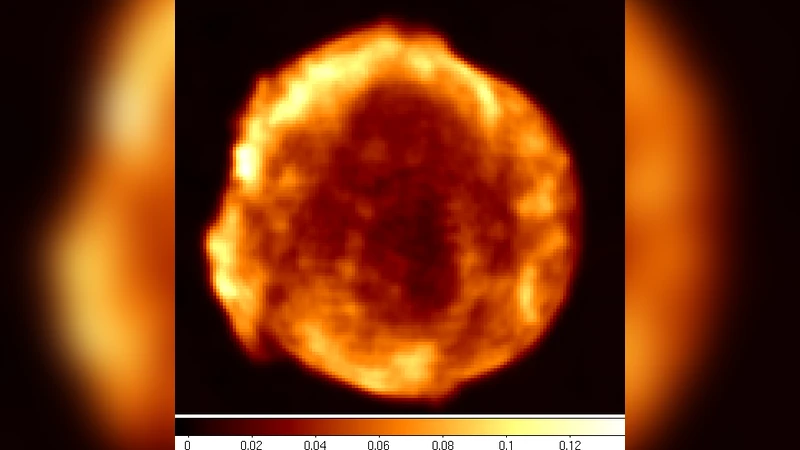
Very recent gamma-ray observations of G120.1+1.4 (Tycho’s) supernova remnant (SNR) by Fermi-LAT and VERITAS provided new fundamental pieces of information for understanding particle acceleration and non-thermal emission in SNRs. We want to outline a coherent description of Tycho’s properties in terms of SNR evolution, shock hydrodynamics and multi-wavelength emission by accounting for particle acceleration at the forward shock via first order Fermi mechanism. We adopt here a quick and reliable semi-analytical approach to non-linear diffusive shock acceleration which includes magnetic field amplification due to resonant streaming instability and the dynamical backreaction on the shock of both cosmic rays (CRs) and self-generated magnetic turbulence. We find that Tycho’s forward shock is accelerating protons up to at least 500 TeV, channelling into CRs about the 10 per cent of its kinetic energy. Moreover, the CR-induced streaming instability is consistent with all the observational evidences indicating a very efficient magnetic field amplification (up to ~300 micro Gauss). In such a strong magnetic field the velocity of the Alfv'en waves scattering CRs in the upstream is expected to be enhanced and to make accelerated particles feel an effective compression factor lower than 4, in turn leading to an energy spectrum steeper than the standard prediction {\propto} E^-2. This latter effect is crucial to explain the GeV-to-TeV gamma-ray spectrum as due to the decay of neutral pions produced in nuclear collisions between accelerated nuclei and the background gas. The self-consistency of such an hadronic scenario, along with the fact that the concurrent leptonic mechanism cannot reproduce both the shape and the normalization of the detected the gamma-ray emission, represents the first clear and direct radiative evidence that hadron acceleration occurs efficiently in young Galactic SNRs.
💡 Research Summary
This paper presents a comprehensive, multi‑wavelength study of the young Type Ia supernova remnant (SNR) Tycho (G120.1+1.4), focusing on the recent GeV–TeV gamma‑ray detections by Fermi‑LAT and VERITAS. The authors aim to test whether the observed high‑energy emission can be explained by efficient acceleration of hadrons (protons and heavier nuclei) at the forward shock, or whether a leptonic (electron‑driven) scenario is sufficient.
To this end they adopt a semi‑analytical, non‑linear diffusive shock acceleration (NLDSA) framework that builds on the work of Amato & Blasi (2005, 2006) and Caprioli et al. (2010). The model simultaneously treats: (i) the dynamical evolution of the SNR using the analytic prescriptions of Truelove & McKee (1999) for a 10⁵¹ erg explosion into a uniform interstellar medium (n₀ ≈ 0.3 cm⁻³); (ii) the resonant streaming instability driven by the accelerated particles, which amplifies the upstream magnetic field up to ≈ 300 µG; (iii) the back‑reaction of both cosmic‑ray pressure and the self‑generated magnetic turbulence on the shock structure; and (iv) the enhanced Alfvénic drift of scattering centers in the amplified field, which reduces the effective compression ratio felt by the particles.
The model predicts that the forward shock currently accelerates protons to at least 500 TeV, converting roughly 10–12 % of the total kinetic energy into cosmic rays. The amplified magnetic field, required to explain the thin X‑ray synchrotron rims (∼0.01 pc) and the radio spectral index (α ≈ 0.6), also increases the Alfvén speed, leading to an effective compression ratio < 4 and a particle spectrum steeper than the canonical E⁻², specifically ∝ E⁻²·². This steeper spectrum naturally reproduces the observed gamma‑ray photon index of Γ ≈ 2.3 measured by Fermi‑LAT (400 MeV–100 GeV) and the VERITAS spectrum extending to ∼10 TeV.
In contrast, a purely leptonic model—incorporating inverse‑Compton scattering on the cosmic microwave background, Galactic infrared/optical fields, and the locally measured dust‑IR photon field—fails to match both the shape and the absolute flux of the gamma‑ray data. The required electron spectrum would be too flat (∝ E⁻¹·⁵–E⁻¹·⁸) and would demand magnetic fields inconsistent with the X‑ray rim analysis.
The authors also discuss ancillary evidence supporting efficient hadron acceleration: the proximity of the forward shock and contact discontinuity, the thinness of the X‑ray filaments, and Balmer‑line studies indicating a CR‑induced precursor upstream of the shock. All these observations are coherently reproduced within the NLDSA framework without invoking interaction with nearby molecular clouds.
In summary, the paper demonstrates that Tycho’s SNR is presently an efficient cosmic‑ray accelerator, channeling about a tenth of its explosion energy into relativistic protons, amplifying the magnetic field to several hundred microgauss, and producing the observed GeV–TeV gamma‑ray emission via neutral‑pion decay. This constitutes the first clear, direct radiative evidence that hadron acceleration operates efficiently in a young Galactic SNR, thereby strengthening the long‑standing supernova paradigm for the origin of Galactic cosmic rays.
Comments & Academic Discussion
Loading comments...
Leave a Comment