Jet rotation driven by MHD shocks in helical magnetic fields
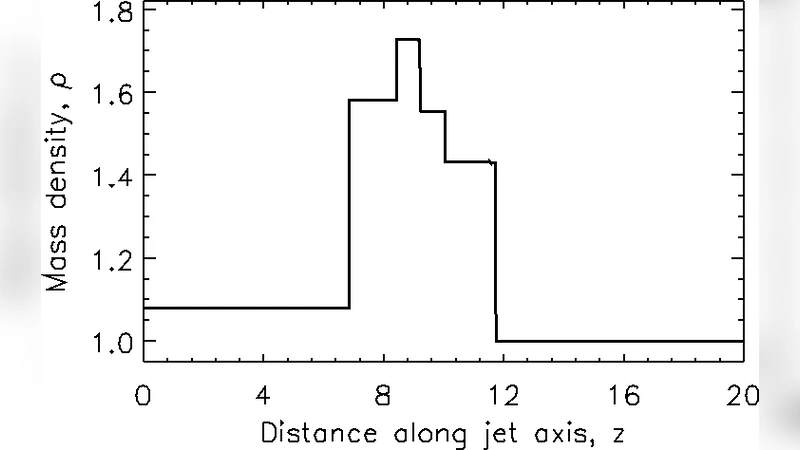
In this paper we present a detailed numerical investigation of the hypothesis that a rotation of astrophysical jets can be caused by magnetohydrodynamic shocks in a helical magnetic field. Shock compression of the helical magnetic field results in a toroidal Lorentz force component which will accelerate the jet material in toroidal direction. This process transforms magnetic angular momentum (magnetic stress) carried along the jet into kinetic angular momentum (rotation). The mechanism proposed here only works in a helical magnetic field configuration. We demonstrate the feasibility of this mechanism by axisymmetric MHD simulations in 1.5D and 2.5D using the PLUTO code. In our setup the jet is injected into the ambient gas with zero kinetic angular momentum (no rotation). Different dynamical parameters for jet propagation are applied such as the jet internal Alfven Mach number and fast magnetosonic Mach number, the density contrast of jet to ambient medium, or the external sonic Mach number of the jet. The mechanism we suggest should work for a variety of jet applications, e.g. protostellar or extragalactic jets, and internal jet shocks (jet knots) or external shocks between the jet and ambient gas (entrainment). For typical parameter values for protostellar jets, the numerically derived rotation feature looks consistent with the observations, i.e. rotational velocities of 0.1-1 percent of the jet bulk velocity.
💡 Research Summary
The paper investigates a novel mechanism for generating rotation in astrophysical jets that does not rely on the jet inheriting angular momentum directly from a rotating accretion disk. Instead, the authors propose that magnetohydrodynamic (MHD) shocks propagating through a helical magnetic field can convert magnetic angular momentum (stored in the twisted field) into kinetic angular momentum of the jet material, thereby inducing a toroidal (rotational) motion.
The authors begin by reviewing observational evidence for jet rotation in protostellar objects (e.g., DG Tau, HH 212, HH 30) and, to a lesser extent, in extragalactic jets. In many cases the measured radial velocity gradients are derived from emission lines that trace shocked gas, suggesting that the standard steady‑state MHD wind models—where the jet simply carries the disk’s rotation outward—may not fully explain the observations, especially when the jet expands by factors of 100–1000 and the expected toroidal velocity would be far below the detected values.
To test the shock‑driven rotation hypothesis, the authors perform axisymmetric (2.5‑D) and pseudo‑1‑D (1.5‑D) simulations using the PLUTO code. The computational domain is set up in cylindrical coordinates (R, Z) with an initially non‑rotating jet (v_φ = 0) injected into an ambient medium. The magnetic field is prescribed as a helical configuration, i.e., a combination of a poloidal component B_p and a toroidal component B_φ that satisfies force‑free conditions far from the source. Key dimensionless parameters are varied: the internal Alfvén Mach number M_A,int, the fast‑magnetosonic Mach number M_f, and the density contrast η = ρ_jet/ρ_amb. By adjusting these parameters the authors generate a suite of shocks of differing strength, both internal (within the jet, mimicking knots) and external (between jet and surrounding gas).
The core physical insight comes from the MHD jump conditions across a shock. Compression of the poloidal field B_p amplifies the toroidal component B_φ, which in turn creates a toroidal Lorentz force F_φ = (J × B)_φ. This force accelerates the plasma in the azimuthal direction, effectively transferring magnetic angular momentum L_m = r B_φ B_p/(4π ρ v_p) into kinetic angular momentum L_k = r v_φ. The simulations confirm that after the shock passage the toroidal velocity v_φ rises from zero to a fraction of the bulk jet speed. For typical protostellar jet parameters (M_A,int ≈ 2–5, M_f ≈ 5–10, η ≈ 0.1–1) the resulting v_φ/v_jet lies in the range 10⁻³–10⁻², i.e., 0.1–1 % of the axial flow speed. This matches the observed rotation speeds of a few km s⁻¹ in jets whose bulk velocities are a few hundred km s⁻¹.
A systematic parameter study shows that lower density contrast (lighter jets) yields a larger fraction of magnetic angular momentum being converted, because the shock more efficiently twists the field lines relative to the inertia of the flow. Conversely, very high Alfvén Mach numbers (strongly magnetized jets) already possess a dominant toroidal field, so the incremental amplification by the shock is modest and the induced rotation is weaker. The spatial extent of the induced rotation is limited to a few Alfvén radii downstream of the shock, after which the flow relaxes and the toroidal velocity gradually decays.
The authors argue that this mechanism is generic: any jet that carries a helical magnetic field and experiences shocks—whether internal knots or external bow shocks—will develop a rotational component even if it started with zero kinetic angular momentum. This provides a natural explanation for why rotation is observed preferentially in shocked emission lines and why the magnitude of the rotation correlates with shock strength rather than with the original disk rotation rate. The paper also discusses implications for extragalactic jets, where helical fields are inferred from rotation‑measure gradients and internal shocks are required to sustain synchrotron emission. Although direct measurements of rotation in AGN jets are scarce, the same physics could operate, potentially contributing to jet stability, particle acceleration, and observed helical morphologies (e.g., NGC 4258).
Limitations of the study are acknowledged. The simulations are ideal MHD, neglecting radiative cooling (except in one test case), resistivity, and three‑dimensional effects such as kink instabilities. Moreover, the jet injection is simplified, and the ambient medium is uniform. Future work should incorporate realistic cooling, magnetic diffusion, and full 3‑D geometry to assess the robustness of the torque transfer in more complex environments.
In conclusion, the paper provides the first quantitative demonstration that MHD shocks in a helical magnetic field can generate observable jet rotation by converting magnetic angular momentum into kinetic form. This mechanism complements traditional disk‑wind models and offers a compelling explanation for rotation signatures seen in shocked emission from both protostellar and possibly extragalactic jets.
Comments & Academic Discussion
Loading comments...
Leave a Comment