Harmonic Sums and Polylogarithms Generated by Cyclotomic Polynomials
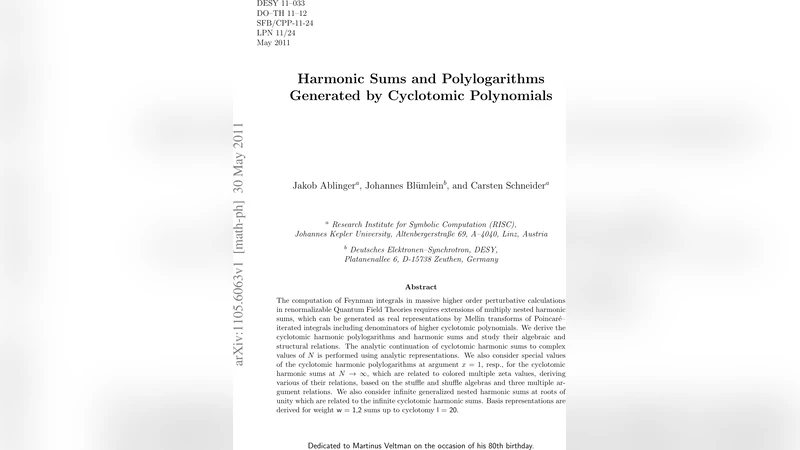
The computation of Feynman integrals in massive higher order perturbative calculations in renormalizable Quantum Field Theories requires extensions of multiply nested harmonic sums, which can be generated as real representations by Mellin transforms of Poincar'e–iterated integrals including denominators of higher cyclotomic polynomials. We derive the cyclotomic harmonic polylogarithms and harmonic sums and study their algebraic and structural relations. The analytic continuation of cyclotomic harmonic sums to complex values of $N$ is performed using analytic representations. We also consider special values of the cyclotomic harmonic polylogarithms at argument $x=1$, resp., for the cyclotomic harmonic sums at $N \rightarrow \infty$, which are related to colored multiple zeta values, deriving various of their relations, based on the stuffle and shuffle algebras and three multiple argument relations. We also consider infinite generalized nested harmonic sums at roots of unity which are related to the infinite cyclotomic harmonic sums. Basis representations are derived for weight {\sf w = 1,2} sums up to cyclotomy {\sf l = 20}.
💡 Research Summary
The paper addresses a pressing need in perturbative quantum field theory (QFT): the evaluation of massive higher‑order Feynman integrals that generate nested sums more intricate than the standard harmonic sums. Traditional harmonic sums, defined by
(S_{b,\mathbf{a}}(N)=\sum_{k=1}^{N}(\operatorname{sign}b)^{k}/k^{|b|},S_{\mathbf{a}}(k)),
are sufficient for massless single‑scale problems, but massive calculations introduce denominators of the form ((\pm1)^{k}/(l,k+m)^{n}) with (l,m,n\in\mathbb{N}). Such terms cannot be expressed solely in terms of ordinary harmonic polylogarithms (HPLs).
The authors propose to enlarge the alphabet of integration kernels by incorporating cyclotomic polynomials (\Phi_{k}(x)). They define an alphabet
\
Comments & Academic Discussion
Loading comments...
Leave a Comment