A New numerical scheme for resistive relativistic MHD using method of characteristics
We present a new numerical method of special relativistic resistive magnetohydrodynamics with scalar resistivity that can treat a range of phenomena, from nonrelativistic to relativistic (shock, contact discontinuity, and Alfv'en wave). The present scheme calculates the numerical flux of fluid by using an approximate Riemann solver, and electromagnetic field by using the method of characteristics. Since this scheme uses appropriate characteristic velocities, it is capable of accurately solving problems that cannot be approximated as ideal magnetohydrodynamics and whose characteristic velocity is much lower than light velocity. The numerical results show that our scheme can solve the above problems as well as nearly ideal MHD problems. Our new scheme is particularly well suited to systems with initially weak magnetic field, and mixed phenomena of relativistic and non-relativistic velocity; for example, MRI in accretion disk, and super Alfv'enic turbulence.
💡 Research Summary
The paper introduces a novel numerical scheme for solving the equations of special relativistic resistive magnetohydrodynamics (RR‑MHD) with a scalar resistivity. Traditional resistive RMHD codes, such as those by Komissarov (2007) and Palenzuela et al. (2009), treat the electromagnetic fields with the speed of light as the characteristic velocity. This choice leads to excessive numerical diffusion whenever the physical characteristic speeds (e.g., Alfvén speed, sound speed) are much lower than the light speed, a situation common in high‑β plasmas, weak‑field regions, or low‑conductivity environments.
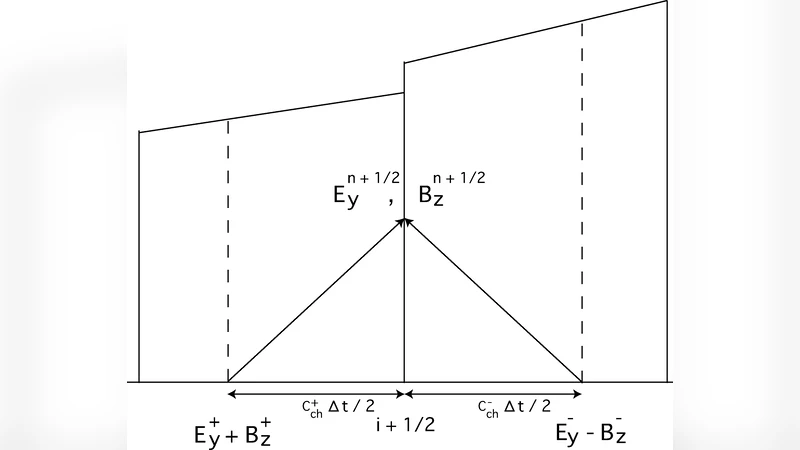
The new scheme resolves this issue by assigning different characteristic velocities to the fluid and electromagnetic components. The fluid fluxes are computed using an approximate Riemann solver with the sound speed as the characteristic speed, while the electromagnetic fluxes are handled by the method of characteristics (MOC) with a velocity that adapts between the light speed and the relativistic Alfvén speed. The adaptation criterion is derived from a linear analysis of transverse electromagnetic‑hydrodynamic waves: the ratio k/σ (wave number to conductivity) determines whether the wave propagates at c or at the Alfvén speed. When σ is below a critical value, the light speed is used; above it, the appropriate MHD characteristic speed is employed. This dynamic selection preserves the correct phase velocity and damping rate of the waves while preventing the artificial diffusion that plagues fixed‑c schemes.
A second major difficulty in resistive RMHD is the stiff source term arising from Ohm’s law. The authors apply Strang splitting to separate the evolution equations into a non‑stiff part (the charge‑advection term q v) and a stiff part (the current J_c = σγ
Comments & Academic Discussion
Loading comments...
Leave a Comment